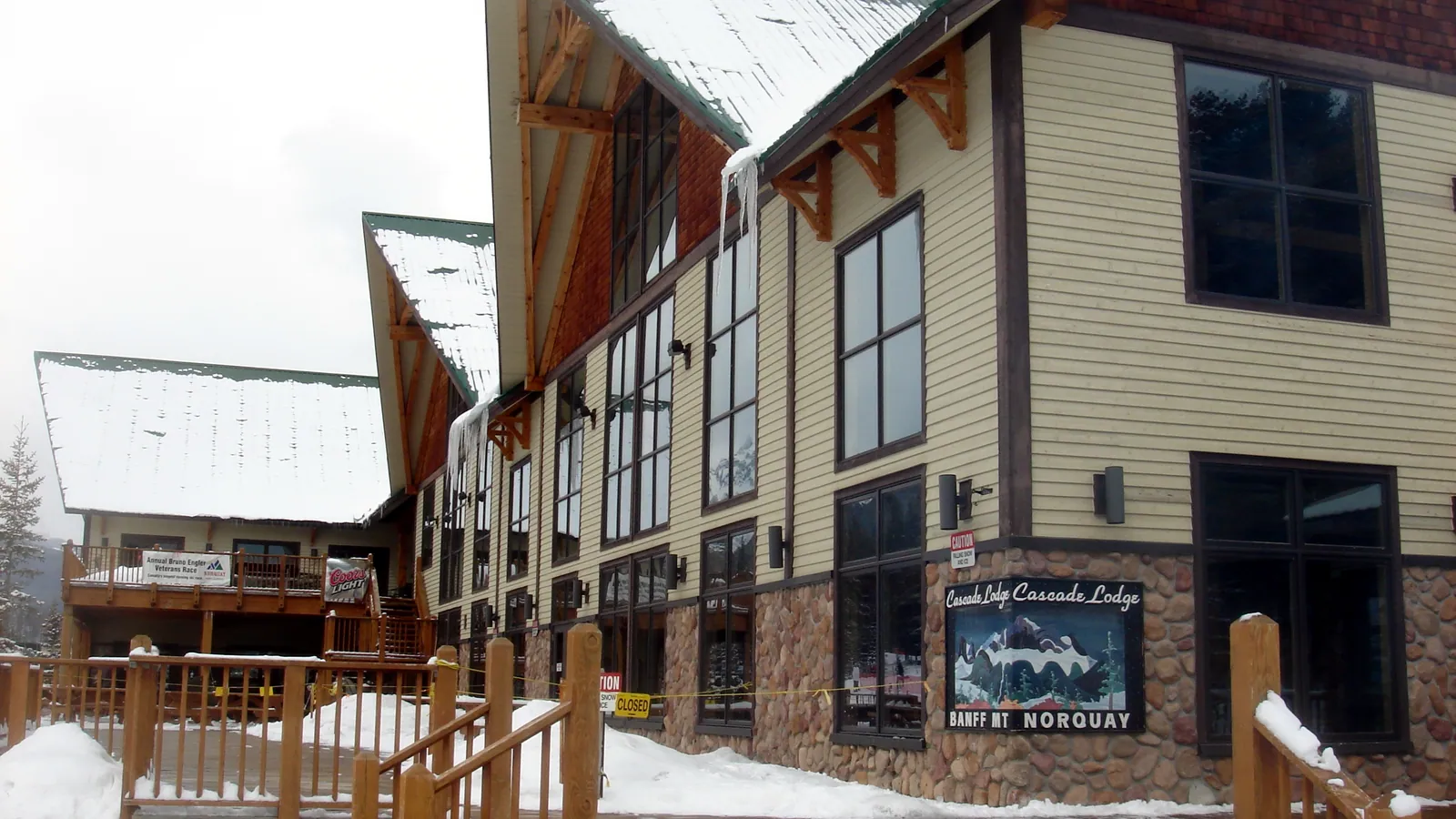
Mount Norquay
Overview
Mount Norquay carries more Canadian ski history than most resorts its size. The mountain was named in 1904 for John Norquay, a former premier of Manitoba, and skiing infrastructure followed early by North American standards: a lodge opened in 1929, rope tows arrived in 1942, and in 1948 Norquay installed what’s cited as Canada’s second chairlift ever built. The resort went on to host World Cup races in 1972 and formed part of Canada’s bids for the 1964 and 1968 Winter Olympics, a competitive pedigree tied to its steep North American slope.
Ownership has shifted more recently than the mountain’s early history: a group that included Olympic alpine skier Ken Read and the Sudermann family ran it from 2006 to 2018, when Norquay Mystic Ridge Ltd., a subsidiary of Liricon Capital Ltd., took over. The resort is closing in on its 100th year of operation and has framed recent planning, described as “Norquay 100,” around that milestone.
Physically, the mountain rises 460.2 vertical meters from a 1,632.3-meter base to a 2,092.5-meter summit, with seven lifts, four chairlifts and three magic carpets, serving 68 runs across 24.86 kilometers, and snowmaking covers a large share of that terrain. Easy terrain leads the difficulty breakdown at 10.79 kilometers, ahead of 7.12 kilometers intermediate and 6.73 kilometers advanced, making Norquay a comparatively approachable option among the three ski areas that make up Banff’s Ski Big 3 partnership. It’s also the only one of the three offering night skiing, and it runs the only via ferrata climbing route inside Banff National Park, accessible via the North American chairlift in summer.
Norquay sits just outside Banff townsite, and Calgary International Airport, 111.7 kilometers away, is the only realistic commercial air option for most visitors; Cranbrook (177.8 km) and Castlegar (256.6 km) are both considerably farther. Calgary itself, population over 1.3 million, is the closest major city at 107.5 kilometers.
Run and lift math underline how the mountain balances its long competitive history against a genuinely approachable layout: seven lifts across 68 runs works out to an average run of just 0.37 kilometers and about 66 meters of vertical per lift, both on the compact side for a Rockies resort with this much snowmaking and this much World Cup pedigree. That short-lap structure, paired with the largest terrain share sitting in the easy category, is part of why Norquay has functioned for close to a century as both a serious training hill and the more forgiving of Banff’s Ski Big 3 options for visitors staying in town.
The mountain’s name itself is a piece of Manitoba political history transplanted onto the Alberta Rockies, chosen in 1904 to honor John Norquay decades before the ski lodge, rope tows, or chairlift arrived. That naming predates virtually every piece of ski infrastructure on the mountain today, and it’s a reminder that Norquay’s identity as a place existed well before its identity as a ski area, a sequence not shared by most of the resorts built specifically as ski developments from the outset. With 85 percent snowmaking coverage layered onto that long history, current ownership has clearly chosen to protect Norquay’s reliability rather than let its century of history alone carry the mountain’s reputation.
Key stats
Official website — Last checked 2026-09-13
Lifts by type
| Type | Count |
|---|---|
| chair lift | 4 |
| magic carpet | 3 |
Runs by difficulty
| Difficulty | Distance |
|---|---|
| easy | 10.79 km |
| other | 0.15 km |
| novice | 0.08 km |
| advanced | 6.73 km |
| intermediate | 7.12 km |
Maps
View official Mount Norquay trail map (PDF) →
Run & lift overview
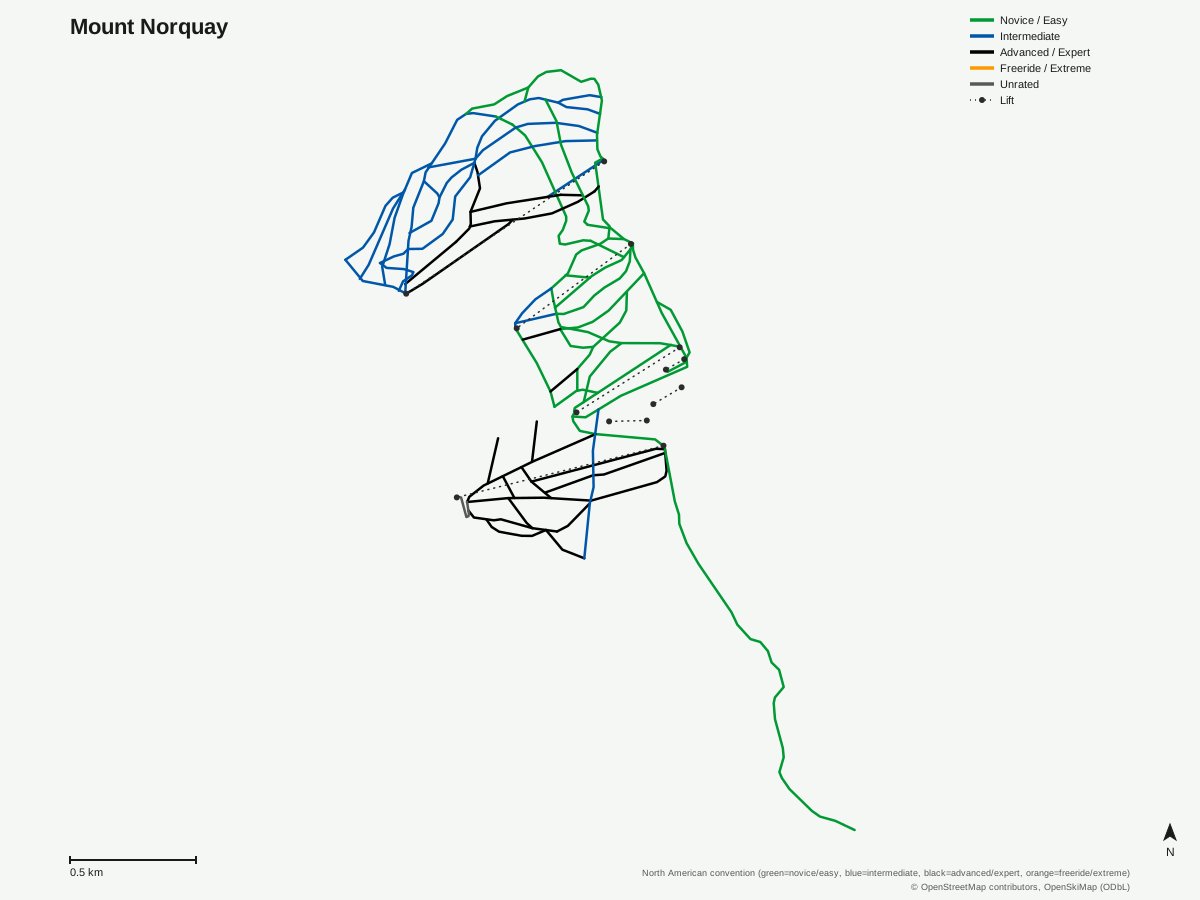
Mount Norquay: 68 runs, 7 lifts. Reflects OpenStreetMap's run and lift mapping for Mount Norquay, not the resort's own trail map graphic. © OpenStreetMap contributors, OpenSkiMap (ODbL).
Typical conditions by month
Monthly conditions data for Mount Norquay is not yet available.
Lift tickets & passes
Mount Norquay has no multi-resort pass affiliations on record.
Getting there
Nearest airports
- Calgary International Airport (YYC) — 111.7 km straight-line
- Cranbrook/Canadian Rockies International Airport (YXC) — 177.8 km straight-line
- Castlegar/West Kootenay Regional Airport (YCG) — 256.6 km straight-line
Nearest cities
- Calgary, Alberta — 107.5 km straight-line
- Red Deer, Alberta — 171.2 km straight-line
- Lethbridge, Alberta — 258.8 km straight-line
Where to stay
A dedicated lodging guide for Mount Norquay is not yet available.
Nearby resorts
- Banff Sunshine Village — 18 km straight-line, 1024.8 m vertical
- Nakiska — 42 km straight-line, 766 m vertical
- Lake Louise Ski Area — 46 km straight-line, 995.2 m vertical
- Panorama Mountain Resort — 95 km straight-line, 1216.5 m vertical
- Fairmont Hot Springs — 98 km straight-line, 261 m vertical
FAQ
- How old is Mount Norquay?
- The mountain was named in 1904 after John Norquay, Manitoba's premier from 1878 to 1887, and skiing began there with a lodge opening in 1929, followed by rope tows in 1942 and Canada's second-ever chairlift in 1948.
- Who owns Mount Norquay?
- Norquay Mystic Ridge Ltd., a subsidiary of Liricon Capital Ltd., since March 2018; before that a group including Olympic alpine skier Ken Read and the Sudermann family owned it from 2006 to 2018.
- How big is Mount Norquay?
- 460.2 vertical meters from a 2,092.5-meter summit to a 1,632.3-meter base, with 7 lifts (4 chairlifts, 3 magic carpets) serving 68 runs across 24.86 mapped kilometers.
- Is Mount Norquay good for beginners?
- Easy terrain is the largest category at 10.79 kilometers, ahead of 7.12 km intermediate and 6.73 km advanced, giving Norquay a broad beginner-to-intermediate base close to Banff townsite.
- Does Mount Norquay have night skiing?
- Yes, it's the only ski area at Banff that offers night skiing.
- Has Mount Norquay hosted major ski races?
- Yes, it hosted World Cup races in 1972 and was part of Canada's Olympic bids for the 1964 and 1968 Winter Games.
- What's the nearest airport to Mount Norquay?
- Calgary International, 111.7 kilometers away, is the only practical commercial option; Cranbrook (177.8 km) and Castlegar (256.6 km) are considerably farther.
- How long is the average run at Mount Norquay, and how far is it from Calgary?
- 24.86 kilometers across 68 runs works out to roughly 0.37 kilometers per run, with vertical per lift averaging about 66 meters across the seven-lift system; Calgary itself, population over 1.3 million, sits about 107.5 kilometers away, with Red Deer (171.2 km) and Lethbridge (258.8 km) both considerably farther.
Data sources
Last verified: 2026-09-17
Base facts from OpenSkiMap (ODbL), OpenStreetMap contributors, Wikidata (CC0), OurAirports (public domain) and GeoNames (CC BY 4.0). See /data-sources/.