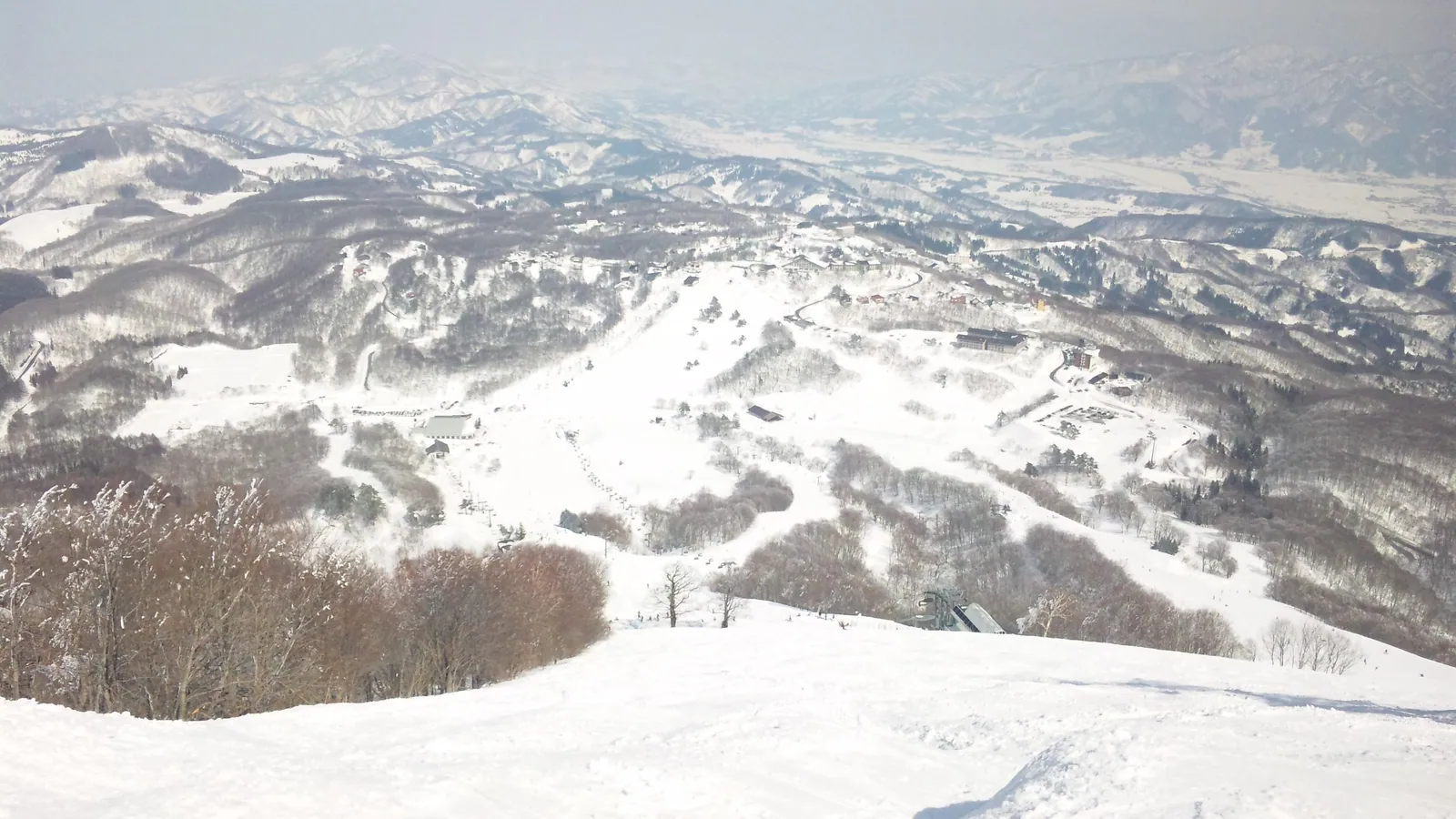
Madarao Kogen Mountain Resort
Overview
Madarao Kogen occupies an unusual spot on the map of Japanese ski resorts: it’s one of the relatively small number that carry Ikon Pass access, with both the full 7-day Ikon Pass and the 5-day Ikon Base Pass covering it, no blackout dates attached to either. That makes it a realistic add-on for skiers already holding a North American Ikon Pass rather than a resort that requires buying lift tickets entirely separately.
The mountain’s own marketing leans hard into its tree-skiing reputation, describing its network of dedicated tree-run courses as the largest of any resort in Japan, paired with an emphasis on 100% natural snowfall rather than machine-made cover — a claim that fits the deep, dry snow reputation of Nagano Prefecture’s Kanto-facing ranges. Terrain runs 421 meters of vertical from a 917.8-meter base to a 1,338.8-meter summit, with nine chairlifts serving 35 runs over 15.37 kilometers. Easy terrain leads the mix at 6.72 km, ahead of 5.73 km intermediate and a comparatively small 1.27 km rated advanced, plus 1.65 km of ungraded terrain — numbers that suggest a mountain built to let intermediate and beginner skiers roam widely through glades rather than one stacked with steep pitches.
Access runs through Nagano city, just 23.5 kilometers away, with Jōetsu (33.7 km) and Ueda (49.4 km) as the next-closest cities of size. By air, Shinshu-Matsumoto Airport is the nearest option at 82 kilometers, though Niigata Airport, considerably farther at 143.5 kilometers, is listed as the resort’s proper regional gateway — a reminder that even well-connected Nagano resorts can involve a longer final leg by road than the nearest airport alone suggests.
Madarao positions itself as a year-round destination rather than a pure winter operation: its site cites average summer temperatures around 20°C and promotes green-season activities centered on the Madarao Plateau Hotel, which also houses an onsen. Combined with the Ikon Pass access and the tree-skiing focus, that gives Madarao a distinct profile among Nagano’s ski areas — smaller in lift count than the region’s giants, but built around a specific kind of natural-snow, glade-skiing appeal rather than sheer scale.
Within this dataset’s small cluster of Nagano Prefecture resorts, Madarao sits at the top by both vertical drop and lift count: its nine chairlifts outnumber Kurohime Kogen’s and Kijimadaira’s six and five respectively, and its 421-meter vertical edges out both. The resort’s terrain and lift positions are also mapped independently through OpenStreetMap and OpenSkiMap, and its run network appears in skimap.org’s map archive, with the resort’s own trail-safety documentation dated to the 2026 season — useful cross-references for skiers who want to check current conditions before booking a multi-resort Nagano trip built around the Ikon Pass.
All three of the resort’s nearest airports are classed as medium airports rather than major international hubs — Shinshu-Matsumoto, Toyama Kitokito, and Noto Satoyama — which is typical for inland Nagano and helps explain why the resort’s listed gateway, Niigata Airport, sits so much farther out despite being a larger facility. On population, Nagano city (372,760 residents) dwarfs the other two nearby cities, Jōetsu (189,430) and Ueda (157,480), reinforcing Nagano’s role as the natural base for a Madarao trip.
Key stats
Official website — Last checked 2026-09-13
Lifts by type
| Type | Count |
|---|---|
| chair lift | 9 |
Runs by difficulty
| Difficulty | Distance |
|---|---|
| easy | 6.72 km |
| other | 1.65 km |
| advanced | 1.27 km |
| intermediate | 5.73 km |
Maps
View official Madarao Kogen Mountain Resort trail map (PDF) →
Run & lift overview
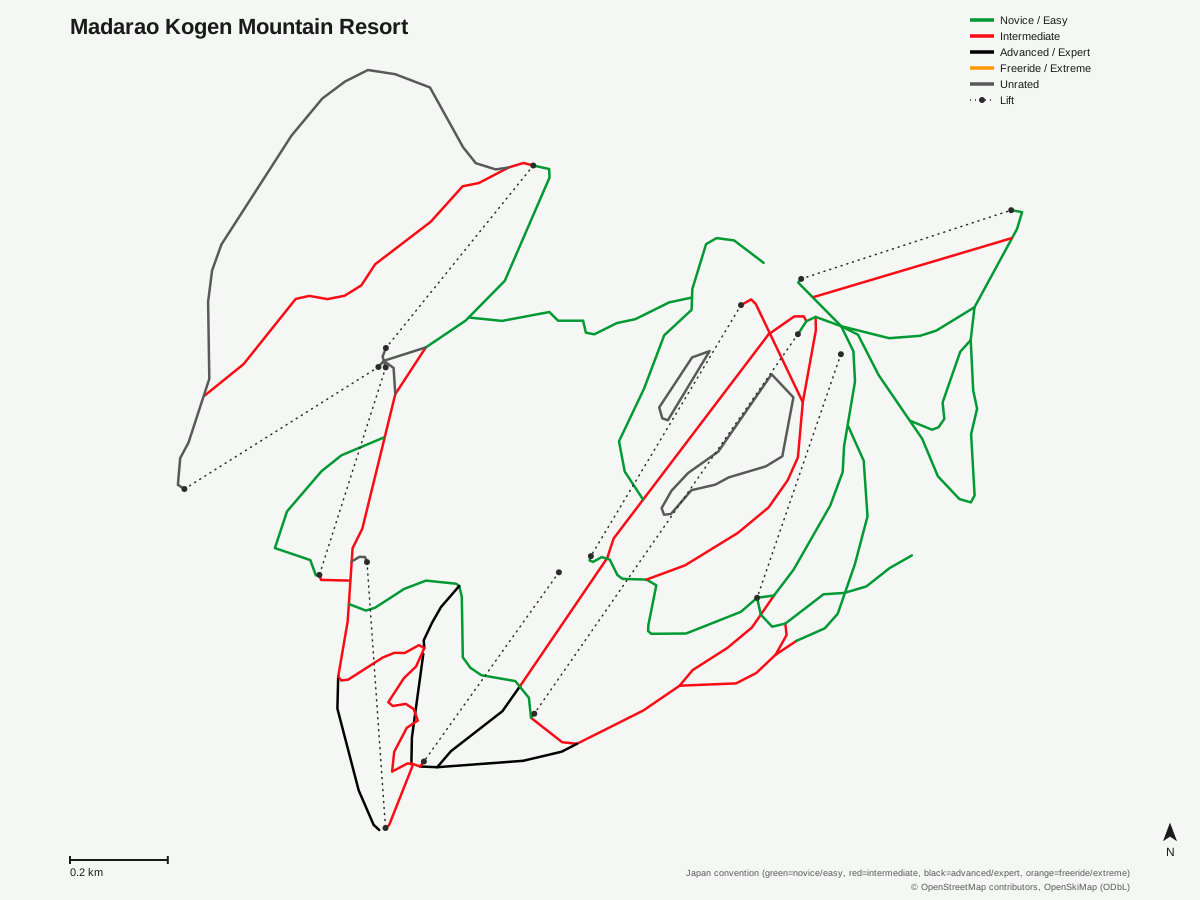
Madarao Kogen Mountain Resort: 37 runs, 9 lifts. Generated from community-mapped OpenStreetMap data, not Madarao Kogen Mountain Resort's official map artwork. © OpenStreetMap contributors, OpenSkiMap (ODbL).
Typical conditions by month
Monthly conditions data for Madarao Kogen Mountain Resort is not yet available.
Lift tickets & passes
- Ikon Pass — 7 days, no blackout
- Ikon Base Pass — 5 days, no additional blackout
Getting there
Nearest airports
- Shinshu-Matsumoto Airport (MMJ) — 82 km straight-line
- Toyama Kitokito Airport (TOY) — 99.7 km straight-line
- Noto Satoyama Airport (NTQ) — 126.9 km straight-line
Nearest cities
- Nagano, Nagano — 23.5 km straight-line
- Jōetsu, Niigata — 33.7 km straight-line
- Ueda, Nagano — 49.4 km straight-line
Also covered by
Where to stay
A dedicated lodging guide for Madarao Kogen Mountain Resort is not yet available.
Nearby resorts
- Tangram Madarao Ski Circus — 1 km straight-line, 509 m vertical
- Kurohime Kogen — 11 km straight-line, 394.2 m vertical
- Makinoiri Kogen Snow Park — 11 km straight-line, 242.2 m vertical
- Akakura Onsen Ski Area — 11 km straight-line, 463.1 m vertical
- Ikenotaira Onsen Alpen Blick Ski Resort — 11 km straight-line, 648 m vertical
FAQ
- Which pass covers Madarao Kogen Mountain Resort?
- Madarao is on the Ikon Pass (7 days, no blackout dates) and the Ikon Base Pass (5 days, no additional blackout), making it one of the more accessible Japanese resorts for North American pass holders.
- What is Madarao Kogen known for?
- Its own site describes it as having the largest number of dedicated tree-run courses of any resort in Japan, and it markets its snow as 100% natural rather than machine-made.
- How big is Madarao Kogen Mountain Resort?
- Vertical drop is 421 meters, from a 917.8-meter base to a 1,338.8-meter summit, with nine chairlifts serving 35 runs across 15.37 kilometers.
- Is Madarao Kogen good for beginners?
- Easy terrain is the largest single category at 6.72 km of the 15.37 km total, ahead of 5.73 km intermediate and 1.27 km advanced, so there's a solid beginner base alongside the tree-run terrain it's known for.
- What's the nearest city to Madarao Kogen?
- Nagano city is closest at 23.5 km, followed by Jōetsu at 33.7 km and Ueda at 49.4 km.
- What's the nearest airport to Madarao Kogen Mountain Resort?
- Shinshu-Matsumoto Airport is nearest at 82 km, though Niigata Airport, 143.5 km away, is the resort's listed regional gateway.
- Is Madarao Kogen open in summer?
- Yes, the resort operates as an all-season destination, with its own site citing an average summer temperature around 20°C and green-season activities around the Madarao Plateau Hotel.
- How does Madarao Kogen compare to nearby Nagano Prefecture resorts?
- At 421 meters of vertical, Madarao has slightly more drop than fellow Nagano resorts Kurohime Kogen (394.2 m) and Kijimadaira (385.6 m) in this dataset, and its nine-lift, all-chairlift network is also the largest lift count of the three.
Data sources
Last verified: 2026-09-15
Base facts from OpenSkiMap (ODbL), OpenStreetMap contributors, Wikidata (CC0), OurAirports (public domain) and GeoNames (CC BY 4.0). See /data-sources/.