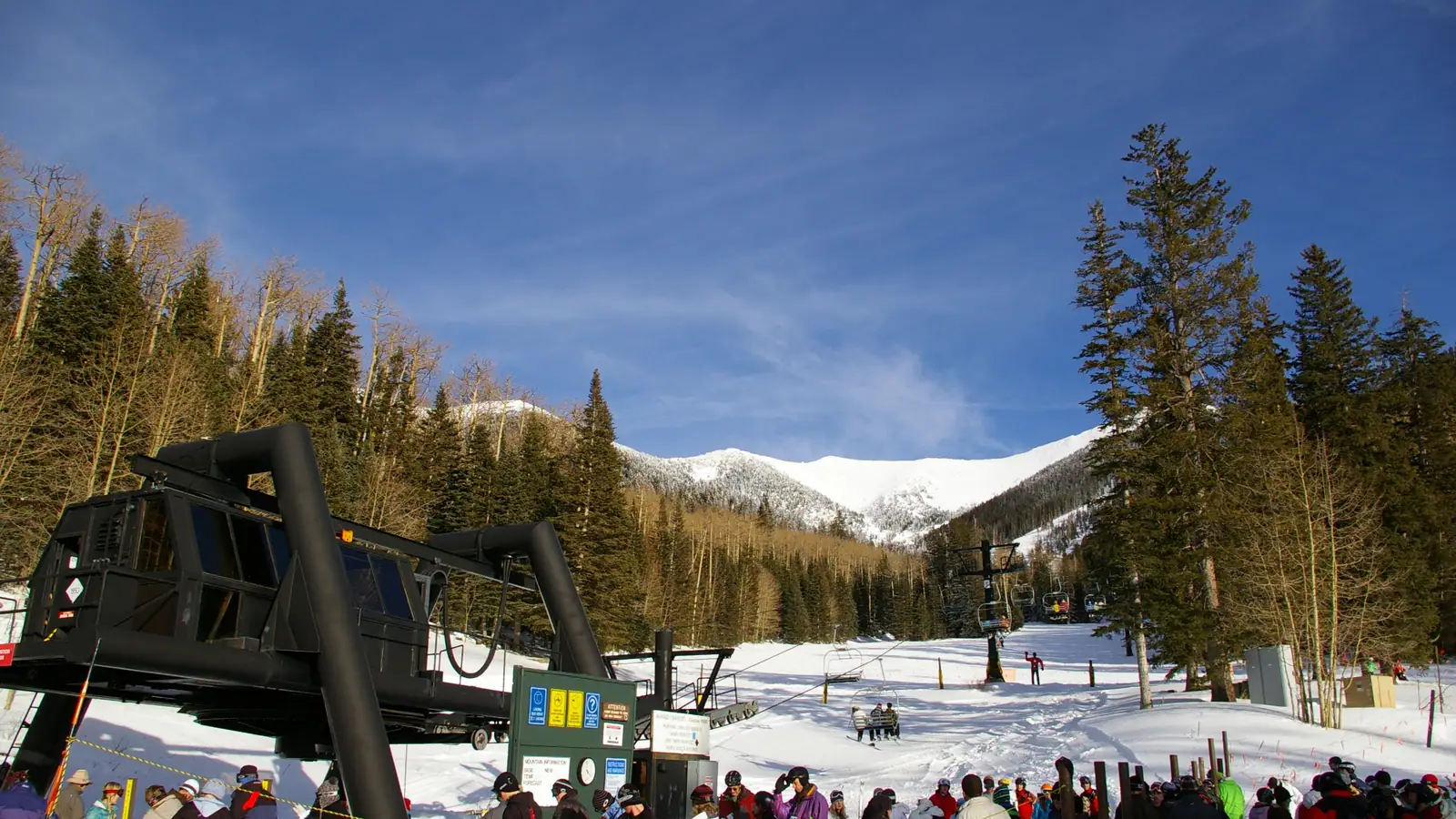
Arizona Snowbowl
Overview
Arizona Snowbowl sits on the west-facing flank of the San Francisco Peaks, a volcanic massif that rises northwest of Flagstaff and, at over 3,500 m at the resort’s summit, catches enough winter snow to support skiing in a state better known for desert. The peaks are sacred to thirteen Native American tribes, and the resort’s use of reclaimed wastewater for snowmaking, in place since 2011, has drawn sustained opposition and several unsuccessful lawsuits from tribal groups objecting to artificial snow on land they consider sacred, an ongoing tension that shapes the resort’s public profile as much as its terrain does.
Skiing history on these slopes predates the resort itself. Ole and Pete Solberg are credited with skiing the area on homemade wooden skis as early as 1915, and Arizona Snowbowl itself opened in 1938 after the US Forest Service permitted development on the peaks’ western slopes. In 1979 the Forest Service approved a further round of growth covering a new lodge, road paving, expanded parking, four additional lifts and 50 more acres of trails, and that access road was paved the following year. Ownership changed hands in 2014, when James Coleman’s investment group acquired the resort and Flagstaff approved a 20-year agreement allowing continued use of reclaimed water for snowmaking; the company followed in 2015 by announcing $10 million in planned improvements. Today the resort covers a 718 m vertical drop, from a base near 2,791 m to a summit around 3,510 m — roughly 9,158 feet to 11,514 feet, a 2,357-foot vertical in imperial terms — one of the larger vertical drops of any ski area in the American Southwest, spread across roughly 777 skiable acres with a longest run of about 2.0 miles.
The 53 runs split mostly toward the middle of the difficulty scale: 11.49 km of intermediate terrain against 6.05 km advanced and 4.76 km easy, out of 22.3 km total — a split of roughly 52% intermediate, 27% advanced and 21% easy. Eight lifts serve the mountain: five chairlifts, headlined by the high-speed six-person Grand Canyon Express installed in late 2016 alongside a quad and other triple and double chairs, two magic carpets for the beginner area, and a hybrid gondola-chairlift installed in late 2020 that can carry either open chairs or enclosed gondola cabins depending on conditions, a design aimed at keeping the mountain running through the wind and sun exposure typical at this altitude. Two base lodges, Hart Prairie Lodge and Agassiz Lodge, handle rentals, food service and ticketing for the two sides of the mountain.
Flagstaff, about 21 km away, is the closest town and the obvious base for a Snowbowl trip, with Flagstaff Pulliam Airport the nearest airport at the same distance. Grand Canyon National Park Airport, about 80 km northwest near Tusayan, is a second regional option for visitors combining a Snowbowl trip with a Grand Canyon visit, while Phoenix Sky Harbor, over 200 km south, remains the resort’s main air gateway for skiers flying in from farther afield. The closest sizeable cities on record, Deer Valley, Surprise and Peoria, are all outlying towns of the Phoenix metro area rather than mountain communities, underlining how isolated the resort is from any nearby population center of its own. The resort carries no Epic- or Ikon-style pass affiliation on record, and tickets are sold only through Snowbowl directly. Arizona Snowbowl supports around 200 full-time jobs and contributes more than $12 million a year in economic output to Flagstaff, a meaningful share of the town’s winter economy for a resort with just eight lifts.
Key stats
Official website — Last checked 2026-09-13
Lifts by type
| Type | Count |
|---|---|
| chair lift | 5 |
| mixed lift | 1 |
| magic carpet | 2 |
Runs by difficulty
| Difficulty | Distance |
|---|---|
| easy | 4.76 km |
| advanced | 6.05 km |
| intermediate | 11.49 km |
Maps
View official Arizona Snowbowl trail map (image) →

Run & lift overview
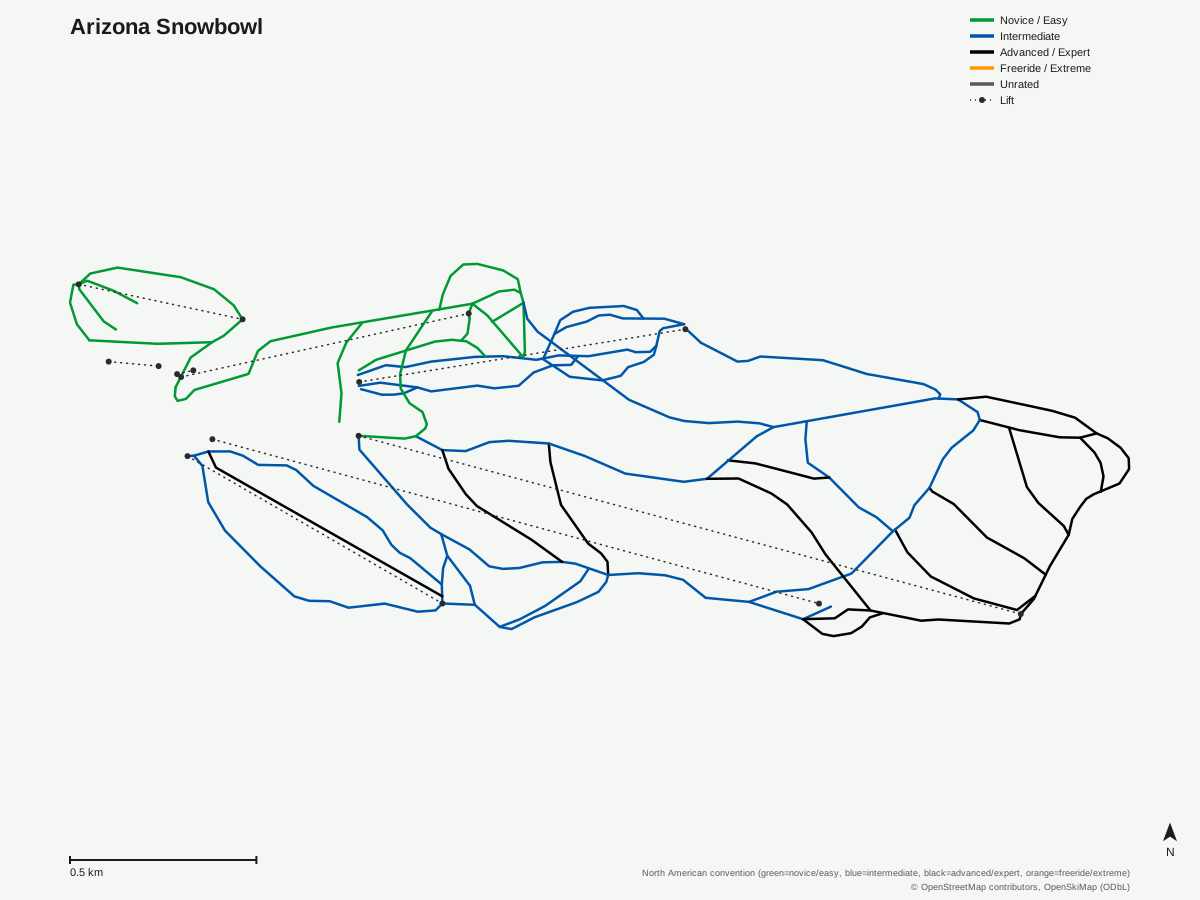
Arizona Snowbowl: 53 runs, 8 lifts. Drawn from OpenStreetMap run and lift data — not the official Arizona Snowbowl trail map. © OpenStreetMap contributors, OpenSkiMap (ODbL).
Typical conditions by month
Monthly conditions data for Arizona Snowbowl is not yet available.
Lift tickets & passes
Arizona Snowbowl has no multi-resort pass affiliations on record.
Getting there
Nearest airports
- Flagstaff Pulliam Airport (FLG) — 21.2 km straight-line
- Grand Canyon National Park Airport (GCN) — 80.3 km straight-line
- Prescott Regional Airport - Ernest A. Love Field (PRC) — 99.9 km straight-line
Nearest cities
- Deer Valley, Arizona — 187.3 km straight-line
- Surprise, Arizona — 197.7 km straight-line
- Peoria, Arizona — 200.6 km straight-line
Also covered by
Where to stay
A dedicated lodging guide for Arizona Snowbowl is not yet available.
Nearby resorts
- Sunrise Park Resort — 248 km straight-line, 469.4 m vertical
- Brian Head Resort — 282 km straight-line, 396.2 m vertical
- Mount Lemmon Ski Valley — 332 km straight-line, 233.1 m vertical
- Eagle Point — 338 km straight-line, 379.3 m vertical
- Lee Canyon — 375 km straight-line, 233.3 m vertical
FAQ
- How big is Arizona Snowbowl?
- Arizona Snowbowl has a 718.4 m vertical drop from a 2,791.3 m base to a 3,509.7 m summit, with 53 runs totaling 22.3 km, served by 8 lifts including five chairlifts, a hybrid gondola-chairlift, and two magic carpets.
- Is Arizona Snowbowl good for beginners?
- There's dedicated beginner infrastructure, two magic carpets and 4.76 km of easy terrain, though the mountain leans more intermediate overall, with 11.49 km of the total 22.3 km rated intermediate and 6.05 km advanced.
- Which pass covers Arizona Snowbowl?
- Arizona Snowbowl doesn't carry an Epic, Ikon, or other multi-resort pass affiliation on record, so tickets are purchased straight from the resort.
- What's the nearest airport to Arizona Snowbowl?
- Flagstaff Pulliam Airport (FLG) is closest at about 21.2 km. Phoenix Sky Harbor, roughly 212.5 km south, is the main airport for skiers flying in from farther away.
- Is skiing at Arizona Snowbowl controversial?
- Yes. The resort sits on the San Francisco Peaks, land sacred to thirteen Native American tribes, and its use of reclaimed wastewater for snowmaking since 2011 has drawn ongoing protests and several unsuccessful lawsuits from tribal groups.
- When did Arizona Snowbowl open, and how long has skiing happened there?
- The resort opened in 1938 after the US Forest Service permitted development on the peaks' western slopes, but skiing on the mountain goes back further: Ole and Pete Solberg are credited with skiing the area on homemade wooden skis as early as 1915.
- Is Arizona Snowbowl good for families?
- Two magic carpets serve the beginner area and 4.76 km of the mountain is rated easy, though families should note the high base elevation, 2,791 m, which can affect skiers unused to altitude.
- How much skiable terrain does Arizona Snowbowl have, and what's the longest run?
- The resort covers about 777 skiable acres, and its longest run stretches roughly 2.0 miles from top to bottom, skiing off a summit above 3,500 m in elevation.
Data sources
Last verified: 2026-09-15
Base facts from OpenSkiMap (ODbL), OpenStreetMap contributors, Wikidata (CC0), OurAirports (public domain) and GeoNames (CC BY 4.0). See /data-sources/.