Bear Mountain
Overview
Bear Mountain has cycled through four names since its first season in 1941: Moonridge Ski Area from 1943 to 1969, Goldmine Mountain through 1987, Big Bear Mountain until 2001, and the current Bear Mountain name from 2002. Ownership has moved just as often, from S-K-I Limited in 1988 through Fibreboard Corp, Booth Creek, and Snow Summit before Mammoth Resorts took over in 2014 and Alterra Mountain Company acquired the resort as part of its 2017 formation, folding Bear Mountain into the Ikon Pass network alongside sister mountain Snow Summit.
That long history is tied closely to freestyle skiing and snowboarding. Bear Mountain built Outlaw in 1992, generally credited as the first dedicated freestyle terrain park in North America, and the resort still runs the only halfpipes in Southern California, a reputation that shapes who the mountain attracts even decades later. The physical mountain itself climbs 502.7 vertical meters from a 2,176.9-meter base to a 2,679.6-meter summit, with 11 lifts, seven chairlifts and four magic carpets, spread across 26 runs and 13.43 kilometers of terrain.
Terrain difficulty is fairly evenly split rather than dominated by any one category: 5.78 kilometers of intermediate runs lead, followed by 3.63 kilometers easy, 1.88 expert, 1.77 advanced, and a smaller 0.38 kilometers of novice terrain. That spread, combined with the terrain-park legacy, points to a mountain built to serve a broad range of park-and-pipe riders and all-mountain skiers rather than one specializing narrowly in steep or beginner terrain.
Access runs through the San Bernardino Valley: San Bernardino International Airport is closest at 37.2 kilometers, with Palm Springs International (54.2 km) and Ontario International (70.5 km) as alternates depending on where a trip originates. San Bernardino the city, population around 216,000, sits 41.4 kilometers out, with Moreno Valley and Rialto both within roughly 50 kilometers, keeping Bear Mountain within a comfortable day-trip radius of the Inland Empire.
With 11 lifts serving just 26 runs, Bear Mountain has one of the highest lift densities of any resort of comparable size, and the numbers show it: vertical per lift averages only about 46 meters, and the typical run measures roughly 0.52 kilometers. That combination points toward a mountain optimized for high lap counts on shorter, more specialized runs, exactly the setup a terrain-park- and halfpipe-focused resort would want, rather than one built around long, continuous descents from a single high-capacity lift. It’s a layout that has followed the mountain through all four of its name changes, from the 1941 Moonridge-era rope tows through today’s Alterra-owned, Ikon Pass-affiliated operation.
Bear Mountain sits in the San Bernardino National Forest above Big Bear Lake, California, at a base elevation of 2,176.9 meters, high enough to hold a reliable snowpack even this far south in California. The Outlaw terrain park’s 1992 debut came well before the mountain’s most recent ownership changes, and the fact that Alterra kept investing in that park-and-pipe identity after taking over in 2017, rather than repositioning Bear Mountain as a second all-mountain option alongside sister resort Snow Summit, says something about how central freestyle terrain remains to the resort’s role within the wider Big Bear Mountain Resort operation. For visitors weighing the two Big Bear-area mountains against each other, Bear Mountain’s terrain-park pedigree and its 11-lift, 26-run footprint make it the more specialized of the pair rather than the broader all-around option.
Key stats
Official website — Last checked 2026-09-13
Lifts by type
| Type | Count |
|---|---|
| chair lift | 7 |
| magic carpet | 4 |
Runs by difficulty
| Difficulty | Distance |
|---|---|
| easy | 3.63 km |
| expert | 1.88 km |
| novice | 0.38 km |
| advanced | 1.77 km |
| intermediate | 5.78 km |
Maps
View official Bear Mountain trail map (image) →

Run & lift overview
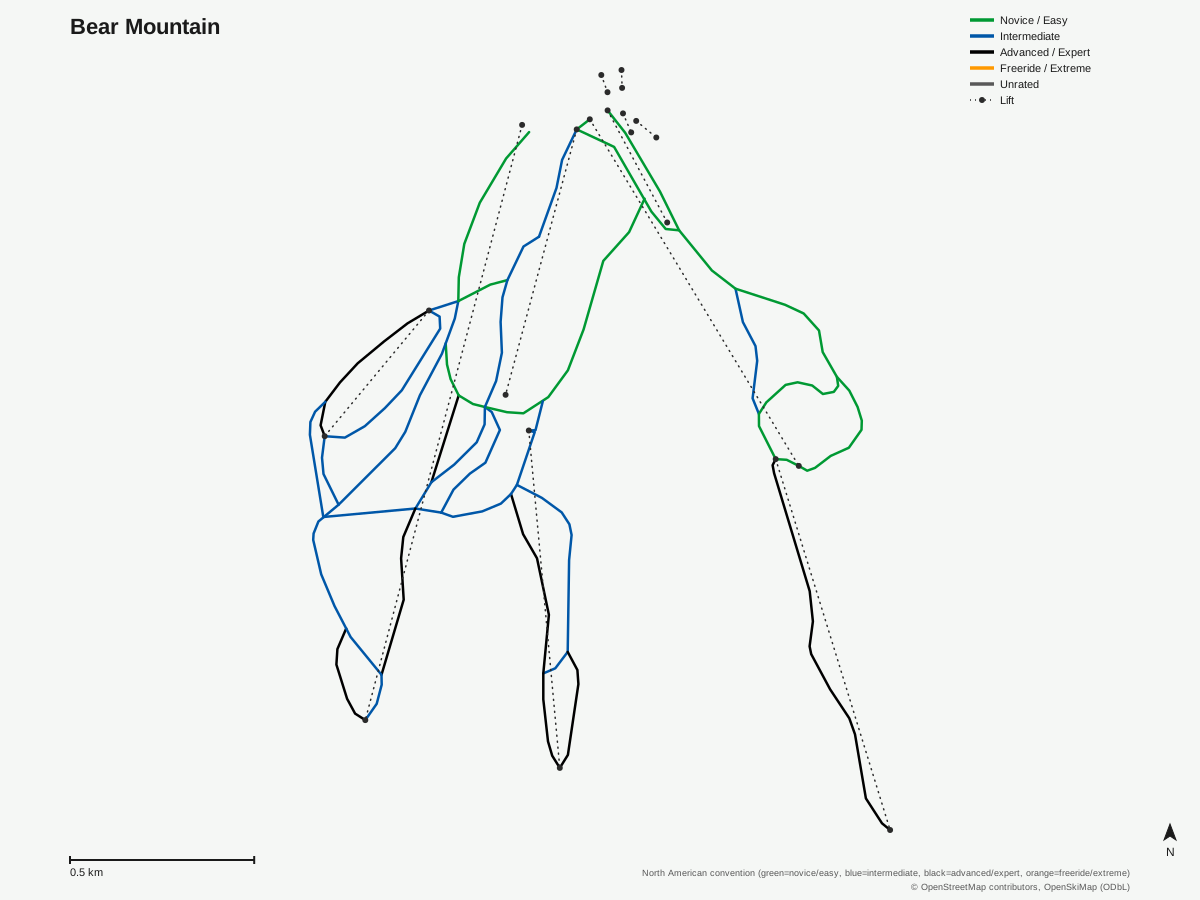
Bear Mountain: 26 runs, 11 lifts. Generated from community-mapped OpenStreetMap data, not Bear Mountain's official map artwork. © OpenStreetMap contributors, OpenSkiMap (ODbL).
Typical conditions by month
Monthly conditions data for Bear Mountain is not yet available.
Lift tickets & passes
Bear Mountain has no multi-resort pass affiliations on record.
Getting there
Nearest airports
- San Bernardino International Airport (SBD) — 37.2 km straight-line
- Palm Springs International Airport (PSP) — 54.2 km straight-line
- Ontario International Airport (ONT) — 70.5 km straight-line
Nearest cities
- San Bernardino, California — 41.4 km straight-line
- Moreno Valley, California — 46.3 km straight-line
- Rialto, California — 48.6 km straight-line
Also covered by
Where to stay
A dedicated lodging guide for Bear Mountain is not yet available.
Nearby resorts
- Snow Summit — 3 km straight-line, 372.2 m vertical
- Snow Valley Mountain Resort — 16 km straight-line, 337.9 m vertical
- Mt. Baldy — 69 km straight-line, 636.3 m vertical
- Mountain High — 78 km straight-line, 486.4 m vertical
- Mount Waterman — 99 km straight-line, 304.6 m vertical
FAQ
- How old is Bear Mountain?
- The ski area dates to 1941, though it has operated under several names since: Moonridge Ski Area (1943-1969), Goldmine Mountain (1970-1987), Big Bear Mountain (1988-2001), and its current name from 2002 onward.
- Who owns Bear Mountain?
- Alterra Mountain Company has owned it since 2017, following a chain of previous owners that includes S-K-I Limited (1988), Fibreboard Corp (1995), Booth Creek (1996), Snow Summit (2002), and Mammoth Resorts (2014).
- Is Bear Mountain known for terrain parks?
- Yes. The resort built Outlaw, credited as the first freestyle terrain park in North America, back in 1992, and it also runs the only halfpipes in Southern California.
- How big is Bear Mountain?
- 502.7 vertical meters from a 2,679.6-meter summit to a 2,176.9-meter base, with 11 lifts (7 chairlifts, 4 magic carpets) serving 26 runs across 13.43 mapped kilometers.
- Is Bear Mountain good for beginners?
- The mapped terrain is fairly balanced but tilts toward the middle: 5.78 km intermediate and 3.63 km easy against 1.88 km expert and 1.77 km advanced, with a small 0.38 km of novice terrain.
- What's the nearest airport to Bear Mountain?
- San Bernardino International Airport, 37.2 kilometers away, followed by Palm Springs International (54.2 km) and Ontario International (70.5 km).
- How far is Bear Mountain from Los Angeles-area cities?
- San Bernardino is the closest listed city at 41.4 kilometers, with Moreno Valley (46.3 km) and Rialto (48.6 km) also within roughly an hour's drive.
- How long is the average run at Bear Mountain?
- 13.43 kilometers across 26 runs works out to roughly 0.52 kilometers per run, and vertical per lift comes to about 46 meters spread across the 11-lift system.
Data sources
Last verified: 2026-09-17
Base facts from OpenSkiMap (ODbL), OpenStreetMap contributors, Wikidata (CC0), OurAirports (public domain) and GeoNames (CC BY 4.0). See /data-sources/.