Beaver Creek
Overview
Beaver Creek’s origin traces back to an Olympic bid that never happened: the site was envisioned in the 1950s by Earl Eaton, and development picked up pace once Vail Associates was purchased by Harry W. Bass Jr., an oil executive who saw the location as a candidate for the 1976 Winter Olympics. Denver, the host city, withdrew before the Games, which moved to Innsbruck instead, but Beaver Creek was built out as a ski resort regardless, opening for the 1980-81 season with six chairlifts, all supplied by Doppelmayr.
That racing pedigree stuck. Beaver Creek has hosted the World Ski Championships three times, in 1989, 1999 and 2015, and it hosts the Birds of Prey World Cup downhill most Decembers on a course considered one of the more demanding stops on the men’s circuit. Today the resort spans five mountains served by 24 lifts, including two gondolas and 15 chairlifts, covering 189 runs and 161.37 km of trail, with a 1,223 m vertical drop between the 2,259 m base and 3,482 m summit.
Despite the racing reputation, Beaver Creek carries a lot of accessible terrain too — nearly 80 km of its trail network, close to half the total, is rated easy, more than the 29.78 km advanced and 5.38 km expert categories combined. About 55% of the mountain’s slopes face north, which helps hold snow quality longer into the day than south-facing terrain typically manages, and the resort receives roughly 323 inches of snow in an average season. The resort itself is really three linked villages, Beaver Creek Village, Bachelor Gulch and Arrowhead, sitting near the town of Avon in Eagle County, each with its own base facilities feeding the same lift network.
Vail Resorts operates Beaver Creek, and it carries the Epic Pass and Epic Local Pass; it’s also included on the independently run Indy Base Pass and Indy+ Pass, each of which grants two lift-ticket days here per season. Eagle County Regional Airport, about 33 km away, is the closest airport, ahead of Aspen-Pitkin County Airport at roughly 52 km, while Denver International Airport, roughly 162 km off, handles most long-haul and international arrivals, with Boulder the nearest larger city at around 117 km.
Being one of five linked mountains within a single resort boundary gives Beaver Creek a more varied lift-served terrain profile than its three-village layout might suggest at first glance, and the arrangement of Beaver Creek Village, Bachelor Gulch and Arrowhead as separate but connected bases means visitors can choose a village that matches their preferred pace, from Beaver Creek Village’s larger-scale amenities to Arrowhead’s quieter setting, while still skiing the same interconnected trail network across all 189 runs.
Key stats
Official website — Last checked 2026-09-13
Lifts by type
| Type | Count |
|---|---|
| gondola | 2 |
| chair lift | 15 |
| mixed lift | 1 |
| magic carpet | 6 |
Runs by difficulty
| Difficulty | Distance |
|---|---|
| easy | 79.65 km |
| other | 0.56 km |
| expert | 5.38 km |
| novice | 0.05 km |
| advanced | 29.78 km |
| intermediate | 45.96 km |
Maps
View official Beaver Creek trail map (page) →
Run & lift overview
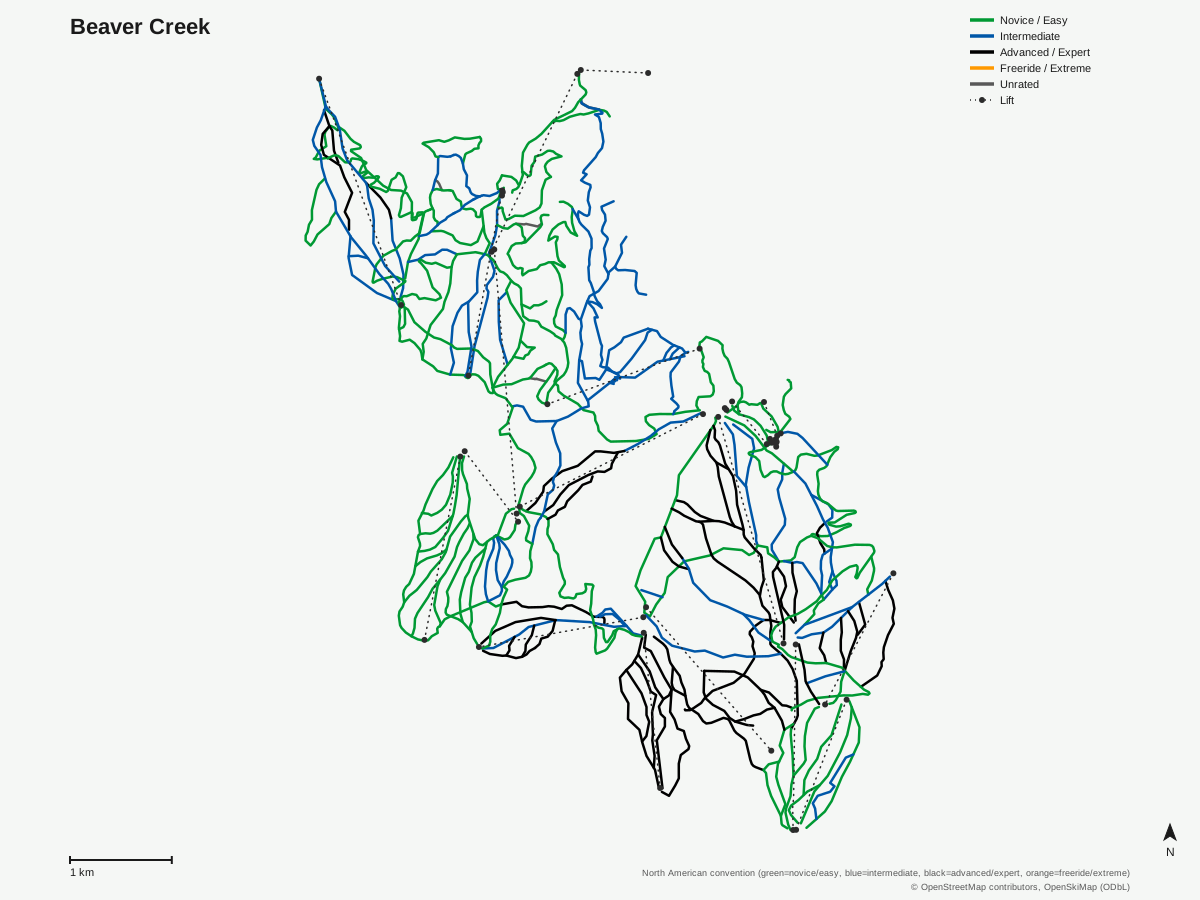
Beaver Creek: 190 runs, 24 lifts. Drawn from OpenStreetMap run and lift data — not the official Beaver Creek trail map. © OpenStreetMap contributors, OpenSkiMap (ODbL).
Typical conditions by month
Monthly conditions data for Beaver Creek is not yet available.
Lift tickets & passes
- Epic Pass — Unlimited, no blackout dates
- Epic Local Pass — Unlimited with holiday blackout dates (Thanksgiving, Dec 26-31, MLK wknd, Presidents wknd)
- Indy Base Pass — 2 All-Day or All-Night tickets per resort; blackout dates apply (exact 26/27 holiday blackout dates not yet finalized as of verified_date)
- Indy+ Pass — 2 All-Day or All-Night tickets per resort, no blackout dates
Getting there
Nearest airports
- Eagle County Regional Airport (EGE) — 32.9 km straight-line
- Aspen-Pitkin County Airport (Sardy Field) (ASE) — 52 km straight-line
- Yampa Valley Airport (HDN) — 112.6 km straight-line
Nearest cities
- Boulder, Colorado — 116.9 km straight-line
- Lakewood, Colorado — 124.9 km straight-line
- Arvada, Colorado — 125.7 km straight-line
Also covered by
Where to stay
A dedicated lodging guide for Beaver Creek is not yet available.
Nearby resorts
- Vail — 15 km straight-line, 1065 m vertical
- Copper Mountain — 35 km straight-line, 796.9 m vertical
- Ski Cooper — 36 km straight-line, 353.2 m vertical
- Breckenridge — 43 km straight-line, 992.7 m vertical
- Keystone — 52 km straight-line, 912.9 m vertical
FAQ
- Was Beaver Creek built for the Olympics?
- It was originally planned as a venue for the 1976 Winter Olympics, but Denver withdrew as host city and the Games moved to Innsbruck. Beaver Creek was developed as a ski resort anyway, opening for the 1980-81 season with six chairlifts built by Doppelmayr.
- How big is Beaver Creek?
- 24 lifts, including two gondolas and 15 chairlifts, serve 189 runs and 161.37 km of trail across five mountains, with a 1,223 m vertical drop from 2,259 m to 3,482 m.
- Is Beaver Creek good for World Cup ski racing?
- Yes — it has hosted the World Ski Championships three times, in 1989, 1999 and 2015, and regularly hosts the Birds of Prey World Cup downhill races each December on a course considered one of the more demanding on the men's circuit.
- Which villages make up Beaver Creek?
- Three: Beaver Creek Village, Bachelor Gulch and Arrowhead, all operated together as one resort near the town of Avon in Eagle County, Colorado.
- Which pass covers Beaver Creek?
- Epic Pass and Epic Local Pass from Vail Resorts, plus Indy Base Pass and Indy+ Pass, which each include two lift tickets per season at Beaver Creek.
- What's the nearest airport to Beaver Creek?
- Eagle County Regional Airport, about 33 km away, is closest, with Aspen-Pitkin County Airport a further alternative at roughly 52 km, and Denver International Airport, about 162 km away, the main hub for long-haul and international connections.
- Is Beaver Creek mostly beginner terrain?
- It has a large amount of easy terrain — nearly 80 km, almost half its total trail distance — but that sits alongside a genuine expert circuit including the Birds of Prey downhill course and 5.38 km of terrain rated expert, so it isn't a purely beginner mountain.
- Why does Beaver Creek hold snow well?
- About 55% of the mountain's slopes face north, which helps hold snow quality longer into the day than south-facing terrain typically manages, on top of the roughly 323 inches of snow the resort receives most seasons.
Data sources
Last verified: 2026-09-15
Base facts from OpenSkiMap (ODbL), OpenStreetMap contributors, Wikidata (CC0), OurAirports (public domain) and GeoNames (CC BY 4.0). See /data-sources/.