Deer Valley Resort
Overview
Deer Valley opened for its first season on December 26, 1981, developed by Edgar Stern on slopes above Park City that had hosted local ski carnivals since the 1930s; WPA crews cut some of the original trails here in 1936 and 1937. Alterra Mountain Company owns the resort today, and it remains one of only three ski areas in the United States, alongside Alta and Mad River Glen, that does not allow snowboarding.
The trail count sits at 344 runs over 945.4 meters of vertical, served by 36 lifts including three funiculars, three gondolas, and a single platter lift. What stands out in the terrain mix is how much of it is groomed and approachable: 62.59 of the resort’s 183.36 kilometers of trail are rated easy, more than a third of the total, while advanced terrain accounts for 36.72 km and expert-rated runs just 2.46 km, a notably gentler balance than the resort over the ridge at Park City Mountain. Deer Valley’s own marketing leans into that grooming, describing “corduroy” runs and service touches like mountain host tours and ski valet parking.
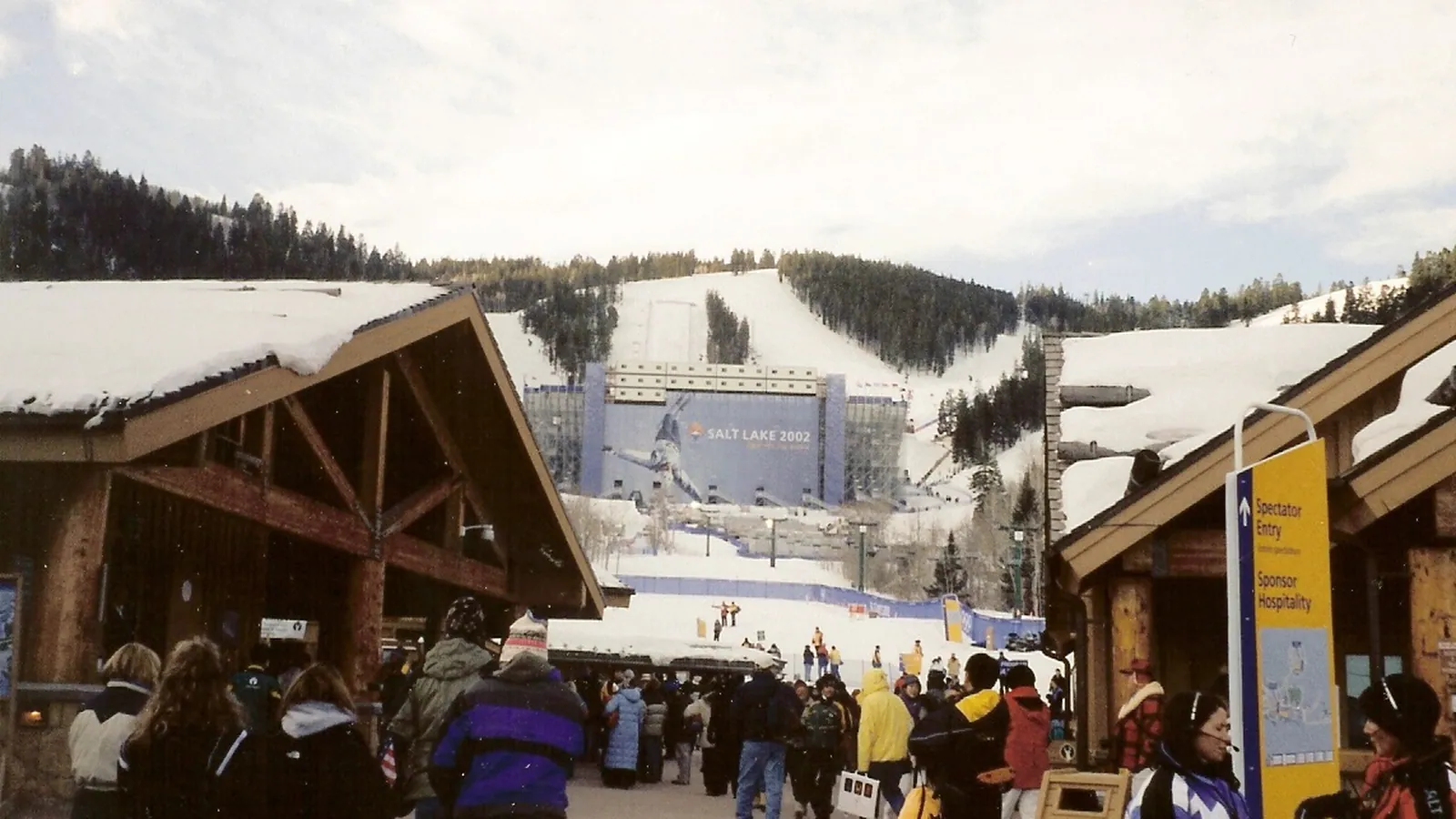
Deer Valley hosted freestyle moguls, aerials, and alpine slalom during the 2002 Salt Lake City Olympics, and it’s scheduled to host moguls and aerials again in 2034; it also runs regular FIS World Cup freestyle events. Ikon Pass holders get seven days here with no blackout dates, but the Ikon Base Pass doesn’t include Deer Valley at all, a gap worth checking for anyone assuming the cheaper Ikon tier covers every Utah resort on the pass.
Dining ranges from family cafés to sit-down restaurants with fireside raclette service, and the resort talks openly about limiting daily ticket sales rather than maximizing them. That positioning, paired with the no-snowboarding rule and the groomed, intermediate-leaning terrain, sets Deer Valley apart from Park City Mountain a few miles away: same mountain range, same Wasatch snow, very different day on the hill. Salt Lake City’s airport, about 46 kilometers away, remains the main gateway for most visitors, with the Salt Lake Valley suburbs of West Jordan (population 111,946, roughly 38.6 km) and West Valley City (population 136,208, roughly 44.3 km) both closer to the resort than Provo. Because Deer Valley caps daily lift ticket sales rather than selling an unlimited volume, the on-mountain crowding that can build up at larger, uncapped resorts is less of a factor here even during peak holiday weeks. In imperial terms, that vertical drop is about 3,101 feet across roughly 113.9 miles of marked trail, some of the longest trail mileage of any Utah resort in this guide. OpenStreetMap-based mapping of Deer Valley counts 345 runs across its 36 lifts, essentially matching the resort’s own 344-run tally. That lift fleet, weighted toward funiculars and gondolas built for smooth people-moving rather than raw uphill capacity, keeps circulation manageable even on the mountain’s busiest powder mornings.
Key stats
Official website — Last checked 2026-09-13
Lifts by type
| Type | Count |
|---|---|
| gondola | 3 |
| platter | 1 |
| funicular | 3 |
| chair lift | 29 |
Runs by difficulty
| Difficulty | Distance |
|---|---|
| easy | 62.59 km |
| other | 2.15 km |
| expert | 2.46 km |
| advanced | 36.72 km |
| intermediate | 79.44 km |
Maps
View official Deer Valley Resort trail map (PDF) →
Run & lift overview
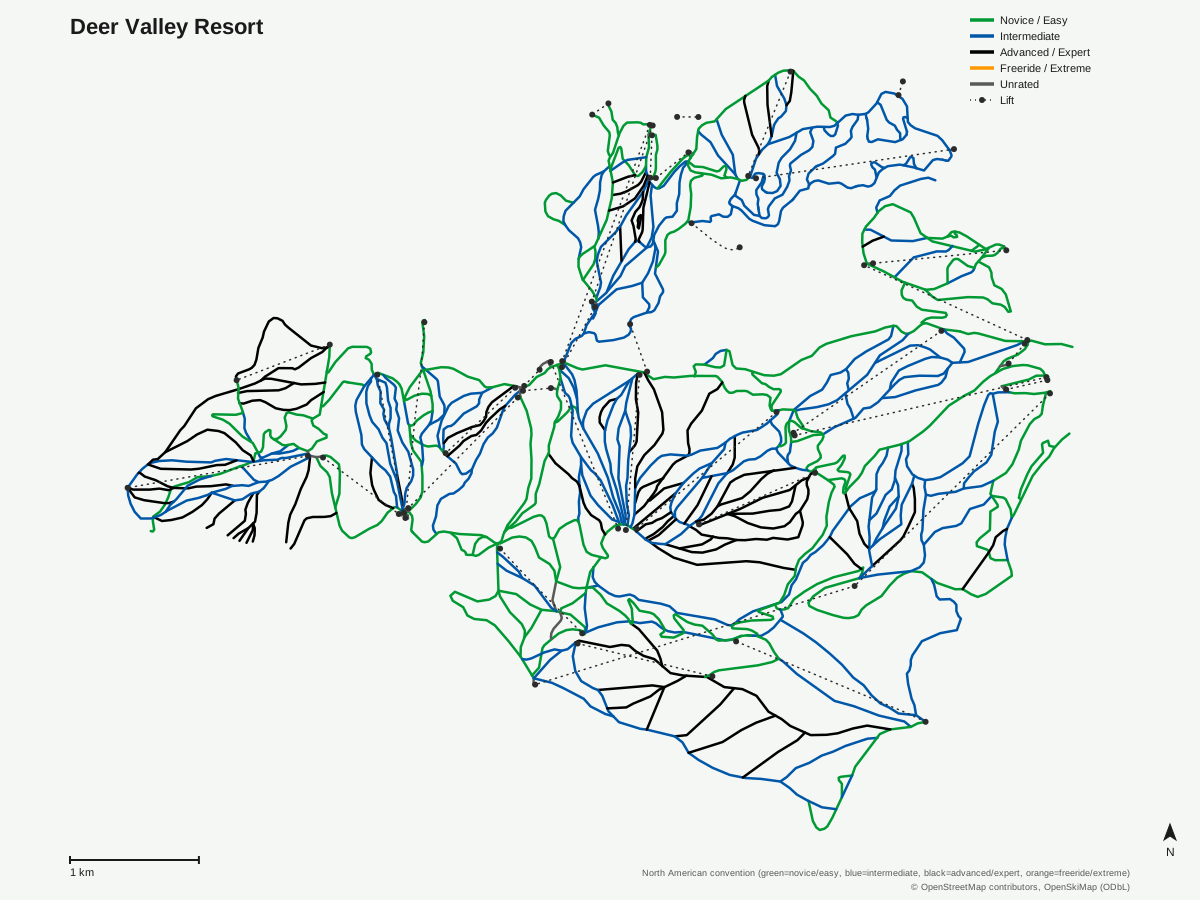
Deer Valley Resort: 345 runs, 36 lifts. Generated from community-mapped OpenStreetMap data, not Deer Valley Resort's official map artwork. © OpenStreetMap contributors, OpenSkiMap (ODbL).
Typical conditions by month
Monthly conditions data for Deer Valley Resort is not yet available.
Lift tickets & passes
- Ikon Pass — 7 days, no blackout
- Ikon Base Pass — No access
Getting there
Nearest airports
- Salt Lake City International Airport (SLC) — 45.6 km straight-line
- Provo Municipal Airport (PVU) — 49.8 km straight-line
- Ogden Hinckley Airport (OGD) — 77.3 km straight-line
Nearest cities
- Salt Lake City, Utah — 37.5 km straight-line
- West Jordan, Utah — 38.6 km straight-line
- West Valley City, Utah — 44.3 km straight-line
Also covered by
Where to stay
A dedicated lodging guide for Deer Valley Resort is not yet available.
Nearby resorts
- Park City Mountain Resort — 6 km straight-line, 990.1 m vertical
- Brighton Resort — 9 km straight-line, 518.7 m vertical
- Solitude Mountain Resort — 10 km straight-line, 612.3 m vertical
- Alta Ski Area — 13 km straight-line, 614.3 m vertical
- Snowbird — 15 km straight-line, 974.6 m vertical
FAQ
- How big is Deer Valley Resort?
- Deer Valley has 344 runs covering 183.36 kilometers of trail across 945.4 meters of vertical, served by 36 lifts including three funiculars and three gondolas. That's smaller in total trail distance than neighboring Park City Mountain, but the two aren't really comparable since Deer Valley is built around groomed, service-heavy skiing rather than volume of terrain.
- Can you snowboard at Deer Valley?
- No. Deer Valley is one of only three ski areas in the United States, along with Alta and Mad River Glen, that does not allow snowboarding. It's a ski-only resort by policy, not just tradition.
- Which pass covers Deer Valley Resort?
- Deer Valley is on the Ikon Pass, which includes seven days here with no blackout dates. The Ikon Base Pass does not include Deer Valley at all, which catches some skiers off guard given it covers other Utah resorts.
- Is Deer Valley good for beginners?
- Yes, more than at most comparable resorts. Of its 183.36 km of trail, 62.59 km is rated easy, over a third of the total, while true expert-rated terrain is limited to just 2.46 km, making it one of the more approachable large resorts in the Wasatch.
- What's the nearest airport to Deer Valley?
- Salt Lake City International Airport is about 46 km away and serves as the main gateway. Provo Municipal Airport (50 km) and Ogden Hinckley Airport (77 km) are secondary options.
- Did Deer Valley host the Winter Olympics?
- Yes. It hosted freestyle moguls, aerials, and alpine slalom during the 2002 Salt Lake City Games, and it's slated to host moguls and aerials again in 2034. The resort also regularly hosts FIS World Cup freestyle skiing events.
- Is Deer Valley good for families or luxury travelers?
- The resort is built around that kind of trip: dining ranges from family cafés to sit-down restaurants with fireside service, and mountain host tours and ski valet are part of the standard offering. Heavily groomed, mostly easy-to-intermediate terrain also makes it comfortable for mixed-ability family groups.
Data sources
Last verified: 2026-09-15
Base facts from OpenSkiMap (ODbL), OpenStreetMap contributors, Wikidata (CC0), OurAirports (public domain) and GeoNames (CC BY 4.0). See /data-sources/.