
Niseko United
Overview
Niseko United isn’t a single ski area but a shared-pass arrangement joining four resorts on one Hokkaido mountain: Niseko Tokyu Grand Hirafu, Hanazono, Niseko Village, and Annupuri, marketed together as “One Mountain, Four Resorts.” Combined, the lift network runs to 29 lifts, six of them gondolas, moving skiers across 164 mapped runs and 58.82 kilometers of trail between a 257-meter base and a 1,176.2-meter top, a 919.2-meter vertical. Unusually for a resort of this scale, more than half that distance, 32.45 kilometers, is graded easy, with 17.47 kilometers intermediate and a comparatively small 8.91 kilometers marked advanced on the groomed trail network, though the mountain’s real drawing card sits outside those groomed numbers.
That draw is snow volume: nearby Kutchan town records a mean annual snowfall of 921 centimeters, about 363 inches, and a mean annual maximum snow depth of 183 centimeters, heavy enough that the surrounding region carries an official special heavy-snowfall designation under Japanese law. Coverage across the four linked areas is handled through Niseko United’s own All Mountain Pass, sold as a day, multi-day, or season product covering all four resorts unlimited, alongside international options: 7 no-blackout days on the Ikon Pass, a blackout-restricted allotment on Ikon Base, and 2 days through Mountain Collective.
International demand transformed Niseko starting around 2000, led initially by Australian visitors and developers before expanding to Hong Kong, Singapore, Malaysian, and mainland Chinese investment; foreign overnight stays across the wider Niseko tourism zone reached roughly 683,000 in fiscal 2018, more than 18 times the number recorded in 2003. New Chitose Airport near Sapporo, a large international hub, is the main air gateway at 83.2 kilometers, with the smaller Okadama Airport closer at 63.9 kilometers for domestic connections, and Sapporo itself, a city of nearly two million, sits 59.2 kilometers from the slopes. That combination, deep and reliable snowfall, four interconnected mountains under one pass, and an international travel infrastructure built up over two decades, is what separates Niseko United from most other resorts of comparable lift count.
The 29-lift network, six gondolas among them, works out to a run-per-lift ratio of roughly 5.7 across the four areas, lower than many single-mountain resorts of similar terrain size, a reflection of how much of Niseko’s lift infrastructure is built to move large volumes of skiers efficiently between connected base areas rather than to reach a long tail of narrow, individually named lines. The area’s rapid growth has come with real strain: local reporting cited in Niseko’s own regional planning highlights labor shortages, rising housing costs, and transport congestion as direct consequences of the tourism boom, prompting municipal investment to keep pace with demand. Total overnight stays across the wider Niseko Tourism Zone reached approximately 1.98 million in fiscal 2017, a scale that has pushed the area beyond a purely winter-season economy into a year-round destination for hiking, rafting, cycling, and hot-spring tourism once the snow melts.
Key stats
Official website — Last checked 2026-09-13
Lifts by type
| Type | Count |
|---|---|
| gondola | 6 |
| chair lift | 20 |
| mixed lift | 1 |
| magic carpet | 2 |
Runs by difficulty
| Difficulty | Distance |
|---|---|
| easy | 32.45 km |
| advanced | 8.91 km |
| intermediate | 17.47 km |
Maps
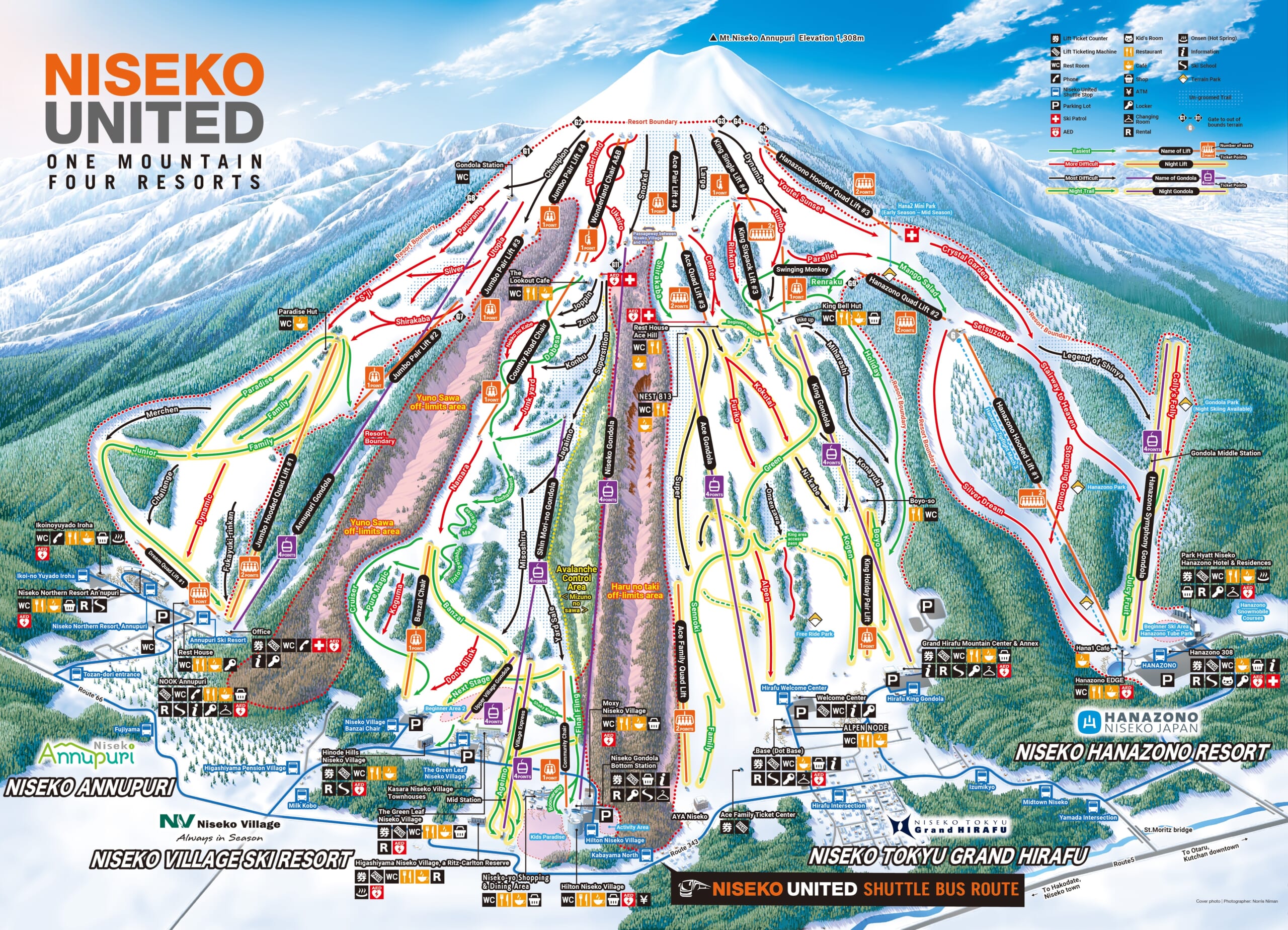
View official Niseko United trail map (image) →
Run & lift overview
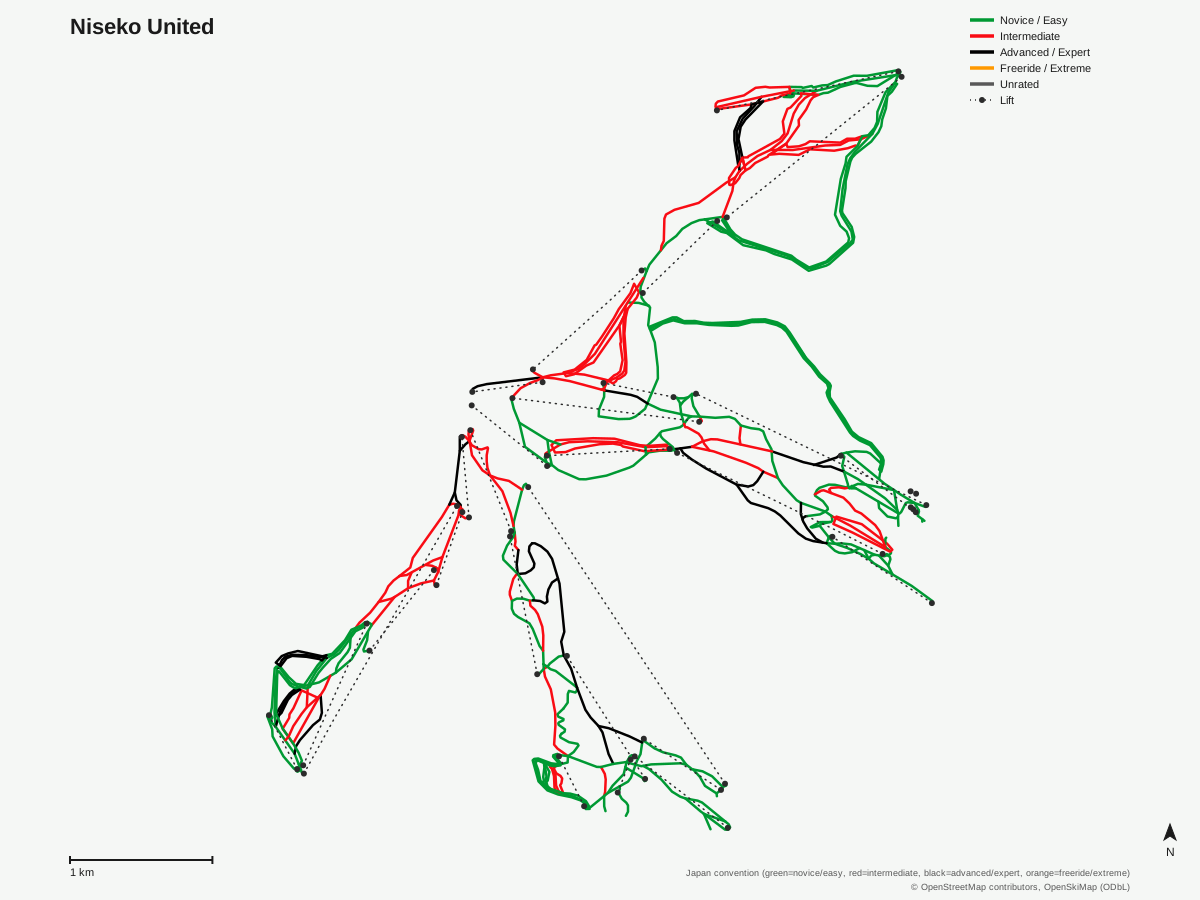
Niseko United: 184 runs, 29 lifts. Reflects OpenStreetMap's run and lift mapping for Niseko United, not the resort's own trail map graphic. © OpenStreetMap contributors, OpenSkiMap (ODbL).
Typical conditions by month
Monthly conditions data for Niseko United is not yet available.
Lift tickets & passes
- Ikon Pass — 7 days, no blackout
- Ikon Base Pass — 5 days, blackout dates apply (unusual - flagged, verify with Ikon support)
- Mountain Collective — 2 days total across the 4 Niseko United areas, no blackout dates, plus half-price additional days; redeem at a ticket counter with order confirmation email + photo ID (physical pass not accepted)
- Niseko United All Mountain Pass — Unlimited across all 4 Niseko United areas (day, multi-day, and season pass products all cover all 4)
Getting there
Nearest airports
- Sapporo Okadama Airport (OKD) — 63.9 km straight-line
- New Chitose Airport (CTS) — 83.2 km straight-line
- Hakodate Airport (HKD) — 122.1 km straight-line
Nearest cities
- Otaru, Hokkaido — 44.9 km straight-line
- Sapporo, Hokkaido — 59.2 km straight-line
- Ebetsu, Hokkaido — 76.1 km straight-line
Also covered by
Where to stay
A dedicated lodging guide for Niseko United is not yet available.
Nearby resorts
- Niseko Moiwa Ski Resort — 4 km straight-line, 444.2 m vertical
- Rusutsu Resort — 24 km straight-line, 565.7 m vertical
- Windsor Snow Village — 31 km straight-line, 396.7 m vertical
- Kiroro Resort — 35 km straight-line, 656.9 m vertical
- Sapporo Kokusai Skiing Resort — 39 km straight-line, 468.5 m vertical
FAQ
- What is Niseko United?
- It's a shared lift-ticket arrangement joining four separate ski areas on the same mountain: Niseko Tokyu Grand Hirafu, Hanazono, Niseko Village, and Annupuri, marketed under the tagline 'One Mountain, Four Resorts.'
- How much snow does Niseko get?
- Nearby Kutchan records a mean annual snowfall of 921 centimeters (about 363 inches) and a mean annual maximum snow depth of 183 centimeters, and the region is officially designated a special heavy-snowfall area under Japanese law.
- Is Niseko United good for beginners?
- Easy terrain is the largest single category at 32.45 of the area's 58.82 mapped kilometers, more than half, making it comparatively beginner-friendly for a resort of this scale.
- Is Niseko United good for advanced skiers?
- Advanced terrain is a smaller share, 8.91 kilometers, with intermediate at 17.47 kilometers, so strong skiers tend to look beyond the groomed count toward the area's extensive tree and backcountry-gate terrain rather than the mapped trail statistics alone.
- Which pass covers Niseko United?
- Niseko United's own All Mountain Pass covers all four areas unlimited on day, multi-day, and season products, and it also accepts the Ikon Pass (7 days, no blackout), the Ikon Base Pass, and Mountain Collective (2 days).
- What's the nearest airport to Niseko United?
- New Chitose Airport (CTS) near Sapporo, a large international airport, is the main gateway at 83.2 kilometers, with the smaller Sapporo Okadama Airport closer at 63.9 kilometers.
- How big is Niseko United?
- 919.2 vertical meters from a 1,176.2-meter top to a 257-meter base, with 29 lifts, six of them gondolas, serving 164 mapped runs.
- Why is Niseko popular with international visitors?
- Foreign overnight stays in the wider Niseko area grew to roughly 683,000 in fiscal 2018, more than 18 times the 2003 figure, driven initially by Australian visitors and investors before expanding to include operators from Hong Kong, Singapore, Malaysia, and mainland China.
Data sources
Last verified: 2026-09-15
Base facts from OpenSkiMap (ODbL), OpenStreetMap contributors, Wikidata (CC0), OurAirports (public domain) and GeoNames (CC BY 4.0). See /data-sources/.