
Purgatory Resort
Overview
Few ski areas have flip-flopped their own name as visibly as this one has. Rangers-turned-developers Chester “Chet” Anderson and Ray Duncan opened the mountain as Purgatory in 1965, a name borrowed from Purgatory Creek running through the base. New owners bought it in 2000 and rebranded it Durango Mountain Resort, a name that stuck for fifteen years until James Coleman’s 2015 purchase restored the original. The old identity runs deeper than signage, too: trails carry religious and mythological names like Angel’s Tread, Demon, Styx, and Nirvana, while Chet’s and Ray’s Ridge honor the two men who started it all.
In the San Juan Mountains of southwest Colorado, the resort has grown into one of the larger mountains covered on this site. It drops 595.1 vertical meters from a 3,290.9-meter summit to a 2,695.8-meter base, and its 89 runs span 66.95 kilometers of trail, more distance than most of its regional peers. The terrain mix tilts toward committed skiers rather than newcomers: 16.81 kilometers rate advanced, narrowly ahead of the 15.92 kilometers of easy terrain, while intermediate trails make up the largest chunk at 33.73 kilometers. Fourteen lifts, including a six-person chair and two high-speed quads per past reporting, move traffic across that terrain.
Purgatory also carries a few amenities uncommon at resorts its size, including an on-site urgent care clinic with midlevel healthcare providers on staff, useful given how far the mountain sits from Durango’s hospitals. No major multi-resort pass currently includes Purgatory, though it belongs to the smaller Power Pass Resorts network that links a handful of independent mountains across the western United States and beyond. Access runs through regional airports rather than a single major hub: Telluride Regional Airport is nearest at 37.2 kilometers, with Durango-La Plata County Airport, which also runs shuttle service to the resort, at 53.1 kilometers. The nearest sizable cities, Pueblo, Colorado Springs, and Albuquerque, all sit close to 300 kilometers away, underscoring how much of Purgatory’s draw depends on visitors willing to make a genuine drive into the San Juans rather than a quick day trip from a nearby metro area.
Snowfall averages around 260 inches a season, with snowmaking covering roughly a fifth of the terrain to backstop natural accumulation on the resort’s lower runs, a modest supplement compared with resorts that rely on snowmaking across most of their footprint. On-mountain lodging comes largely in the form of rental condos rather than a single flagship hotel, and a shuttle service links the resort with the town of Durango for visitors who prefer to base themselves off-property. Ski school programs run across children’s, youth, and adult tracks, standard infrastructure for a resort of Purgatory’s size, though the combination of San Juan Mountains scenery and a genuinely advanced-leaning terrain mix keeps drawing skiers willing to make the longer trip from Colorado’s Front Range cities.
Purgatory’s 14-lift network is a genuine mix rather than one dominant lift type, ten chairlifts, two drag lifts, and two magic carpets, spread across 89 runs, a ratio of roughly six runs per lift that’s fairly typical for a resort of this scale. At 66.95 kilometers of total trail, Purgatory’s mapped distance edges out several other Colorado-adjacent resorts in this dataset despite a comparatively modest 595.1-meter vertical drop, a sign of a mountain that spreads its terrain wide across the ridge rather than concentrating it on a single steep face. With advanced trail distance narrowly outpacing easy terrain, and intermediate runs making up exactly half the total, Purgatory’s numbers back up its long-standing reputation as a mountain that rewards skiers already past the beginner stage more than one built primarily around first-timers.
Key stats
Official website — Last checked 2026-09-13
Lifts by type
| Type | Count |
|---|---|
| drag lift | 2 |
| chair lift | 10 |
| magic carpet | 2 |
Runs by difficulty
| Difficulty | Distance |
|---|---|
| easy | 15.92 km |
| other | 0.49 km |
| advanced | 16.81 km |
| intermediate | 33.73 km |
Maps
View official Purgatory Resort trail map (PDF) →
Run & lift overview
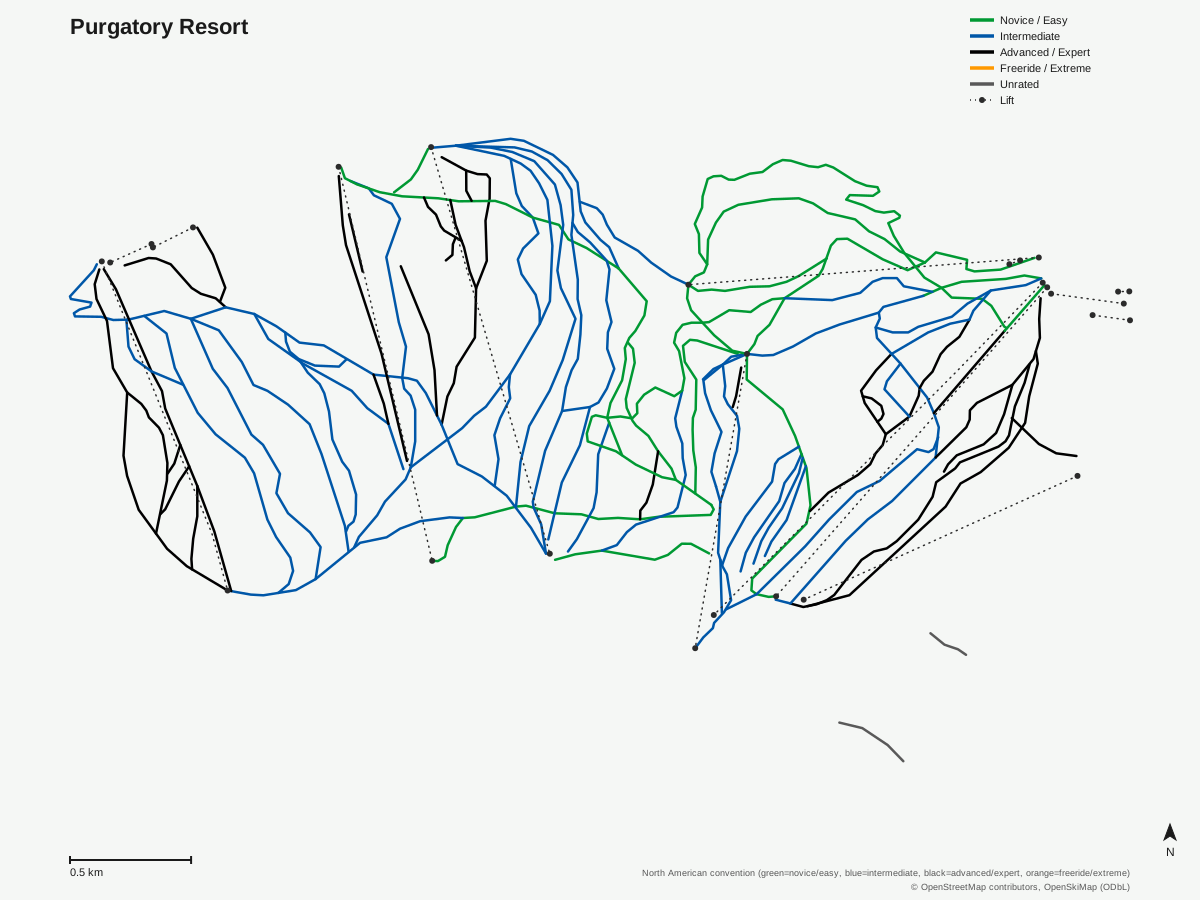
Purgatory Resort: 89 runs, 14 lifts. A schematic built from OpenStreetMap/OpenSkiMap data — this is not Purgatory Resort's official trail map. © OpenStreetMap contributors, OpenSkiMap (ODbL).
Typical conditions by month
Monthly conditions data for Purgatory Resort is not yet available.
Lift tickets & passes
Purgatory Resort has no multi-resort pass affiliations on record.
Getting there
Nearest airports
- Telluride Regional Airport (TEX) — 37.2 km straight-line
- Durango La Plata County Airport (DRO) — 53.1 km straight-line
- Cortez Municipal Airport (CEZ) — 79.3 km straight-line
Nearest cities
- Pueblo, Colorado — 290.7 km straight-line
- Colorado Springs, Colorado — 294.8 km straight-line
- Albuquerque, New Mexico — 301.5 km straight-line
Also covered by
Where to stay
A dedicated lodging guide for Purgatory Resort is not yet available.
Nearby resorts
- Telluride Ski Area — 33 km straight-line, 1149.5 m vertical
- Wolf Creek Ski Area — 93 km straight-line, 454.5 m vertical
- Crested Butte Mountain Resort — 161 km straight-line, 705.7 m vertical
- Powderhorn — 162 km straight-line, 503.3 m vertical
- Monarch Mountain — 163 km straight-line, 338 m vertical
FAQ
- Was Purgatory Resort always called Purgatory?
- No. It opened under that name in 1965, was renamed Durango Mountain Resort after a 2000 sale, and reverted to Purgatory Resort after James Coleman bought it in 2015.
- Where does the name Purgatory come from?
- Purgatory Creek, which runs through the base area. Several trail names carry the theme further, including Angel's Tread, Demon, Styx, and Nirvana, alongside runs like Chet's and Ray's Ridge named for the resort's founders.
- Who founded Purgatory Resort?
- Forest Service ranger Chester 'Chet' Anderson and oilman Ray Duncan opened it in 1965.
- How big is Purgatory Resort?
- A 595.1-meter vertical drop from a 3,290.9-meter summit to a 2,695.8-meter base, with 14 lifts serving 89 runs across 66.95 kilometers of trail, among the larger totals in this dataset.
- Is Purgatory Resort good for advanced skiers?
- It has a genuinely advanced-leaning terrain mix: 16.81 of its 66.95 kilometers are graded advanced, edging out the 15.92 kilometers of easy terrain, with intermediate the largest single share at 33.73 kilometers.
- Does Purgatory Resort have on-site medical care?
- Yes, the resort operates an on-site urgent care clinic staffed by midlevel healthcare providers, a notable amenity for a mountain of this size.
- What's the nearest airport to Purgatory Resort?
- Telluride Regional Airport is closest at 37.2 kilometers, followed by Durango-La Plata County Airport at 53.1 kilometers, which also runs a shuttle service to the resort.
- What passes work at Purgatory Resort?
- No major multi-resort pass currently lists Purgatory among its partners; the resort instead belongs to the smaller Power Pass Resorts network alongside areas such as Brian Head and Arizona Snowbowl.
Data sources
Last verified: 2026-09-17
Base facts from OpenSkiMap (ODbL), OpenStreetMap contributors, Wikidata (CC0), OurAirports (public domain) and GeoNames (CC BY 4.0). See /data-sources/.