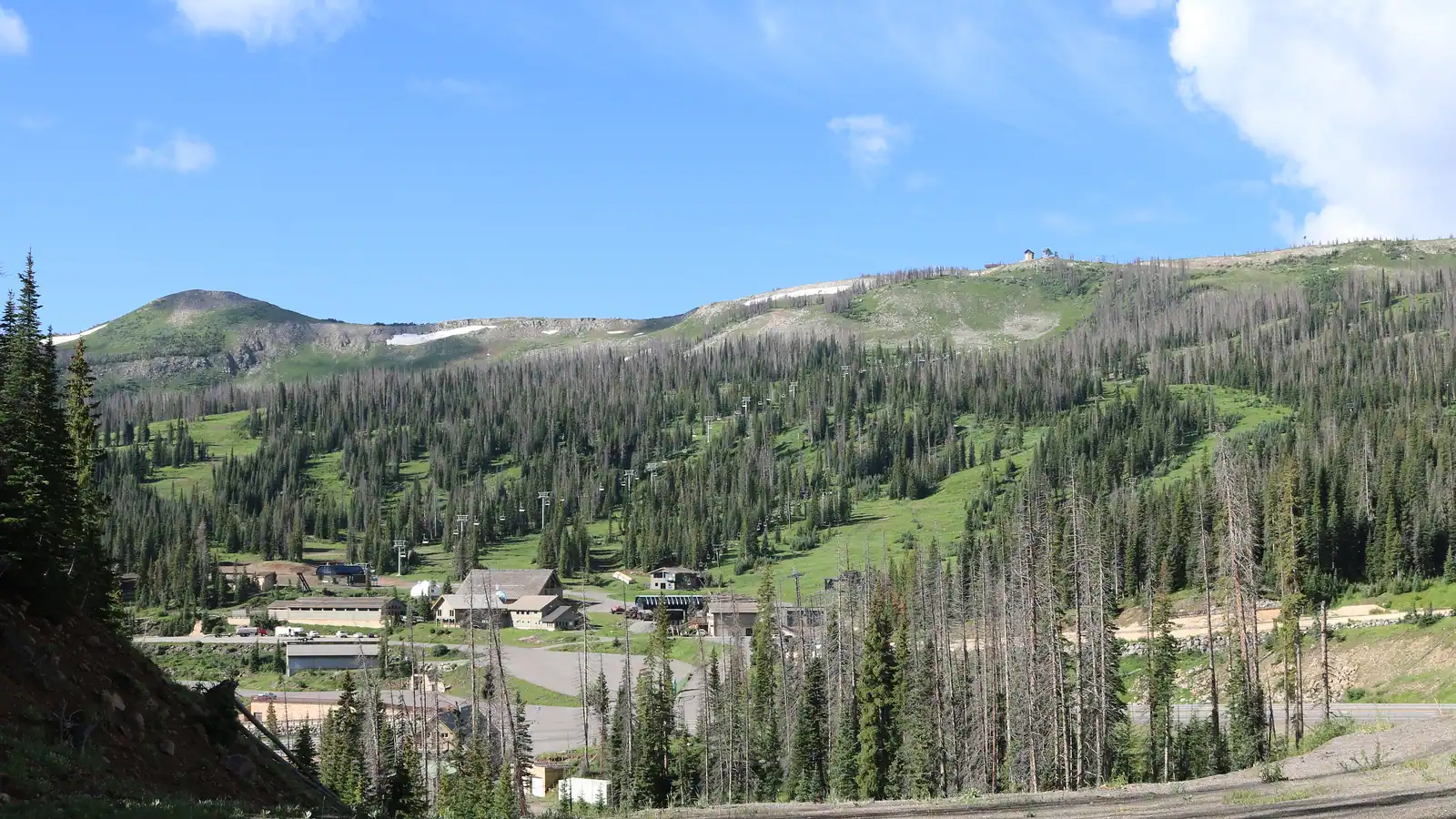
Wolf Creek Ski Area
Overview
Wolf Creek Ski Area’s identity starts with snow: the resort’s own marketing calls it “The Most Snow in Colorado,” and the claim has some history behind it. Wikipedia credits Wolf Creek with the state’s highest average annual snowfall, around 430 inches, and its own record season, 1978-79, brought 807 inches, followed by 730.5 inches the year after. The mountain’s base alone sits above 3,100 meters, high enough that storms crossing the Continental Divide tend to dump heavily before reaching the valley beyond.
That reputation traces to 1938, when San Luis Valley skiers led by Kelly Boyce formed the Wolf Creek Ski Club and put up a rope tow near the pass summit. The operation moved to its current site south of the Continental Divide in the mid-1950s under early organizers Charles Elliott and Ed Sharp, who served as club president for 12 years. Ownership passed through several hands afterward, including an unsuccessful 1960-63 stint under Joe Dyer and Clay Scott and a 1972-76 period backed by a Dallas investor group that included NFL figures Mike Ditka, Charlie Waters, and Dave Edwards, before Kingsbury Pitcher took over as CEO in 1976 and became sole owner in 1978, a role the family has held since.
The mountain climbs 454.5 vertical meters from a 3,128.6-meter base to a 3,583.1-meter summit, with 11 lifts, a platter tow, eight chairlifts, and two magic carpets, serving 107 runs across 55.88 kilometers, terrain totals well above what most similarly sized Colorado resorts offer. Intermediate skiing dominates the mix at 29.39 kilometers, more than easy (9.47 km) and advanced (16.11 km) combined, and the longest run, Navajo Trail, stretches roughly two miles.
Wolf Creek sits well off the interstate grid: San Luis Valley Regional in Alamosa is the closest airport at 81.6 kilometers, with Durango La Plata County (92 km) and Telluride Regional (112.4 km) as backups, and Pueblo, the nearest sizeable city, is still 210.8 kilometers away, keeping Wolf Creek a genuine drive-in destination rather than a metro day trip.
With 107 runs spread across 11 lifts, Wolf Creek’s average run length comes out to roughly 0.52 kilometers and vertical per lift to about 41 meters, figures that look modest next to the resort’s snowfall reputation but reflect a mountain whose terrain was built out gradually over decades by local ski-club volunteers and a handful of long-term owners rather than a single large developer laying out a resort all at once. That incremental growth, from a 1938 rope tow through eleven lifts today, has left the terrain count high relative to lift count, a pattern common at resorts that expanded organically rather than being master-planned from the start.
The mountain’s base elevation, 3,128.6 meters, is high even by Colorado standards, and the summit at 3,583.1 meters sits well above treeline on the Continental Divide, terrain that receives storms directly rather than through a sheltering ridgeline. That exposure is central to how Wolf Creek built its snowfall reputation in the first place, and it has held through a long, sometimes chaotic ownership history, local-club decades, an unsuccessful early-1960s attempt, a mid-1970s Dallas investor group, and the Pitcher family’s tenure since 1976, all operating on essentially the same storm-exposed site south of the Continental Divide that the original Wolf Creek Ski Club settled on in the 1950s.
Key stats
Official website — Last checked 2026-09-13
Lifts by type
| Type | Count |
|---|---|
| platter | 1 |
| chair lift | 8 |
| magic carpet | 2 |
Runs by difficulty
| Difficulty | Distance |
|---|---|
| easy | 9.47 km |
| other | 0.92 km |
| advanced | 16.11 km |
| intermediate | 29.39 km |
Maps
View official Wolf Creek Ski Area trail map (PDF) →
Run & lift overview
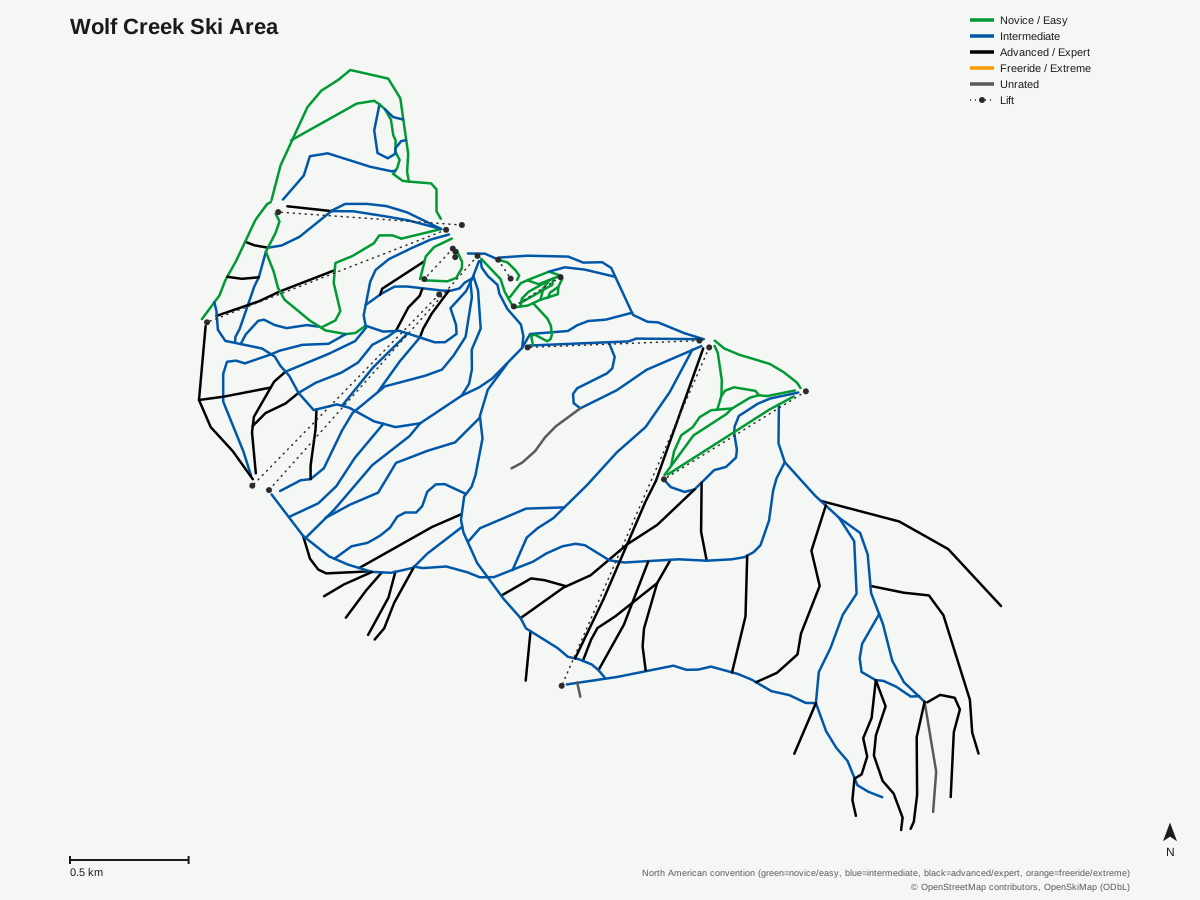
Wolf Creek Ski Area: 107 runs, 11 lifts. A schematic built from OpenStreetMap/OpenSkiMap data — this is not Wolf Creek Ski Area's official trail map. © OpenStreetMap contributors, OpenSkiMap (ODbL).
Typical conditions by month
Monthly conditions data for Wolf Creek Ski Area is not yet available.
Lift tickets & passes
Wolf Creek Ski Area has no multi-resort pass affiliations on record.
Getting there
Nearest airports
- San Luis Valley Regional Airport/Bergman Field (ALS) — 81.6 km straight-line
- Durango La Plata County Airport (DRO) — 92 km straight-line
- Telluride Regional Airport (TEX) — 112.4 km straight-line
Nearest cities
- Pueblo, Colorado — 210.8 km straight-line
- Colorado Springs, Colorado — 230 km straight-line
- Albuquerque, New Mexico — 264.8 km straight-line
Also covered by
Where to stay
A dedicated lodging guide for Wolf Creek Ski Area is not yet available.
Nearby resorts
- Purgatory Resort — 93 km straight-line, 595.1 m vertical
- Telluride Ski Area — 105 km straight-line, 1149.5 m vertical
- Monarch Mountain — 124 km straight-line, 338 m vertical
- Red River Ski Area — 149 km straight-line, 496.6 m vertical
- Taos Ski Valley — 154 km straight-line, 752.2 m vertical
FAQ
- Does Wolf Creek Ski Area really get the most snow in Colorado?
- The resort markets itself that way, and Wikipedia credits it with the highest average annual snowfall of any Colorado resort at roughly 430 inches, including a state-record 807 inches in the 1978-79 season.
- How old is Wolf Creek Ski Area?
- It dates to 1938, when San Luis Valley skiers led by Kelly Boyce formed the Wolf Creek Ski Club and installed a rope tow near the pass summit before the area relocated to its current site south of the Continental Divide in the mid-1950s.
- Who owns Wolf Creek Ski Area?
- Kingsbury Pitcher, who became CEO in 1976 and sole owner in 1978, following a chain of earlier operators that included a 1972-76 Dallas investor group whose members included NFL players Mike Ditka, Charlie Waters, and Dave Edwards.
- How big is Wolf Creek Ski Area?
- 454.5 vertical meters from a 3,583.1-meter summit to a 3,128.6-meter base, with 11 lifts (1 platter, 8 chairlifts, 2 magic carpets) serving 107 runs across 55.88 mapped kilometers, one of the larger terrain footprints among Colorado's smaller independent resorts.
- Is Wolf Creek good for intermediate skiers?
- Intermediate terrain leads by a wide margin at 29.39 kilometers, well ahead of 16.11 km advanced and 9.47 km easy.
- What's the longest run at Wolf Creek Ski Area?
- Navajo Trail, cited at about two miles, one of the longer named runs at any Colorado resort.
- What's the nearest airport to Wolf Creek Ski Area?
- San Luis Valley Regional in Alamosa is closest at 81.6 kilometers, with Durango La Plata County (92 km) and Telluride Regional (112.4 km) as alternatives.
- How long is the average run at Wolf Creek Ski Area?
- 55.88 kilometers across 107 runs works out to roughly 0.52 kilometers per run, with vertical per lift averaging about 41 meters across the 11-lift system.
Data sources
Last verified: 2026-09-17
Base facts from OpenSkiMap (ODbL), OpenStreetMap contributors, Wikidata (CC0), OurAirports (public domain) and GeoNames (CC BY 4.0). See /data-sources/.