
Angel Fire Resort
Overview
Angel Fire Resort began in 1966, when the LeBus family converted what had been cattle grazing land in northern New Mexico into a ski area roughly 25 miles east of Taos. Ownership shifted more than once in the decades that followed: Dan Lasater bought the resort for $19 million in 1984 and held it through 1987, a 1994 bankruptcy filing led to a sale to a group of Texas businessmen in November 1995 for $12 million, and that Texas connection has stuck ever since, most visibly in the resort’s annual “Big Ol’ Texas Weekend.”
The mountain today runs 8 lifts, six chairlifts and two magic carpets, across 101 runs totaling 53 kilometers, with a 638.1-meter vertical drop between a 3,256.1-meter summit and a 2,618-meter base, among the highest base elevations of any resort in this set. That elevation helps the area hold snow through a southern Rocky Mountain season, and the terrain itself skews intermediate, 25.45 of the 53 kilometers, well over half the mountain, ahead of 14.85 kilometers easy and 12.7 kilometers advanced.
Angel Fire has built a year-round identity beyond winter skiing, with summer mountain bike trails that have hosted multiple competitive events and a golf course that keeps the base village active outside ski season. Taos Regional Airport, 39.1 kilometers away, is the nearest air option, followed by Santa Fe Municipal at 113.7 kilometers and San Luis Valley Regional in Alamosa, Colorado at 129.4 kilometers, giving visitors a spread of small regional airports rather than one dominant gateway.
Albuquerque, population around 564,600, is the nearest sizable city at 191.9 kilometers, well ahead of Pueblo and Colorado Springs in Colorado. With 8 lifts serving 101 runs, better than 12.6 runs per lift, Angel Fire packs an especially dense trail network onto a relatively small number of lifts, a layout that has long made it a favorite with Texas families driving up for a week rather than fly-in destination skiers chasing a single marquee run.
One run at Angel Fire has historically been credited with the second-biggest lift-served vertical drop anywhere in New Mexico, a distinction that reflects just how much elevation the resort’s high base, over 2,600 meters, leaves available above it even before accounting for the mountain’s overall 638.1-meter drop. Roughly 230 acres of the mountain carry snowmaking coverage, a meaningful hedge against a snowfall total, around 210 inches, that runs lighter than some of Colorado’s higher-elevation resorts a few hours north. That combination of strong natural elevation, targeted snowmaking, and a long, multi-decade relationship with Texas visitors specifically has shaped Angel Fire’s identity more than any single terrain feature: it functions as an accessible, family-scaled Rocky Mountain ski trip for a Texan customer base that in many cases has been driving up for generations, longer than some of the resort’s own several changes in ownership.
Three regional airports, Taos, Santa Fe, and Alamosa’s San Luis Valley Regional, sit within roughly 130 kilometers, none dominant enough to serve as a true hub, which is part of why so many visitors simply drive the full distance from Texas rather than flying and renting a car locally. Albuquerque, the nearest sizable city at 191.9 kilometers, remains a common connection point for those who do fly, with Pueblo and Colorado Springs in Colorado both considerably farther out despite sitting in the opposite direction from the New Mexico gateway cities. That long list of moderate-distance airports and cities, rather than one dominant nearby hub, has reinforced Angel Fire’s identity as a drive-to destination first and a fly-in resort second, a pattern that has held steady across its several changes in ownership since 1966.
Key stats
Official website — Last checked 2026-09-13
Lifts by type
| Type | Count |
|---|---|
| chair lift | 6 |
| magic carpet | 2 |
Runs by difficulty
| Difficulty | Distance |
|---|---|
| easy | 14.85 km |
| advanced | 12.7 km |
| intermediate | 25.45 km |
Maps
View official Angel Fire Resort trail map (image) →

Run & lift overview
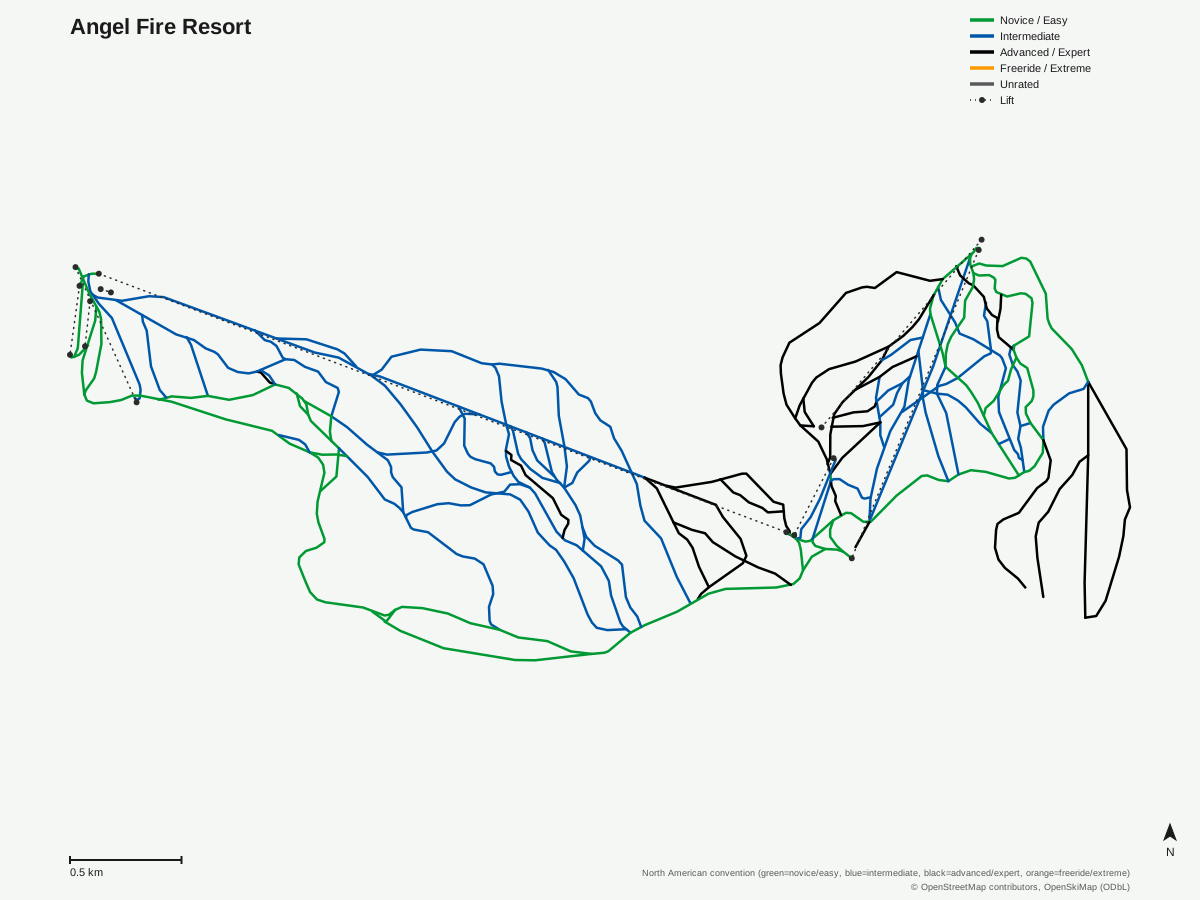
Angel Fire Resort: 101 runs, 8 lifts. Generated from community-mapped OpenStreetMap data, not Angel Fire Resort's official map artwork. © OpenStreetMap contributors, OpenSkiMap (ODbL).
Typical conditions by month
Monthly conditions data for Angel Fire Resort is not yet available.
Lift tickets & passes
Angel Fire Resort has no multi-resort pass affiliations on record.
Getting there
Nearest airports
- Taos Regional Airport (TSM) — 39.1 km straight-line
- Santa Fe Municipal Airport (SAF) — 113.7 km straight-line
- San Luis Valley Regional Airport/Bergman Field (ALS) — 129.4 km straight-line
Nearest cities
- Albuquerque, New Mexico — 191.9 km straight-line
- Pueblo, Colorado — 215.8 km straight-line
- Colorado Springs, Colorado — 275.3 km straight-line
Also covered by
Where to stay
A dedicated lodging guide for Angel Fire Resort is not yet available.
Nearby resorts
- Taos Ski Valley — 28 km straight-line, 752.2 m vertical
- Sipapu Ski and Summer Resort — 37 km straight-line, 322.8 m vertical
- Red River Ski Area — 38 km straight-line, 496.6 m vertical
- Ski Santa Fe — 82 km straight-line, 534.4 m vertical
- Pajarito Mountain — 116 km straight-line, 443.3 m vertical
FAQ
- How big is Angel Fire Resort?
- 638.1 vertical meters from a 3,256.1-meter summit to a 2,618-meter base, with 8 lifts serving 101 runs across 53 kilometers of trail.
- Is Angel Fire Resort good for intermediate skiers?
- Yes, intermediate terrain covers 25.45 of the resort's 53 kilometers, well over half, ahead of 14.85 kilometers easy and 12.7 kilometers advanced.
- How did Angel Fire Resort start?
- The LeBus family converted former cattle grazing land into the resort in 1966; ownership later passed through Dan Lasater in the 1980s and a group of Texas businessmen after a 1994 bankruptcy.
- What's the nearest airport to Angel Fire Resort?
- Taos Regional Airport is closest at 39.1 kilometers, ahead of Santa Fe Municipal at 113.7 kilometers.
- Is Angel Fire Resort popular with Texas visitors?
- Yes, it has traditionally drawn heavily from Texas, hosting an annual 'Big Ol' Texas Weekend' event celebrating that connection.
- What's the base elevation at Angel Fire Resort?
- 2,618 meters, among the higher base elevations of any resort in this list, which helps the area hold snow despite its southern New Mexico location.
- Does Angel Fire Resort have mountain biking?
- Yes, its summer mountain bike terrain has hosted multiple competitive events.
- What's the nearest city to Angel Fire Resort?
- Albuquerque, New Mexico, population around 564,600, is the nearest listed city at 191.9 kilometers.
Data sources
Last verified: 2026-09-17
Base facts from OpenSkiMap (ODbL), OpenStreetMap contributors, Wikidata (CC0), OurAirports (public domain) and GeoNames (CC BY 4.0). See /data-sources/.