
Snow King Mountain
Overview
Snow King Mountain has a stronger claim than almost any ski area in this list to a genuine historical first: it opened in 1939 as Wyoming’s original developed ski area, running a rope tow up a trail the Civilian Conservation Corps had cleared three years earlier. The Jackson Hole Ski Club, formed in 1937, was behind the push, and the hill picked up its current name in 1938 after going by “Kelly’s Hill” before that. Locals still call it “the Town Hill,” a fitting nickname given it rises straight off the southeast edge of Jackson rather than sitting apart from town like most Wyoming resorts.
The lift infrastructure has been rebuilt repeatedly over nine decades. Snow King’s first chairlift, installed in 1946, was a converted ore tram brought in from Colorado. A Rafferty double chairlift went up in 1978 and was replaced by a Doppelmayr quad in 2014; a summit lift from 1981 was pulled out in 2021 and replaced with the gondola that now anchors the mountain’s 9-lift network. That network serves 39 runs across 17.75 kilometers today, dropping 514.4 meters from summit to base over terrain split fairly evenly between easy, intermediate, and advanced ground.
Snow King has also leaned into being a four-season attraction. The Cowboy Coaster, a 1,660-foot alpine coaster, opened in 2015; a 2,820-foot zipline followed in 2022; and a summit observatory and planetarium opened in 2024, giving visitors reasons to ride the gondola outside ski season. Between the coaster, the zipline, and the observatory, Snow King has built a genuinely year-round business model around its single summit gondola in a way that’s uncommon even among larger Wyoming and Montana resorts, most of which lean more heavily on summer hiking and biking alone.
In April 2025 the resort’s hotel and base-area real estate sold to Castle Peak Holdings for a reported figure near $84 million, a sign of continued investment in the property. Because it sits inside Jackson itself, Snow King has by far the shortest airport commute of any resort in this group — Jackson Hole Airport is only about 16 kilometers away — and it isn’t tied to Ikon, Epic, or Indy Pass, operating instead as a stand-alone ticket.
Snow King’s 514.4-meter vertical drop, about 1,688 feet, is modest next to the bigger destination resorts in the broader Jackson Hole region, and that’s really the point of the mountain: it exists to serve a town rather than to compete with nearby larger resorts on scale. Its 39 runs across 17.75 kilometers make for a genuinely full ski day despite the comparatively small vertical figure, and the mix of a modern gondola, a platter lift, standard chairs, and four magic carpets gives the resort lift infrastructure spanning everything from beginner learning terrain to faster upper-mountain access — a broader spread of lift types than many resorts twice its size operate.
Key stats
Official website — Last checked 2026-09-13
Lifts by type
| Type | Count |
|---|---|
| gondola | 1 |
| platter | 1 |
| chair lift | 3 |
| magic carpet | 4 |
Runs by difficulty
| Difficulty | Distance |
|---|---|
| easy | 5.39 km |
| advanced | 5.09 km |
| intermediate | 7.26 km |
Maps
View official Snow King Mountain trail map (page) →
Run & lift overview
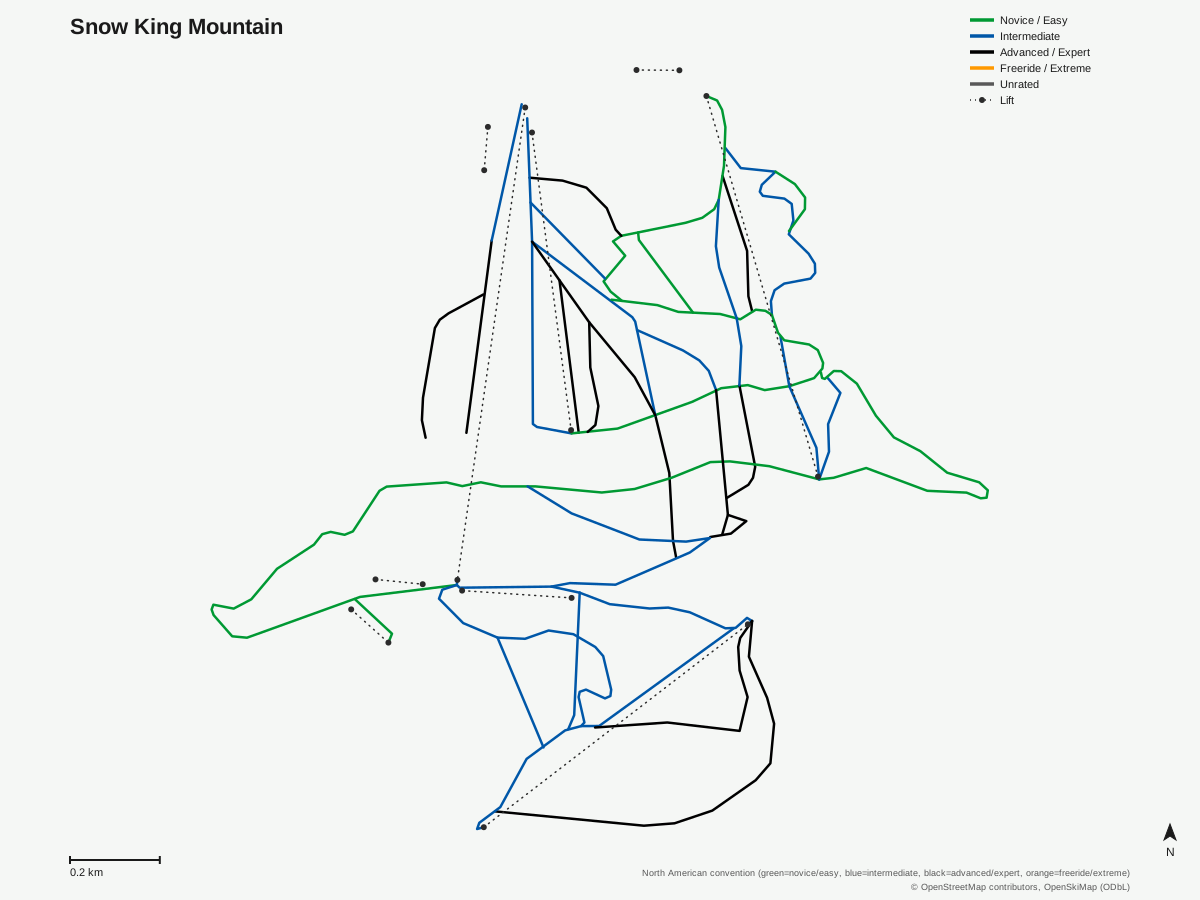
Snow King Mountain: 39 runs, 9 lifts. A schematic built from OpenStreetMap/OpenSkiMap data — this is not Snow King Mountain's official trail map. © OpenStreetMap contributors, OpenSkiMap (ODbL).
Typical conditions by month
Monthly conditions data for Snow King Mountain is not yet available.
Lift tickets & passes
Snow King Mountain has no multi-resort pass affiliations on record.
Getting there
Nearest airports
- Jackson Hole Airport (JAC) — 15.6 km straight-line
- Idaho Falls Regional Airport (IDA) — 106 km straight-line
- Yellowstone Airport (WYS) — 138.7 km straight-line
Nearest cities
- Billings, Montana — 313.4 km straight-line
- Salt Lake City, Utah — 315.2 km straight-line
- West Valley City, Utah — 325.3 km straight-line
Also covered by
Where to stay
A dedicated lodging guide for Snow King Mountain is not yet available.
Nearby resorts
- Jackson Hole Mountain Resort — 17 km straight-line, 1240.4 m vertical
- Grand Targhee Resort — 39 km straight-line, 681.7 m vertical
- Kelly Canyon Ski Resort — 72 km straight-line, 267.5 m vertical
- White Pine Resort — 98 km straight-line, 273.8 m vertical
- Sleeping Giant Winter Sports Area — 131 km straight-line, 241.1 m vertical
FAQ
- Is Snow King Mountain Wyoming's oldest ski area?
- Yes — it opened in 1939 with a rope tow on a trail cut by the Civilian Conservation Corps in 1936, making it Wyoming's first developed ski area, though it was officially named Snow King only in 1938, having previously gone by 'Kelly's Hill.'
- Why is Snow King called 'the Town Hill'?
- Because it rises directly off the southeast edge of Jackson, Wyoming, close enough that locals ski it as an in-town hill rather than a destination drive requiring a car and a mountain-pass commute.
- How big is Snow King Mountain?
- It has 39 runs across 17.75 km, with a 514.4 m vertical drop between a 2,416.2 m summit and a 1,901.8 m base, served by 9 lifts including a gondola, a platter lift, and several magic carpets.
- Does Snow King have activities beyond skiing?
- Yes — a 1,660-foot alpine coaster called the Cowboy Coaster (opened 2015), a 2,820-foot zipline (2022), and a summit observatory and planetarium that opened in 2024, all reachable via the same gondola used for skiing.
- What's the nearest airport to Snow King Mountain?
- Jackson Hole Airport, only about 16 km away — one of the shortest airport-to-resort distances of any ski area in the region, and short enough that a same-day fly-and-ski trip is genuinely realistic.
- Is Snow King good for intermediate skiers?
- Its terrain splits close to evenly — 7.26 km intermediate, 5.09 km advanced, 5.39 km easy — so it works reasonably well across ability levels rather than favoring one, though it's known regionally as a steeper in-town option than nearby destination resorts.
- Is Snow King on a multi-resort pass?
- It's not currently listed on Ikon, Epic, or Indy Pass, so lift tickets are handled directly through the resort rather than a national multi-mountain program.
- How has Snow King's lift system changed over time?
- Its first chairlift, installed in 1946, was a converted ore tram from Colorado; a 1978 Rafferty double chair was replaced by a Doppelmayr quad in 2014, and a 1981 summit lift gave way to the current gondola in 2021.
Data sources
Last verified: 2026-09-15
Base facts from OpenSkiMap (ODbL), OpenStreetMap contributors, Wikidata (CC0), OurAirports (public domain) and GeoNames (CC BY 4.0). See /data-sources/.