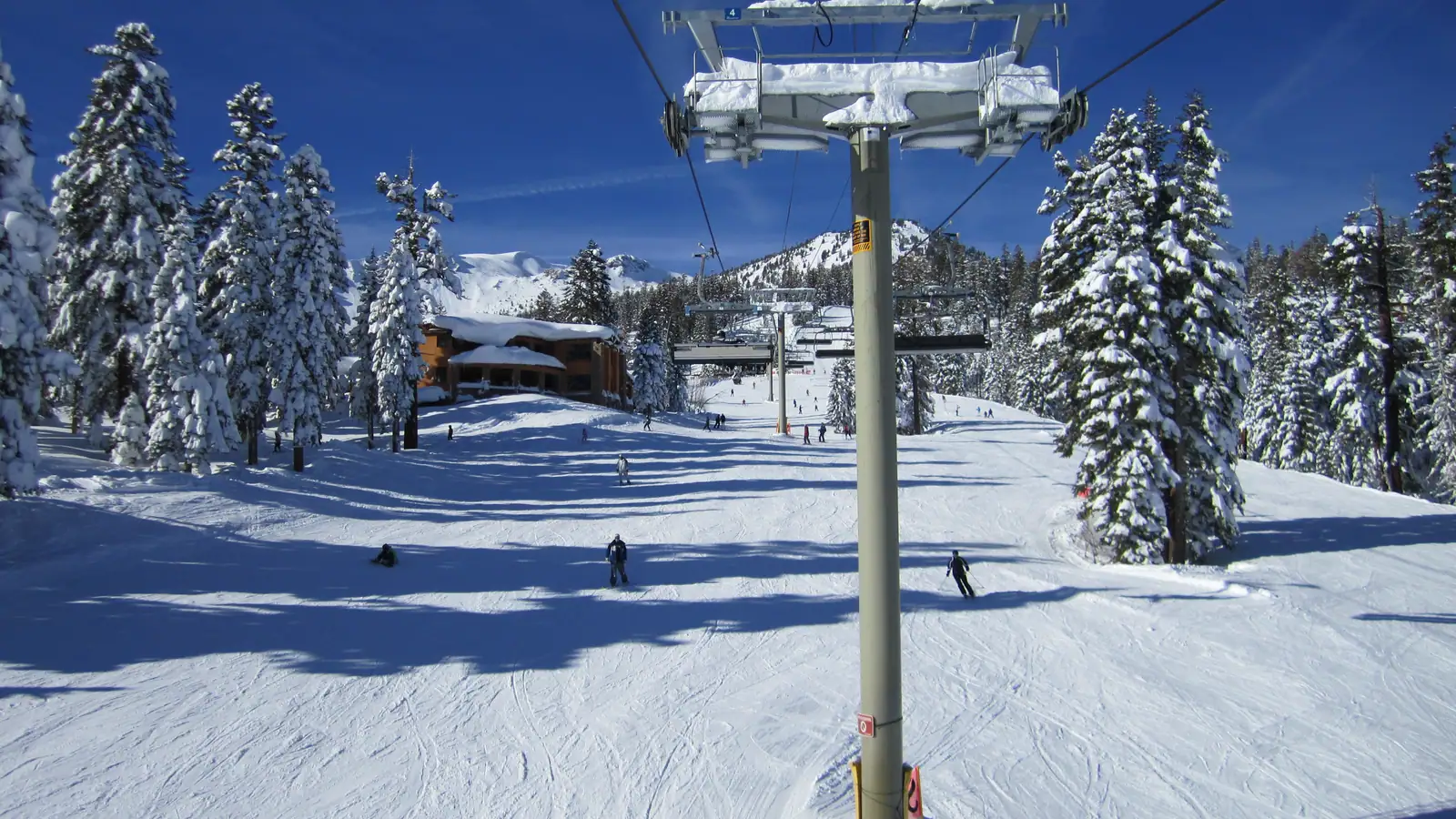
Mammoth Mountain
Overview
Mammoth Mountain is a genuine volcano, a lava dome complex built from about a dozen overlapping rhyodacite and dacite domes erupted between roughly 110,000 and 57,000 years ago, and it’s still capable of releasing carbon dioxide from vents on its south flank near Horseshoe Lake, a hazard that has killed off trees across some 170 acres there. Dave McCoy turned that volcanic terrain into a ski area in 1953, and it remains California’s highest resort, its 3,359.7-meter summit towering over a 2,456.9-meter base for a 902.8-meter vertical. Twenty-eight lifts, three of them gondolas, serve 154 mapped runs across 85.79 kilometers of trail today.
The mountain’s position in a low gap along the Sierra Nevada crest funnels an unusual amount of moisture into a place that also gets an unusual amount of sun: roughly 400 inches of snow a year alongside about 300 sunny days, a combination that keeps the season running long by California standards. Terrain here leans firmly intermediate, with 52.17 of the 85.79 mapped kilometers, well over 60%, graded that way, while advanced terrain accounts for a comparatively modest 13.41 kilometers and novice/easy runs add up to roughly 16 kilometers between them. That skew toward the middle grade, on a mountain this large, is part of why Mammoth draws such a broad range of visiting skill levels rather than skewing toward one extreme.
The Ikon Pass reaches Mammoth with unlimited no-blackout access, while the Ikon Base Pass offers unlimited access with blackout dates. Access by air is unusually direct for a resort of this size: Mammoth Yosemite Airport sits just 14.8 kilometers from the mountain, though travelers seeking more flight options typically route through Fresno Yosemite International, a full-service airport 115.2 kilometers away. On the ground, Fresno is the closest sizeable city at 120.5 kilometers with a population over half a million. Between the volcanic backdrop, the sunshine-and-snow combination, and a terrain profile built around long intermediate cruisers, Mammoth’s identity is shaped as much by its geology and climate as by its lift count.
With 154 mapped runs served by 28 lifts, three of them gondolas, the ratio comes to roughly 5.5 runs per lift, on the lower end among the large resorts covered on this site, consistent with a mountain that moves high skier volumes across broad, connected intermediate terrain rather than a dense web of short, individually distinct lines. The 3.86 kilometers of trail in Mammoth’s own “other” category, alongside 12.05 kilometers graded novice, gives the mountain a genuinely graduated beginner pathway distinct from its advanced 13.41 kilometers, useful for skiers progressing through ability levels on the same mountain over multiple visits. The same lava-dome structure that built the mountain, a cluster of roughly a dozen overlapping domes rather than a single conical peak, is part of why Mammoth’s terrain fans out across so many distinct aspects and exposures, giving the resort’s 28 lifts a wide range of snow-holding faces to draw from through a season that regularly runs deep into spring.
Only two Ikon-branded products currently reach Mammoth, the full Ikon Pass and the Ikon Base Pass, rather than a broader multi-brand pass roster, though both carry generous day allotments relative to many comparably sized resorts. On the ground, Clovis, Fresno, and Visalia are the resort’s three nearest listed cities, all of them well over 100 kilometers away, a reminder that despite Mammoth’s size and name recognition, it remains a genuine mountain destination rather than a metro-adjacent day-trip resort.
Key stats
Official website — Last checked 2026-09-13
Lifts by type
| Type | Count |
|---|---|
| gondola | 3 |
| platter | 1 |
| chair lift | 22 |
| magic carpet | 2 |
Runs by difficulty
| Difficulty | Distance |
|---|---|
| easy | 4.31 km |
| other | 3.86 km |
| novice | 12.05 km |
| advanced | 13.41 km |
| intermediate | 52.17 km |
Maps
View official Mammoth Mountain trail map (page) →
Run & lift overview
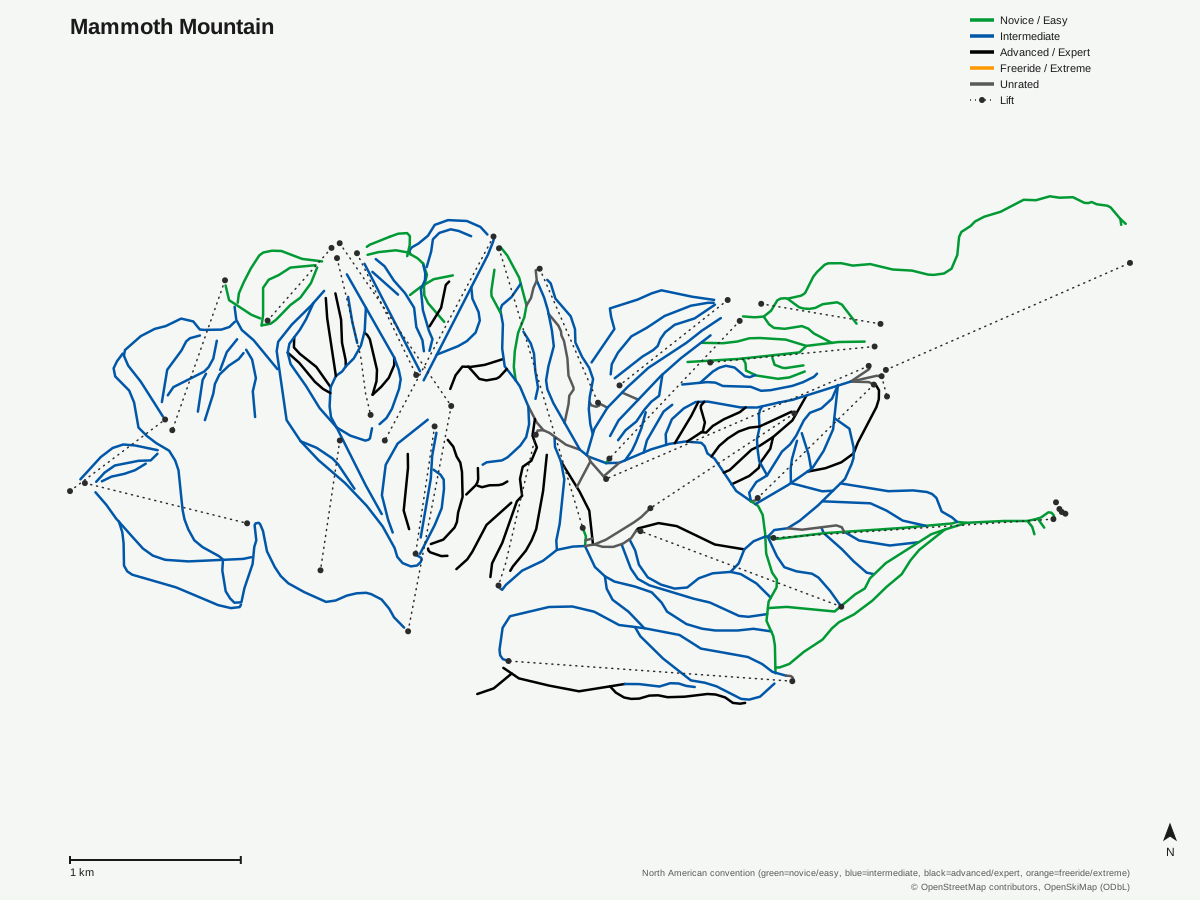
Mammoth Mountain: 154 runs, 28 lifts. Reflects OpenStreetMap's run and lift mapping for Mammoth Mountain, not the resort's own trail map graphic. © OpenStreetMap contributors, OpenSkiMap (ODbL).
Typical conditions by month
Monthly conditions data for Mammoth Mountain is not yet available.
Lift tickets & passes
- Ikon Pass — Unlimited, no blackout
- Ikon Base Pass — Unlimited, blackout dates apply
Getting there
Nearest airports
- Mammoth Yosemite Airport (MMH) — 14.8 km straight-line
- Eastern Sierra Regional Airport (BIH) — 64.4 km straight-line
- Fresno Yosemite International Airport (FAT) — 115.2 km straight-line
Nearest cities
- Clovis, California — 109.8 km straight-line
- Fresno, California — 120.5 km straight-line
- Visalia, California — 148.3 km straight-line
Also covered by
Where to stay
A dedicated lodging guide for Mammoth Mountain is not yet available.
Nearby resorts
- June Mountain — 13 km straight-line, 780.5 m vertical
- China Peak Mountain Resort — 48 km straight-line, 487.3 m vertical
- Dodge Ridge Ski Area — 102 km straight-line, 478.9 m vertical
- Bear Valley — 130 km straight-line, 558.7 m vertical
- Kirkwood Mountain Resort — 148 km straight-line, 504.9 m vertical
FAQ
- Is Mammoth Mountain a volcano?
- Yes, Mammoth Mountain is a lava dome complex formed by eruptions between roughly 110,000 and 57,000 years ago, made up of about a dozen overlapping rhyodacite and dacite domes.
- Who founded Mammoth Mountain?
- Dave McCoy established the Mammoth Mountain Ski Area in 1953, and it remains California's highest ski resort.
- How much snow does Mammoth Mountain get?
- The mountain averages around 400 inches (roughly 1,000 centimeters) of snow annually, combined with about 300 days of sunshine a year thanks to its position in a low gap along the Sierra Nevada crest.
- How big is Mammoth Mountain?
- 902.8 vertical meters from a 3,359.7-meter summit to a 2,456.9-meter base, with 28 lifts, three of them gondolas, serving 154 mapped runs across 85.79 kilometers.
- Is Mammoth Mountain good for intermediate skiers?
- Very much so: 52.17 of the mountain's 85.79 mapped kilometers, over 60%, are graded intermediate, the largest share by a wide margin over the 13.41 kilometers of advanced terrain.
- Which pass covers Mammoth Mountain?
- The Ikon Pass includes unlimited access with no blackout dates, and the Ikon Base Pass includes unlimited access with blackout dates in effect.
- What's the nearest airport to Mammoth Mountain?
- Mammoth Yosemite Airport is closest at just 14.8 kilometers, with Fresno Yosemite International, a larger commercial airport, at 115.2 kilometers for broader flight options.
- Is there a hazard area at Mammoth Mountain?
- Yes, the mountain's south flank near Horseshoe Lake actively vents carbon dioxide gas, a natural hazard that has killed trees across roughly 170 acres in the affected zone.
Data sources
Last verified: 2026-09-15
Base facts from OpenSkiMap (ODbL), OpenStreetMap contributors, Wikidata (CC0), OurAirports (public domain) and GeoNames (CC BY 4.0). See /data-sources/.