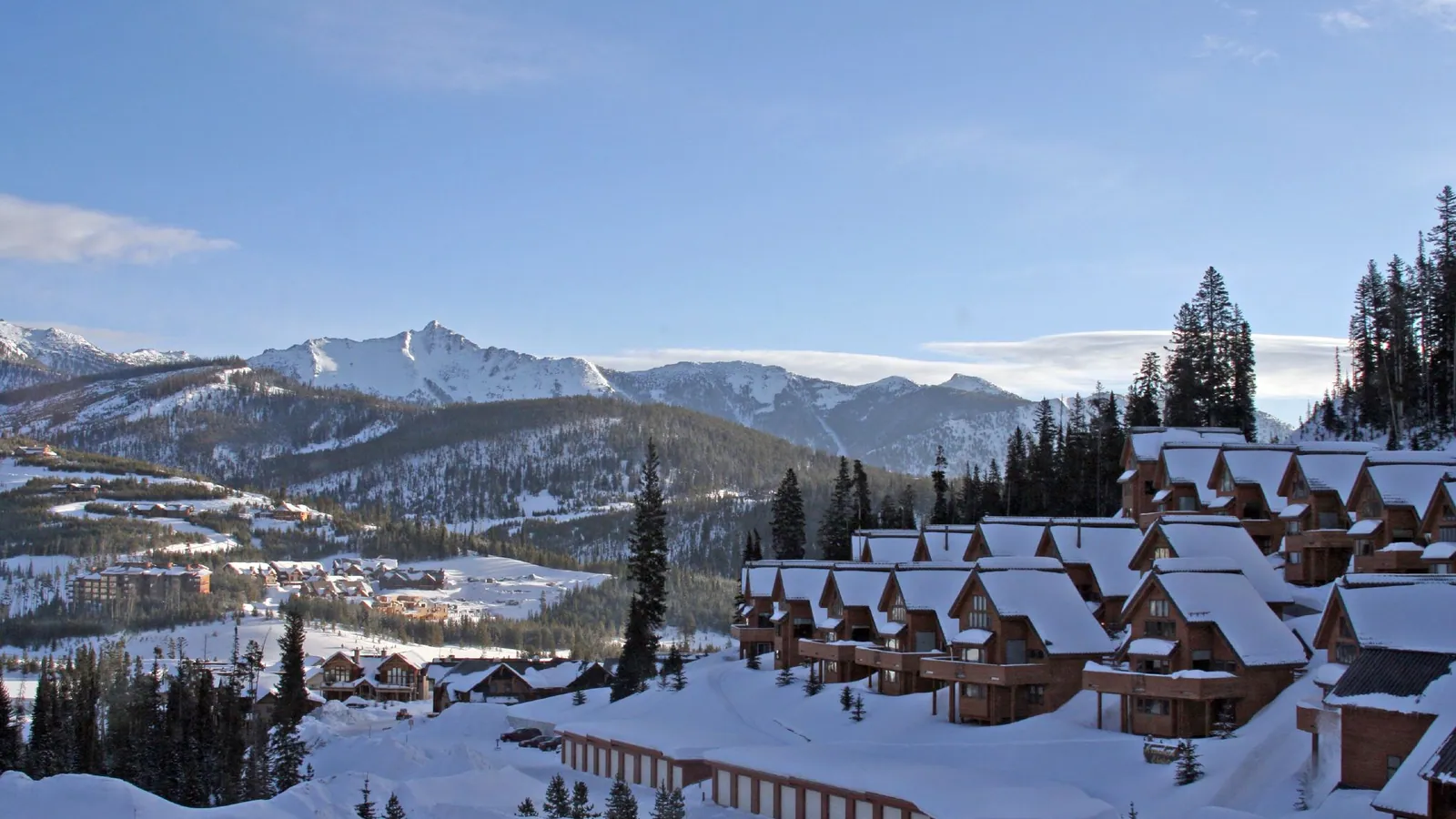
Big Sky Resort
Overview
Big Sky Resort exists because a television news anchor wanted a mountain of his own. Chet Huntley, the longtime co-anchor of NBC’s Huntley-Brinkley Report, developed the resort on the eastern face of Lone Mountain in southwest Montana, and it opened in December 1973; Huntley died the following year, and Boyne Resorts bought the operation in 1976, a relationship that continues today. What Boyne inherited was a good site with room to grow, and grow it did — most significantly in 2013, when Big Sky absorbed the neighboring Moonlight Basin and Spanish Peaks terrain, consolidating what had been three separate operations into one of the largest ski areas in North America.
The scale that resulted is difficult to overstate: a 1,324.7m vertical drop from a 2,077.5m base to a 3,402.2m summit, 458 runs, and 238.17km of terrain, spread across 45 lifts that range from magic carpets to a full aerial tram. The terrain mix is genuinely broad rather than skewed to one end — 65.03km easy and 89.9km intermediate cover most of the mountain, while 68.88km advanced and a combined 14km of expert and extreme terrain give experienced skiers a real reason to seek out the upper mountain. Much of that top-end terrain is reached via the Lone Peak Tram, installed in 1995 to access the 3,402.2m summit of Lone Peak itself; Boyne has been developing a replacement tram with two 75-passenger cabins and glass-floor panels for summer sightseeing. On the lift-tech side, Big Sky’s Ramcharger 8, added in 2018, was North America’s first eight-person chairlift, a small but real first for the industry.
Part of what gives Big Sky its particular reputation is its neighbor: the resort sits directly against the private, members-only Yellowstone Club, a juxtaposition of wide-open public terrain against one of the most exclusive ski clubs in the world. Big Sky is covered by the Ikon Pass (7 days, no blackout), the Ikon Base Pass (5 days, blackout dates apply), and Mountain Collective (2 days, no blackout). It sits about an hour from Bozeman Yellowstone International Airport, the closest airport at roughly 59.9km, in a part of Montana where the nearest sizable city, Billings, is still 234.3km away — a reminder that Big Sky’s scale comes with genuine remoteness attached.
That remoteness is compounded by the resort’s own listed gateway airport, Boise Air Terminal, sitting more than 420km away — a reflection of how sparsely populated southwest Montana is rather than a sign Big Sky is hard to reach; most visitors fly directly into Bozeman rather than routing through Idaho. With 45 lifts spread across 238.17km of terrain, Big Sky also averages roughly one lift for every 5km of skiable trail, a ratio that points to genuinely long, wide-open runs rather than the tightly packed lift networks typical of smaller Eastern resorts, and it’s part of why the resort markets itself around uncrowded skiing despite its overall size.
Key stats
Official website — Last checked 2026-09-14
Lifts by type
| Type | Count |
|---|---|
| gondola | 3 |
| platter | 8 |
| cable car | 1 |
| chair lift | 25 |
| magic carpet | 8 |
Runs by difficulty
| Difficulty | Distance |
|---|---|
| easy | 65.03 km |
| other | 0.35 km |
| expert | 8.8 km |
| extreme | 5.21 km |
| advanced | 68.88 km |
| intermediate | 89.9 km |
Maps
View official Big Sky Resort trail map (PDF) →
Run & lift overview
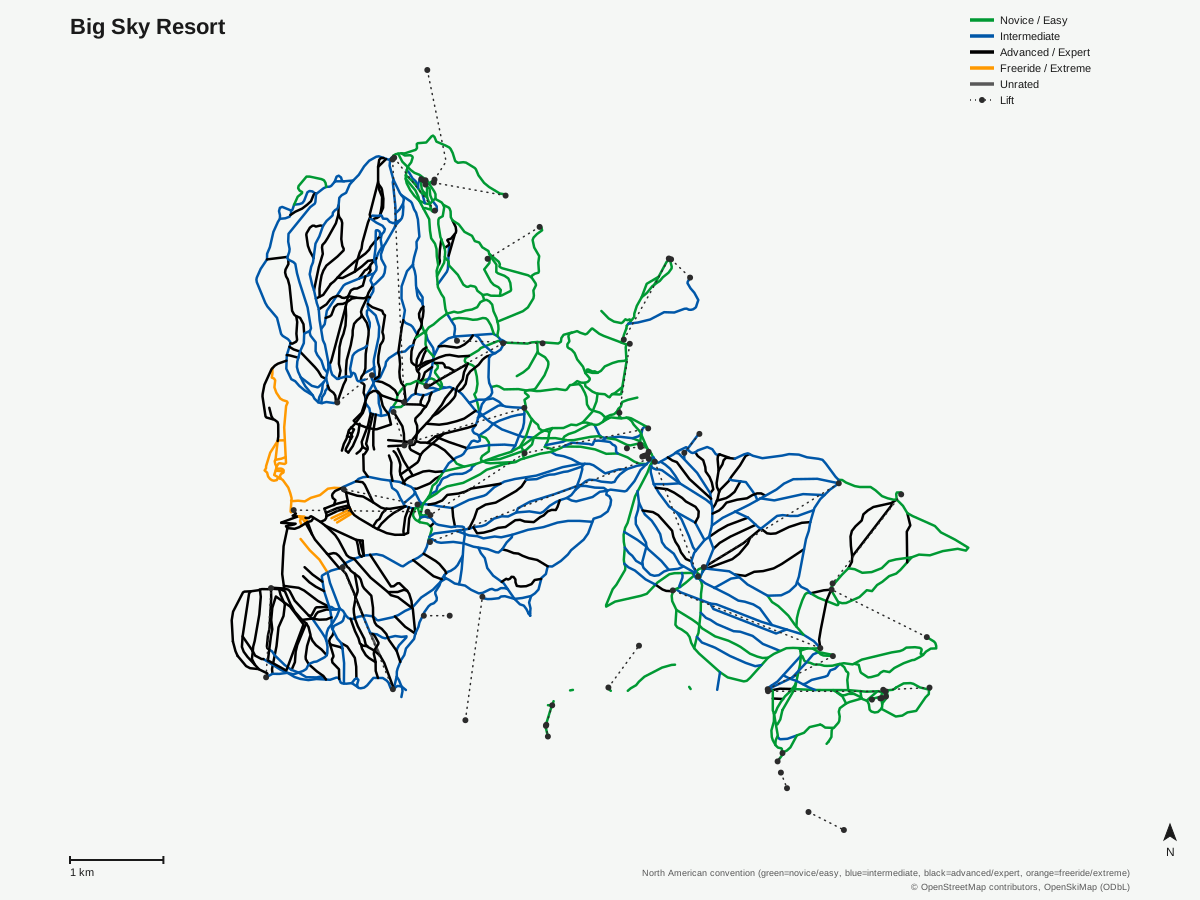
Big Sky Resort: 460 runs, 45 lifts. Generated from community-mapped OpenStreetMap data, not Big Sky Resort's official map artwork. © OpenStreetMap contributors, OpenSkiMap (ODbL).
Typical conditions by month
Monthly conditions data for Big Sky Resort is not yet available.
Lift tickets & passes
- Ikon Pass — 7 days, no blackout
- Ikon Base Pass — 5 days, blackout dates apply
- Mountain Collective — 2 days at this destination, no blackout dates
Getting there
Nearest airports
- Bozeman Yellowstone International Airport (BZN) — 59.9 km straight-line
- Yellowstone Airport (WYS) — 69.3 km straight-line
- Bert Mooney Airport (BTM) — 112.9 km straight-line
Nearest cities
- Billings, Montana — 234.3 km straight-line
- Boise, Idaho — 422.2 km straight-line
- Lethbridge, Alberta — 503.2 km straight-line
Also covered by
Where to stay
A dedicated lodging guide for Big Sky Resort is not yet available.
Nearby resorts
- Bridger Bowl — 72 km straight-line, 592 m vertical
- Sleeping Giant Winter Sports Area — 145 km straight-line, 241.1 m vertical
- Red Lodge Mountain — 162 km straight-line, 697.1 m vertical
- Grand Targhee Resort — 170 km straight-line, 681.7 m vertical
- Great Divide Ski Area — 179 km straight-line, 425.2 m vertical
FAQ
- How big is Big Sky Resort?
- Big Sky is enormous by any measure: a 1,324.7m vertical drop from a 2,077.5m base to a 3,402.2m summit, 458 runs, and 238.17km of total terrain — among the largest ski areas in the United States. Forty-five lifts serve the mountain, including three gondolas, a cable car, twenty-five chairlifts, eight platters, and eight magic carpets.
- Is Big Sky good for beginners and experts alike?
- The terrain spread is genuinely wide: 65.03km easy and 89.9km intermediate make up the bulk of the mountain, while 68.88km advanced plus smaller 8.8km expert and 5.21km extreme sections give confident skiers plenty to chase, much of it accessed via the Lone Peak Tram.
- How did Big Sky Resort start?
- It was founded by Chet Huntley, the longtime co-anchor of NBC's Huntley-Brinkley Report, and opened in December 1973 on Lone Mountain's eastern face. Huntley died in 1974, shortly after the resort opened, and Boyne Resorts bought the operation in 1976.
- What is the Lone Peak Tram?
- It's an aerial tram installed in 1995 that carries skiers to the 11,166-foot (3,402.2m) summit of Lone Peak, opening up Big Sky's steepest, most advanced terrain; a new tram with two 75-passenger cabins and glass-floor panels has been in development.
- Is Big Sky Resort near the Yellowstone Club?
- Yes — Big Sky sits immediately next to the private, members-only Yellowstone Club, and the resort itself absorbed the neighboring Moonlight Basin and Spanish Peaks terrain in 2013, which is a large part of why its skiable area is so large today.
- Which pass covers Big Sky Resort?
- The Ikon Pass covers 7 days at Big Sky with no blackout dates, the Ikon Base Pass covers 5 days with blackout dates, and Mountain Collective includes 2 days at no blackout.
- What's the nearest airport to Big Sky Resort?
- Bozeman Yellowstone International Airport (BZN) is closest at about 59.9km, with Yellowstone Airport (WYS) at 69.3km and Bert Mooney Airport in Butte (BTM) at 112.9km.
- What's a notable lift record at Big Sky?
- The Ramcharger 8, installed in 2018, was North America's first eight-person chairlift.
Data sources
Last verified: 2026-09-15
Base facts from OpenSkiMap (ODbL), OpenStreetMap contributors, Wikidata (CC0), OurAirports (public domain) and GeoNames (CC BY 4.0). See /data-sources/.