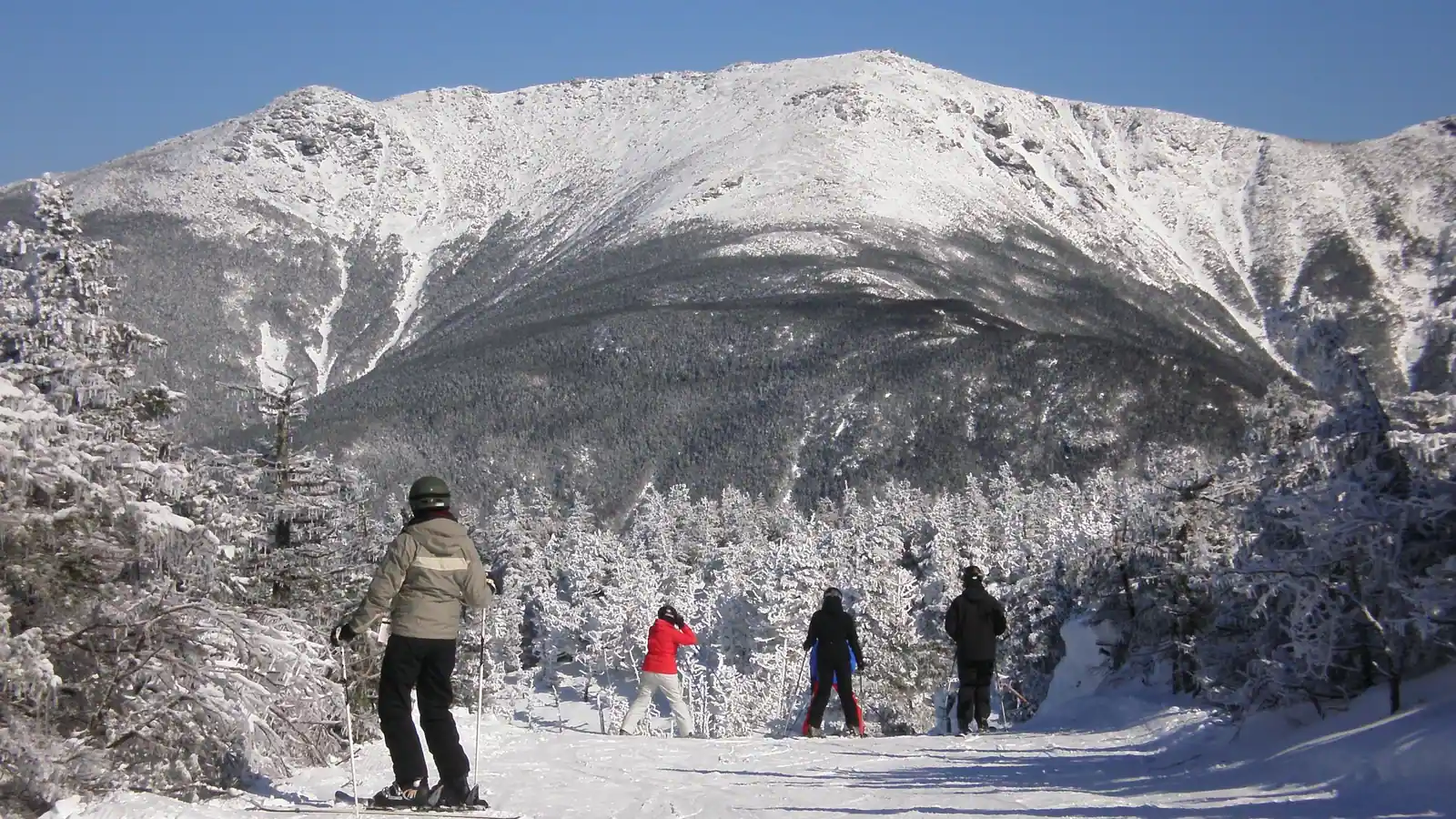
Cannon Mountain
Overview
Cannon Mountain has a claim to ski history that few American resorts can match: in 1938 it opened the first aerial tramway in North America, and in 1967 it hosted the continent’s first Alpine Skiing World Cup races. Both milestones took place on this granite dome within Franconia Notch State Park in New Hampshire’s White Mountains, a peak that carried the name Profile Mountain until an official change to Cannon Mountain in 1972. The state of New Hampshire has owned and operated the ski area throughout, and today it runs 9 lifts, seven chairlifts, a t-bar, and a rope tow, over 104 runs spanning 38.91 kilometers, with a 656.7-meter vertical drop from a 1,230.5-meter summit to a 573.8-meter base.
The terrain leans intermediate, 19.7 of the 38.91 kilometers, ahead of 13.32 kilometers advanced and 5.6 kilometers easy, spread across a mountain shaped by its geology as much as its ski history: Cannon Cliff, roughly 1,000 feet high and over a mile long, is regarded as the largest vertical rock face in the northeastern United States and draws climbers as well as skiers. The New England Ski Museum has operated at the base since 1982, tying the mountain’s racing past to its present-day operation, and Olympic skier Bode Miller trained here on his way up through competitive skiing.
Two Indy passes reach Cannon Mountain: the Indy Base Pass for 2 all-day or all-night tickets with blackout dates, and the Indy+ Pass for 2 tickets with none, giving pass holders a way to add a state-owned New England mountain with genuine World Cup history to a season built around other resorts.
Lebanon Municipal Airport is the nearest air option at 77.6 kilometers, with Burlington International in Vermont farther out at 120 kilometers and Rutland close behind at 122.9 kilometers. Manchester, New Hampshire, population around 110,200, is the nearest listed city at 132.4 kilometers, just ahead of Sherbrooke, Quebec across the Canadian border. With 9 lifts serving 104 runs, nearly 11.6 runs per lift, Cannon Mountain packs an unusually high trail count onto a modest lift network, a pattern consistent with a mountain built up gradually over nearly ninety years of skiing rather than designed all at once.
The mountain’s exposed granite summit has also made it a site of extremes beyond skiing: on April 2, 1973, an observatory here recorded a surface wind gust of 199.5 miles per hour, the second-strongest ever measured in the United States. Just downslope, the Old Man of the Mountain rock formation, a natural profile that once served as a symbol of New Hampshire itself, stood watch over Franconia Notch for centuries before collapsing on May 3, 2003, a loss still marked at a memorial site near the mountain’s base. Three sub-peaks known as the Cannon Balls rise along the ridge above the ski area, drawing rock climbers to routes first pioneered in the 1920s on the same cliff face, over 1,000 feet high and more than a mile long, that towers above the ski trails below. The resort’s historic aerial tramway, direct descendant of that 1938 original, closed in September 2025 for replacement, a modernization that follows nearly ninety years of continuous operation on a mountain where the state has consistently reinvested in infrastructure rather than letting its early ski-history status become purely nostalgic. That state ownership also keeps ticket pricing and operations tied to public rather than purely commercial priorities, a structure shared by only a handful of ski areas nationwide and one that has helped preserve Cannon Mountain’s identity as a working piece of New Hampshire’s outdoor recreation history rather than a purely private resort brand.
Key stats
Official website — Last checked 2026-09-14
Lifts by type
| Type | Count |
|---|---|
| t-bar | 1 |
| rope tow | 1 |
| chair lift | 7 |
Runs by difficulty
| Difficulty | Distance |
|---|---|
| easy | 5.6 km |
| other | 0.29 km |
| advanced | 13.32 km |
| intermediate | 19.7 km |
Maps
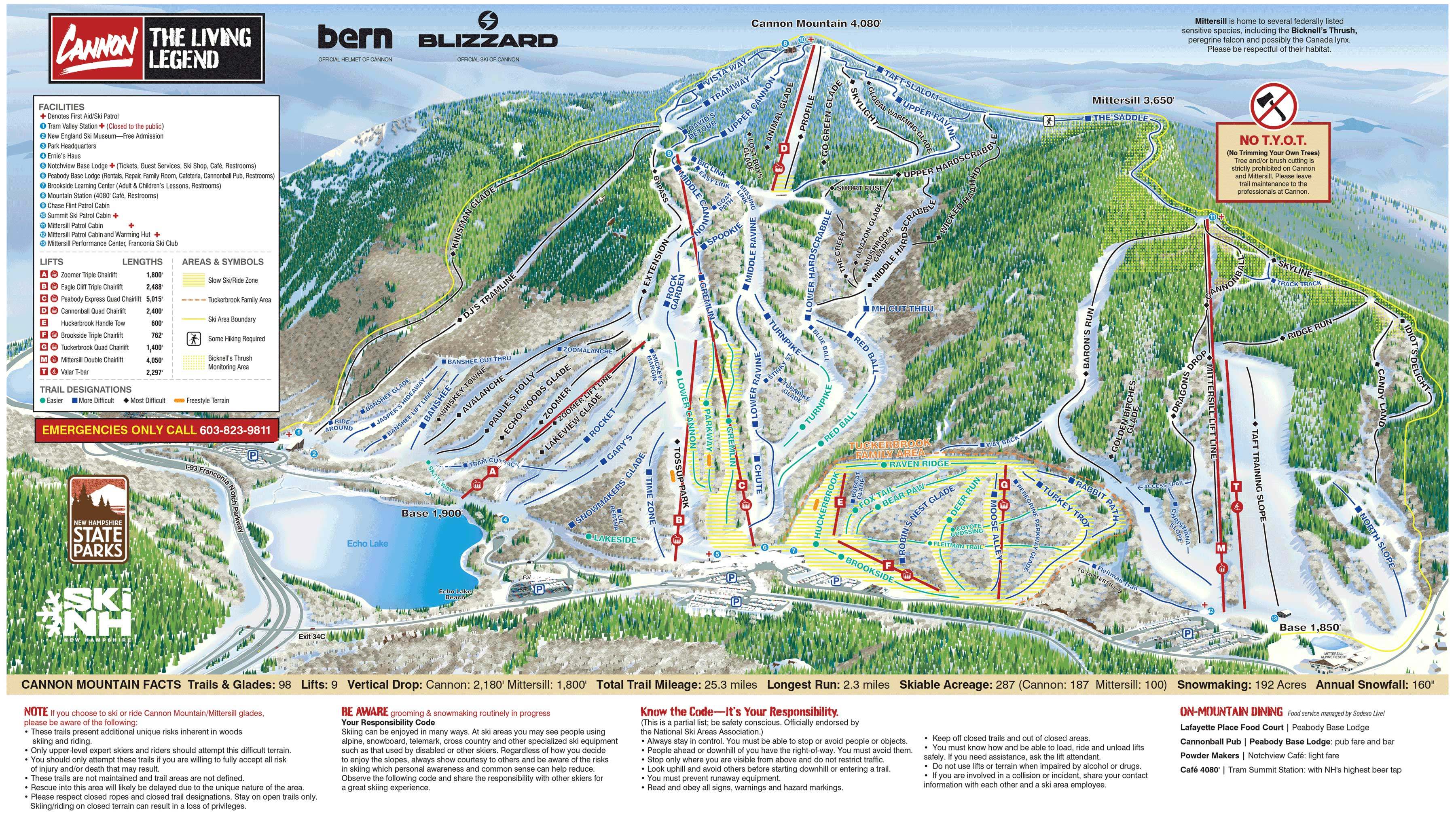
View official Cannon Mountain trail map (image) →
Run & lift overview
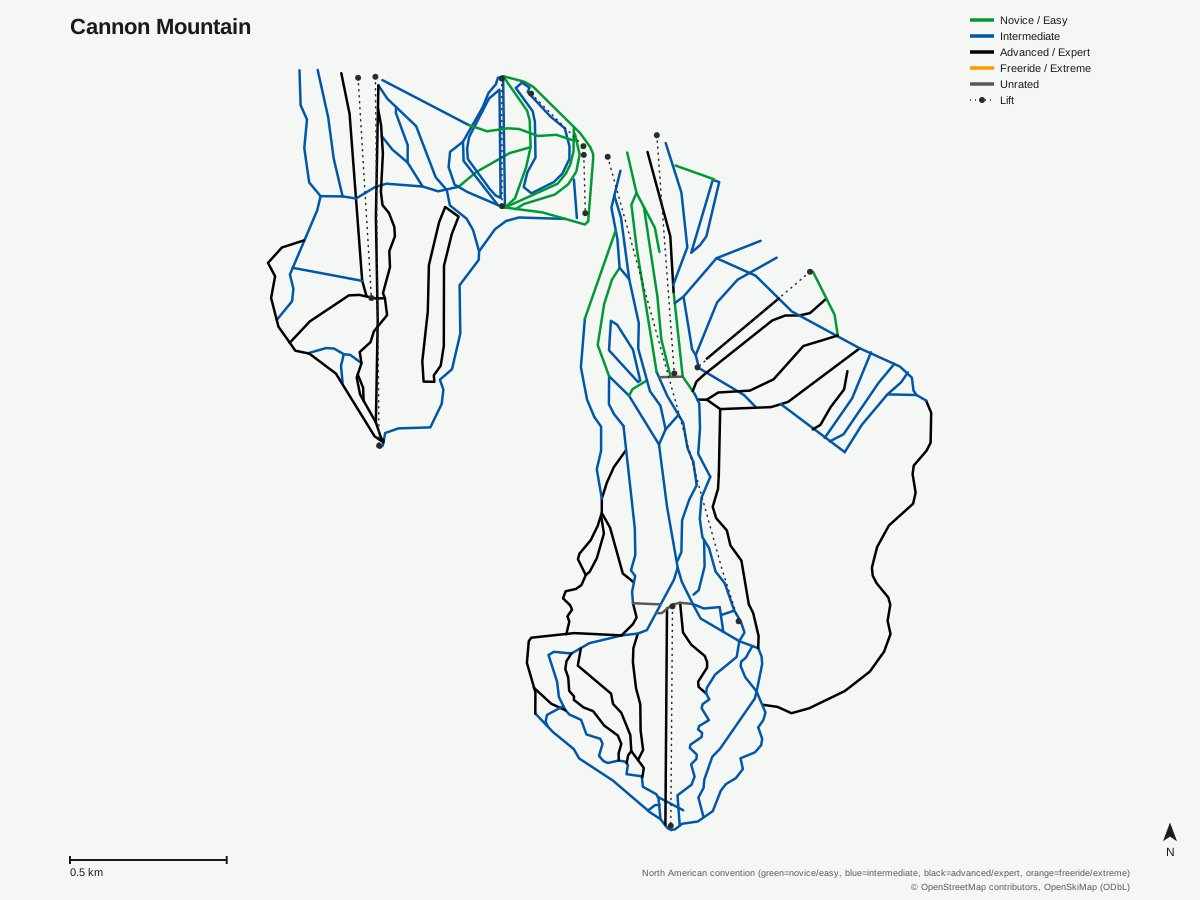
Cannon Mountain: 109 runs, 9 lifts. A schematic built from OpenStreetMap/OpenSkiMap data — this is not Cannon Mountain's official trail map. © OpenStreetMap contributors, OpenSkiMap (ODbL).
Typical conditions by month
Monthly conditions data for Cannon Mountain is not yet available.
Lift tickets & passes
- Indy Base Pass — 2 All-Day or All-Night tickets per resort; blackout dates apply (exact 26/27 holiday blackout dates not yet finalized as of verified_date)
- Indy+ Pass — 2 All-Day or All-Night tickets per resort, no blackout dates
Getting there
Nearest airports
- Lebanon Municipal Airport (LEB) — 77.6 km straight-line
- Patrick Leahy Burlington International Airport (BTV) — 120 km straight-line
- Rutland - Southern Vermont Regional Airport (RUT) — 122.9 km straight-line
Nearest cities
- Manchester, New Hampshire — 132.4 km straight-line
- Sherbrooke, Quebec — 137.3 km straight-line
- Lowell, Massachusetts — 174 km straight-line
Also covered by
Where to stay
A dedicated lodging guide for Cannon Mountain is not yet available.
Nearby resorts
- Loon Mountain Resort — 15 km straight-line, 666.2 m vertical
- Bretton Woods Ski Area — 21 km straight-line, 424.9 m vertical
- Waterville Valley Resort — 27 km straight-line, 606.6 m vertical
- Attitash Mountain Resort — 39 km straight-line, 505.2 m vertical
- Wildcat Mountain — 39 km straight-line, 617.6 m vertical
FAQ
- How big is Cannon Mountain?
- 656.7 vertical meters from a 1,230.5-meter summit to a 573.8-meter base, with 9 lifts serving 104 runs across 38.91 kilometers of trail.
- Is Cannon Mountain good for intermediate skiers?
- Yes, intermediate terrain covers 19.7 of the resort's 38.91 kilometers, the largest category, ahead of 13.32 kilometers advanced and 5.6 kilometers easy.
- Why is Cannon Mountain historically significant?
- It was home to the first aerial tramway in North America, built in 1938, and hosted the first Alpine Skiing World Cup races in North America in 1967.
- Who owns Cannon Mountain?
- The State of New Hampshire owns and operates Cannon Mountain, within Franconia Notch State Park.
- Which passes cover Cannon Mountain?
- The Indy Base Pass includes 2 all-day or all-night tickets with blackout dates, and the Indy+ Pass includes 2 tickets with none.
- What's the nearest airport to Cannon Mountain?
- Lebanon Municipal Airport is closest at 77.6 kilometers, ahead of Burlington International at 120 kilometers.
- Has any well-known skier trained at Cannon Mountain?
- Yes, Olympic skier Bode Miller trained at Cannon Mountain.
- What's the nearest city to Cannon Mountain?
- Manchester, New Hampshire, population around 110,200, is closest at 132.4 kilometers, just ahead of Sherbrooke, Quebec.
Data sources
Last verified: 2026-09-17
Base facts from OpenSkiMap (ODbL), OpenStreetMap contributors, Wikidata (CC0), OurAirports (public domain) and GeoNames (CC BY 4.0). See /data-sources/.