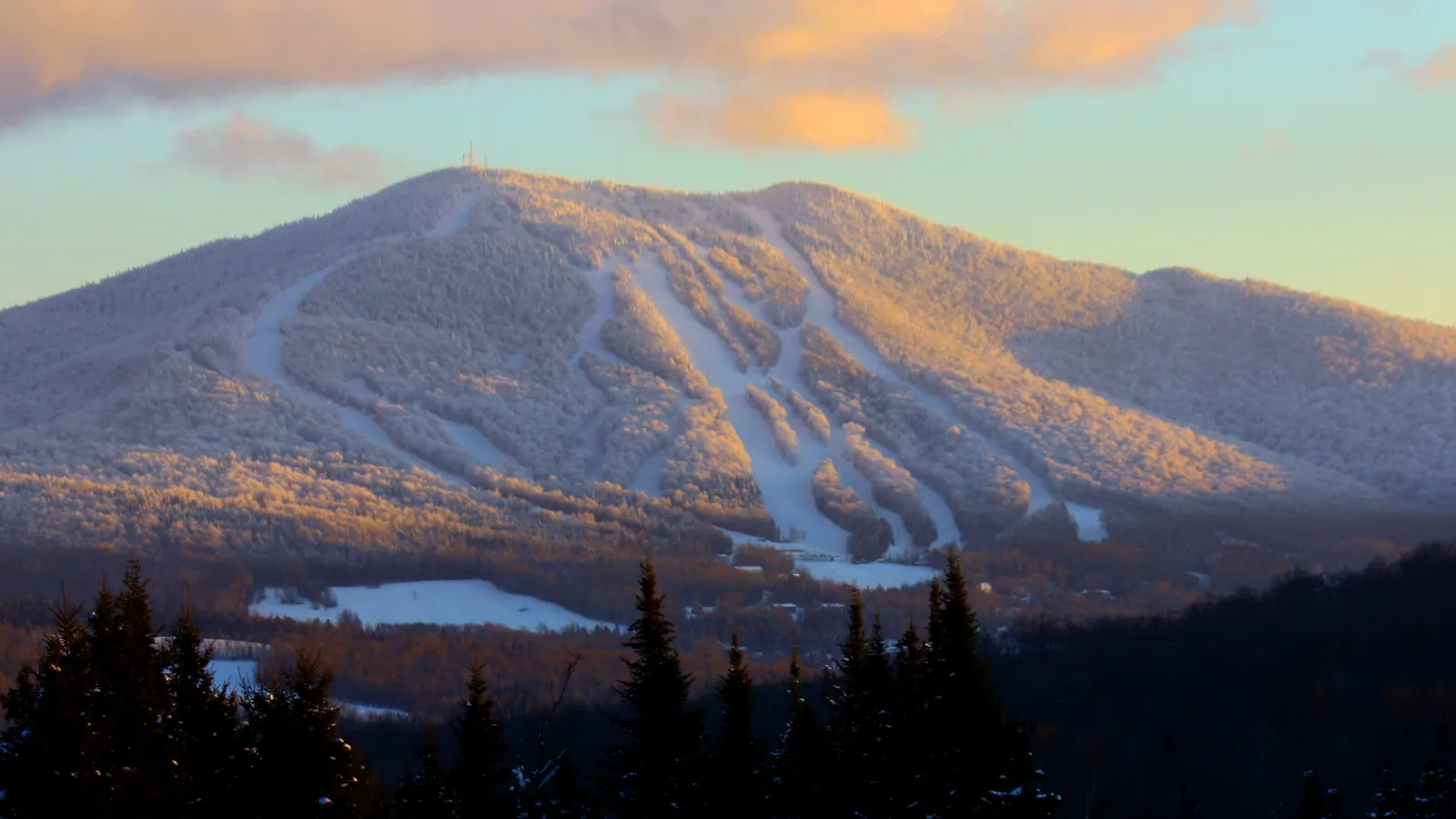
Burke Mountain Resort
Overview
Burke Mountain sits apart from Vermont’s better-known resort corridor, tucked into the Northeast Kingdom in East Burke, about seven miles off Interstate 91. It’s a smaller operation by New England standards, with 5 lifts and 61 runs, but the vertical drop of roughly 607 meters holds its own against much larger neighbors, and the terrain mix skews toward intermediate and advanced skiing rather than gentle cruising. The resort’s own pitch leans on that scale rather than apologizing for it, framing itself as a place where skiing hasn’t been smoothed over by heavy commercial development.
The mountain’s identity is inseparable from Burke Mountain Academy, the ski racing school based here that has produced national and Olympic-level competitors over the years. That racing pedigree gives Burke a reputation in New England skiing circles that outsizes its lift count, and it shapes the character of the trail network, which includes glades and lines that reward stronger skiers even if the total run mileage, around 30 kilometers, is modest next to the region’s giants.
Ownership at Burke has been unusually turbulent for a mountain this size. Jay Peak’s owners bought the resort in 2012, and it was later swept into the same EB-5 investor fraud case that entangled Jay Peak, landing Burke in federal receivership by 2016. That chapter closed in April 2025, when Bear Den Partners bought the resort for $11.5 million and committed to as much as $20 million in future infrastructure investment, a signal that new capital is going into a mountain that spent nearly a decade in limbo.
Burke is one of the more accessible mountains in this part of Vermont for pass holders, carrying both the Indy Base Pass and Indy+ Pass, each worth two tickets per visit, which puts it within reach of skiers who’ve already bought into that network for other resorts. Burlington International Airport is the nearest sizable airport, about 100 kilometers south, making Burke a workable day-trip or weekend destination for travelers flying into Vermont’s largest airport rather than driving in from Boston or New York.
By category, Burke’s 29.97 kilometers split into 16.01 km intermediate, 6.61 km easy, 6.51 km advanced, and 0.66 km expert, with a small 0.18 km logged as other terrain, numbers that back up the mountain’s reputation for real pitch without tipping fully into an expert-only layout. Sherbrooke, just across the Quebec border at 91 kilometers, is closer to Burke than any Vermont city of comparable size, a reminder of how far north into the Northeast Kingdom this resort actually sits. Burke’s 61 runs average out to about 490 meters apiece across the 29.97 total kilometers, shorter than several of its larger New England neighbors, a byproduct of a trail network built up gradually around a modest five-lift footprint rather than laid out across a single sprawling face.
Key stats
Official website — Last checked 2026-09-13
Lifts by type
| Type | Count |
|---|---|
| j-bar | 1 |
| t-bar | 1 |
| chair lift | 2 |
| magic carpet | 1 |
Runs by difficulty
| Difficulty | Distance |
|---|---|
| easy | 6.61 km |
| other | 0.18 km |
| expert | 0.66 km |
| advanced | 6.51 km |
| intermediate | 16.01 km |
Maps
View official Burke Mountain Resort trail map (image) →

Run & lift overview
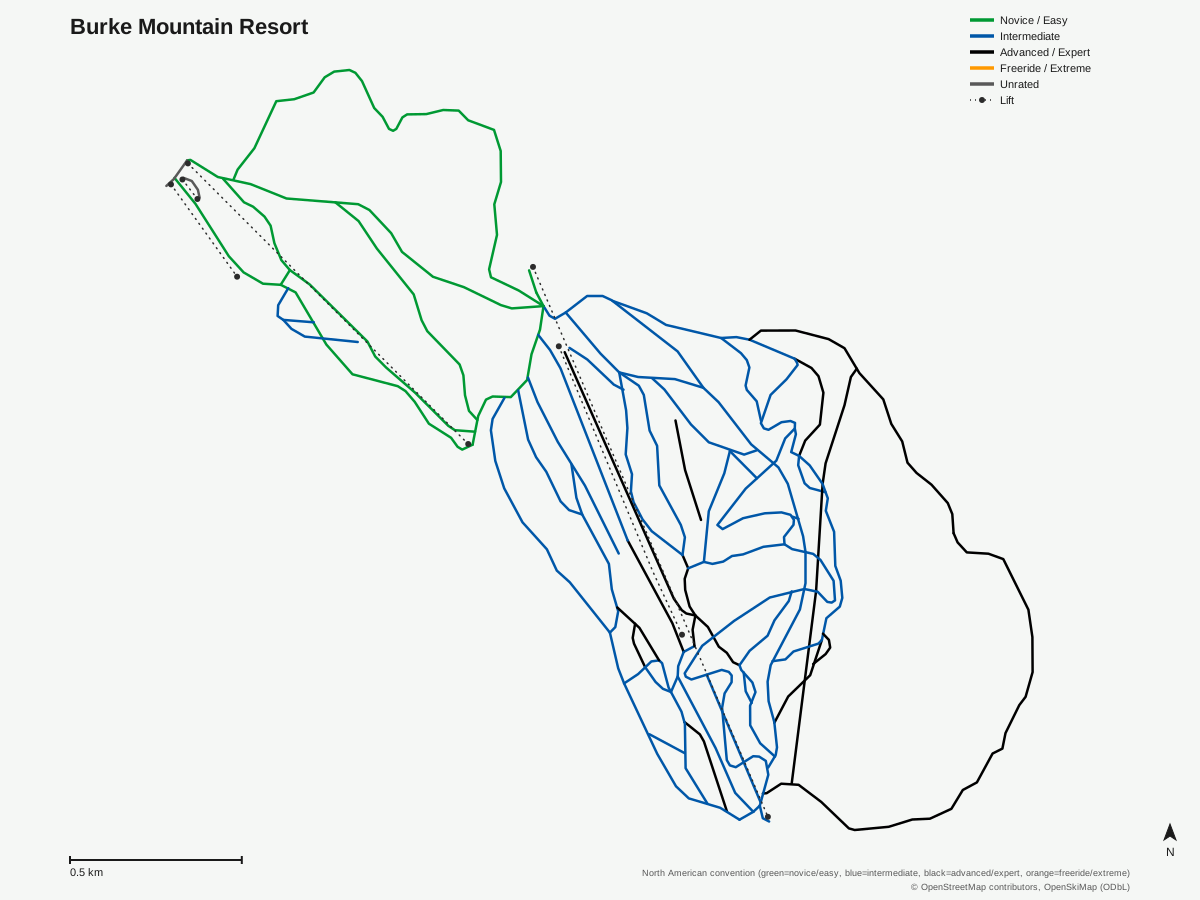
Burke Mountain Resort: 61 runs, 5 lifts. A schematic built from OpenStreetMap/OpenSkiMap data — this is not Burke Mountain Resort's official trail map. © OpenStreetMap contributors, OpenSkiMap (ODbL).
Typical conditions by month
Monthly conditions data for Burke Mountain Resort is not yet available.
Lift tickets & passes
- Indy Base Pass — 2 All-Day or All-Night tickets per resort; blackout dates apply (exact 26/27 holiday blackout dates not yet finalized as of verified_date)
- Indy+ Pass — 2 All-Day or All-Night tickets per resort, no blackout dates
Getting there
Nearest airports
- Patrick Leahy Burlington International Airport (BTV) — 99.6 km straight-line
- Lebanon Municipal Airport (LEB) — 111 km straight-line
- Plattsburgh International Airport (PBG) — 123.9 km straight-line
Nearest cities
- Sherbrooke, Quebec — 91 km straight-line
- Longueuil, Quebec — 160.7 km straight-line
- Le Vieux-Longueuil, Quebec — 164.6 km straight-line
Also covered by
Where to stay
A dedicated lodging guide for Burke Mountain Resort is not yet available.
Nearby resorts
- Cannon Mountain — 48 km straight-line, 656.7 m vertical
- Bretton Woods Ski Area — 51 km straight-line, 424.9 m vertical
- Jay Peak Resort — 62 km straight-line, 605.4 m vertical
- Owl's Head — 63 km straight-line, 474.8 m vertical
- Loon Mountain Resort — 63 km straight-line, 666.2 m vertical
FAQ
- How big is Burke Mountain?
- Burke's 5 lifts serve 61 runs, adding up to about 30 kilometers of trail and a 607-meter drop from summit to base. Intermediate terrain dominates at about 16 km, with a smaller but genuine advanced and expert share for stronger skiers.
- Is Burke Mountain good for beginners?
- Reasonably, with about 6.6 km of easy trail and a magic carpet lift serving that terrain, though the mountain's broader reputation leans toward intermediate and advanced skiing rather than a beginner-first layout.
- Does Burke Mountain have a ski racing academy?
- Yes, Burke Mountain Academy operates on the mountain and trains competitive alpine racers, part of why Burke carries a reputation beyond its size in New England ski racing circles.
- Which pass covers Burke Mountain?
- Burke carries both Indy Base and Indy+ Pass access, good for two visits under either one. Indy+ holders face no blackout restrictions, while Indy Base holders should double-check holiday-period exclusions before booking.
- What's the nearest airport to Burke Mountain?
- Patrick Leahy Burlington International (BTV), roughly 100 km south, is the nearest option, though Lebanon Municipal (111 km) and Plattsburgh International (124 km) are both reasonably close alternatives.
- Is Burke Mountain crowded?
- No. Burke sits in Vermont's Northeast Kingdom, well off the main resort corridor, and its own marketing leans on an independent, low-crowd identity rather than competing on visitor volume with the bigger destination resorts to the south.
- Who owns Burke Mountain now?
- Bear Den Partners purchased Burke in April 2025 for $11.5 million, with plans to invest up to $20 million in infrastructure, following a period of federal receivership after a prior owner's fraud case.
- What's the exact terrain breakdown at Burke Mountain?
- Of the resort's 29.97 km, 16.01 km is intermediate, 6.61 km easy, 6.51 km advanced, and 0.66 km expert, with a small 0.18 km logged as other terrain — a mountain built mainly around intermediate cruising with a real advanced-terrain component on top.
Data sources
Last verified: 2026-09-15
Base facts from OpenSkiMap (ODbL), OpenStreetMap contributors, Wikidata (CC0), OurAirports (public domain) and GeoNames (CC BY 4.0). See /data-sources/.