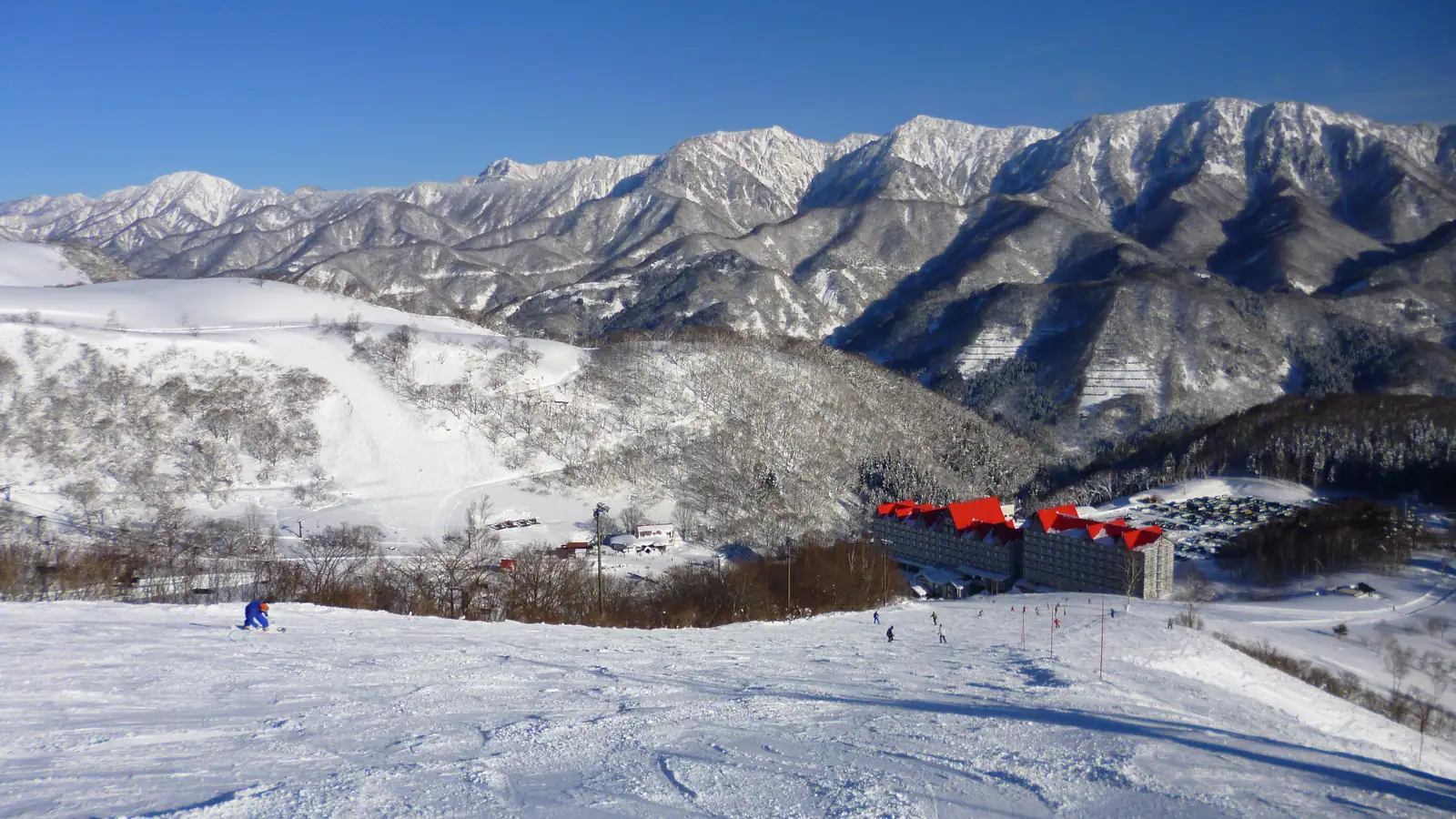
Hakuba Cortina
Overview
Hakuba Cortina sits in the town of Hakuba, Nagano Prefecture, on the Hakuba Valley cluster at the base of Japan’s Northern Alps. It is one of ten ski areas joined under the Hakuba Valley All-Mountain Pass, a shared lift ticket that, per Hakuba Valley’s own season pass page, covers Cortina alongside better-known neighbors such as Happo-One, Goryu, and Tsugaike. The valley as a whole hosted alpine events during the 1998 Nagano Winter Olympics and is described on the region’s own tourism site as blessed with heavy snowfall and high-quality powder, though Cortina itself runs as a smaller, quieter piece of that larger system rather than a marquee destination in its own right.
The resort’s base sits at 808 meters and its top lift discharges at 1,391 meters, for 583 meters of vertical spread across six chairlifts — no gondola or surface lift in the mix, just chairs serving the whole hill. Nineteen mapped runs add up to 12.5 kilometers of piste. Easy terrain leads the tally at 6.2 kilometers, roughly half of everything on the mountain, while advanced runs account for 3.3 kilometers and intermediate pitches make up 2.8 kilometers, with a sliver of ungraded terrain rounding out the total. That balance points to a hill built more for cruising and beginner mileage than for steep technical skiing, at least judged by the graded distances rather than any single showcase run.
Getting there without a car usually means flying into Shinshu-Matsumoto Airport, about 68 kilometers away, or Toyama Kitokito Airport at roughly 64 kilometers; Noto Satoyama Airport is a more distant third option near 100 kilometers out. Komatsu Airport, the area’s broader regional gateway, sits nearly 139 kilometers away. Closer on the ground, the city of Nagano is about 30 kilometers from the resort and is by far the largest population center nearby at over 370,000 residents, followed by Jōetsu and Ueda, both more than 50 kilometers out. For anyone already staying in Hakuba Valley and holding the all-mountain pass, Cortina is simply one more lift ticket already paid for rather than a separate trip to plan.
By the numbers, Cortina’s 19 runs and 12.5 kilometers of piste average out to roughly 660 meters per run, and the six chairlifts translate to about 2.1 kilometers of trail per lift, a generous ratio for one of the smaller areas inside the ten-resort Hakuba Valley system. That scale, modest next to giants like Happo-One within the same valley pass, is exactly why Cortina tends to draw skiers already staying in the valley for the wider terrain rather than visitors booking a trip specifically to ski this one hill. Among the small Japanese resorts covered in this comparison set, Hakuba Cortina’s 583-meter vertical is the largest, ahead of Grandeco Snow Resort’s 570 meters, while the remaining three cluster closely together near 560 meters — a reminder that even resorts marketed very differently, one inside a ten-area valley pass system, the others standalone, can land in a similar size bracket.
Key stats
Official website — Last checked 2026-09-13
Lifts by type
| Type | Count |
|---|---|
| chair lift | 6 |
Runs by difficulty
| Difficulty | Distance |
|---|---|
| easy | 6.21 km |
| other | 0.13 km |
| advanced | 3.3 km |
| intermediate | 2.83 km |
Maps
Official trail map: see hakubacortina.jp
Run & lift overview
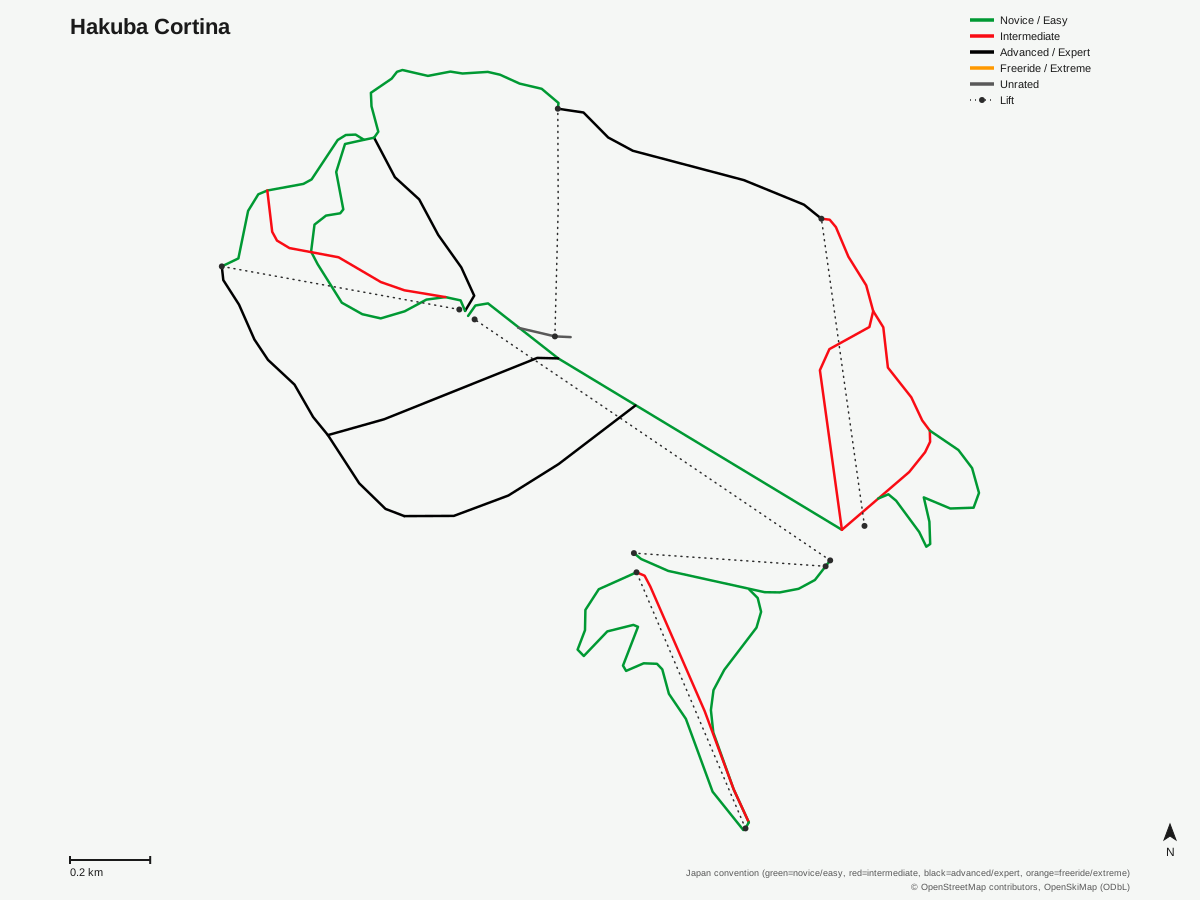
Hakuba Cortina: 19 runs, 6 lifts. A schematic built from OpenStreetMap/OpenSkiMap data — this is not Hakuba Cortina's official trail map. © OpenStreetMap contributors, OpenSkiMap (ODbL).
Typical conditions by month
Monthly conditions data for Hakuba Cortina is not yet available.
Lift tickets & passes
- Epic Pass — One complimentary 5-day Hakuba Valley ticket (all 10 areas), consecutive days from first use (shuttle-only use counts; 10 days total combined with Rusutsu); no blackout dates; excludes night skiing and night shuttles
- Epic Local Pass — One complimentary 5-day Hakuba Valley ticket (all 10 areas), consecutive days from first use (shuttle-only use counts; 10 days total combined with Rusutsu); no blackout dates; excludes night skiing and night shuttles
- Hakuba Valley All-Mountain Pass — Unlimited across all 10 Hakuba Valley areas (day pass and season pass products both cover all 10)
Getting there
Nearest airports
- Toyama Kitokito Airport (TOY) — 63.8 km straight-line
- Shinshu-Matsumoto Airport (MMJ) — 68.3 km straight-line
- Noto Satoyama Airport (NTQ) — 99.7 km straight-line
Nearest cities
- Nagano, Nagano — 30.4 km straight-line
- Jōetsu, Niigata — 51.5 km straight-line
- Ueda, Nagano — 55 km straight-line
Also covered by
Where to stay
A dedicated lodging guide for Hakuba Cortina is not yet available.
Nearby resorts
- Hakuba Norikura Onsen Ski Resort — 2 km straight-line, 468.6 m vertical
- Tsugaike Kogen — 4 km straight-line, 903.6 m vertical
- Hakuba Iwatake — 7 km straight-line, 536.5 m vertical
- Hakuba Happo One — 10 km straight-line, 1076.8 m vertical
- Hakuba 47 — 13 km straight-line, 819.8 m vertical
FAQ
- How many ski areas does the Hakuba Valley pass cover, and is Hakuba Cortina one of them?
- Yes. The Hakuba Valley All-Mountain Pass, sold directly by Hakuba Valley's own tourism site, covers ten ski areas including Hakuba Cortina alongside Happo-One, Goryu, Hakuba47, and others, on both day-ticket and season-pass products.
- What is the vertical drop at Hakuba Cortina?
- The resort's base sits at 808 meters and its highest lift-served point reaches 1,391 meters, giving a vertical drop of about 583 meters.
- How many lifts and runs does Hakuba Cortina have?
- Six chairlifts serve 19 mapped runs totaling 12.5 kilometers of piste; there are no gondolas or surface lifts in the current lift mix.
- What share of Hakuba Cortina's terrain is beginner-friendly?
- Easy-graded runs make up 6.2 of the resort's 12.5 total kilometers, close to half the mountain, with 2.8 kilometers of intermediate and 3.3 kilometers of advanced terrain filling out the rest.
- What's the closest airport to Hakuba Cortina?
- Shinshu-Matsumoto Airport is about 68 kilometers away and Toyama Kitokito Airport about 64 kilometers, the two most practical fly-in options; Komatsu Airport, roughly 139 kilometers out, is listed as the wider region's gateway.
- What's the nearest city to Hakuba Cortina?
- Nagano, the prefectural capital with a population over 370,000, sits about 30 kilometers from the resort, making it the largest and closest urban center by a wide margin.
- Did the Hakuba Valley area host Olympic skiing events?
- Yes. The wider Hakuba Valley, home to Cortina and nine other linked ski areas, hosted alpine skiing events during the 1998 Nagano Winter Olympics.
- How long is the average run at Hakuba Cortina?
- With 19 runs across 12.5 km, the average comes out to roughly 660 meters, and the six chairlifts work out to about 2.1 km of piste per lift, a fairly generous lift-to-terrain ratio for one of the smaller areas in the Hakuba Valley cluster.
Data sources
Last verified: 2026-09-15
Base facts from OpenSkiMap (ODbL), OpenStreetMap contributors, Wikidata (CC0), OurAirports (public domain) and GeoNames (CC BY 4.0). See /data-sources/.