Mt. Bachelor
Overview
Mt. Bachelor rises to a 2,723.7-meter summit above a 1,737.8-meter base, a 985.9-meter vertical drop that ranks it among the taller lift-served mountains in the Pacific Northwest. Fifteen lifts, twelve chairlifts plus three magic carpets for learners, spread skiers across 119 mapped runs and 92.2 kilometers of trail. The terrain mix tilts toward the middle and upper difficulty bands: 51.05 kilometers graded intermediate and 26.6 kilometers advanced, against just 14.55 kilometers of easy terrain. That ratio, a bit under one beginner kilometer for every two advanced ones, marks Mt. Bachelor as a mountain built more for skiers already comfortable on blues and blacks than for first-timers, even though its own operations extend well beyond winter into a lift-served mountain bike park and other warm-weather programming that keeps the resort busy outside ski season.
Two Ikon products cover the mountain: the full Ikon Pass grants 7 days with no blackout restrictions, while the Ikon Base Pass includes 5 days subject to blackout dates. Getting there means flying into Roberts Field in Redmond, the closest airport at roughly 51.5 kilometers, or routing through Eugene Airport (123 kilometers) or Salem’s McNary Field (146 kilometers) further afield. Portland International Airport, the largest airport in the region, sits well beyond both at 191.4 kilometers, making it more of a fallback than a primary gateway for a Bachelor trip. On the ground, Eugene is the nearest population center of real size at 112.4 kilometers and roughly 176,650 residents, with Salem and Gresham both further out past 150 kilometers.
At 92.2 kilometers of trail spread across 119 runs, the average run length works out to under 800 meters, consistent with a mountain whose 985.9-meter vertical is climbed and descended repeatedly across a wide, varied footprint rather than concentrated into a handful of long top-to-bottom descents. For skiers weighing Bachelor against other central Oregon options, the combination of a tall vertical, a lift fleet weighted toward chairs over surface lifts, and an intermediate-and-up terrain split is the clearest signal of what a day here actually looks like on snow.
Only two of the twelve chairlifts are supplemented by surface lifts, the three magic carpets reserved for the gentlest learner terrain, which underlines how much of the mountain’s 119 runs sit above true-beginner difficulty. With 15 lifts serving 119 runs, the lift-to-run ratio works out to roughly one lift for every eight trails, a moderate figure that suggests reasonably even skier distribution across the mountain rather than heavy concentration on one or two marquee lifts. Beyond winter operations, Mt. Bachelor’s own site promotes a lift-served mountain bike park with downhill trails across ability levels and a zip line it describes as the steepest and fastest in the Pacific Northwest, both run through the fall schedule that, as of the resort’s own posted hours, operated Thursday through Sunday into early October. That year-round infrastructure, layered onto a winter terrain profile weighted toward intermediate and advanced skiing, gives Mt. Bachelor a broader identity than a single-season ski hill, even though its winter statistics, the 985.9-meter vertical foremost among them, remain the core of what draws skiers to central Oregon in the first place.
Gresham, at 177.4 kilometers and roughly 110,550 residents, rounds out the resort’s three listed nearby cities alongside Eugene and Salem, none of them especially close by the standards of resorts built right next to a metro area, which underscores how much of Mt. Bachelor’s visitor base likely arrives as a planned ski trip rather than a spontaneous day trip. Two Ikon products, rather than a full multi-pass roster, currently reach the mountain, a narrower pass footprint than some comparably sized western resorts carry, which is worth checking before assuming broader coverage from other programs. Taken together, the vertical, the lift mix, the terrain split, and the specific pass and airport details tracked here give a fuller picture of what a visit actually requires than any single statistic on its own.
Key stats
Official website — Last checked 2026-09-14
Lifts by type
| Type | Count |
|---|---|
| chair lift | 12 |
| magic carpet | 3 |
Runs by difficulty
| Difficulty | Distance |
|---|---|
| easy | 14.55 km |
| advanced | 26.6 km |
| intermediate | 51.05 km |
Maps
View official Mt. Bachelor trail map (page) →
Run & lift overview
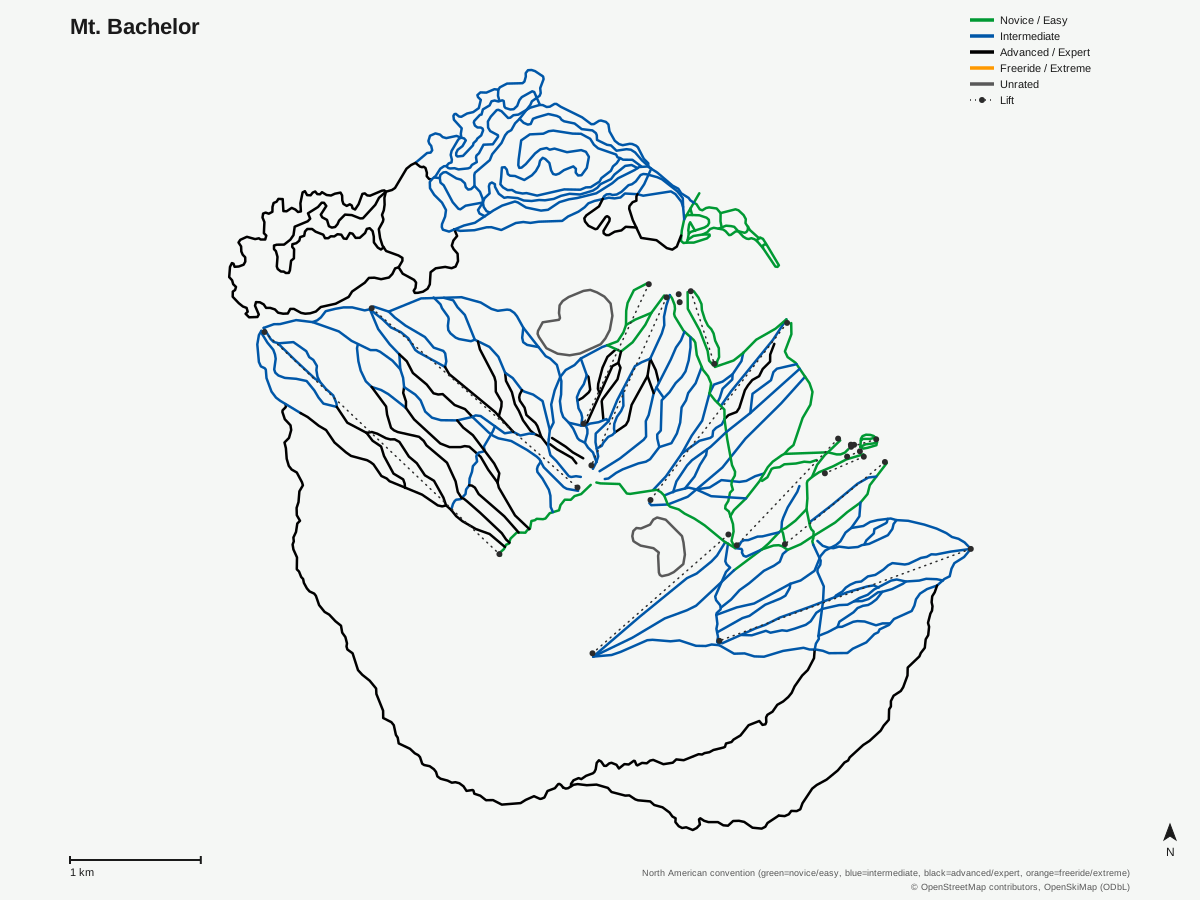
Mt. Bachelor: 154 runs, 15 lifts. Generated from community-mapped OpenStreetMap data, not Mt. Bachelor's official map artwork. © OpenStreetMap contributors, OpenSkiMap (ODbL).
Typical conditions by month
Monthly conditions data for Mt. Bachelor is not yet available.
Lift tickets & passes
- Ikon Pass — 7 days, no blackout
- Ikon Base Pass — 5 days, blackout dates apply
Getting there
Nearest airports
- Roberts Field (RDM) — 51.5 km straight-line
- Eugene Airport (EUG) — 123 km straight-line
- Salem-Willamette Valley Airport/McNary Field (SLE) — 146 km straight-line
Nearest cities
- Eugene, Oregon — 112.4 km straight-line
- Salem, Oregon — 150.4 km straight-line
- Gresham, Oregon — 177.4 km straight-line
Also covered by
Where to stay
A dedicated lodging guide for Mt. Bachelor is not yet available.
Nearby resorts
- Hoodoo Ski Area — 48 km straight-line, 300.6 m vertical
- Willamette Pass — 51 km straight-line, 474.4 m vertical
- Mt. Hood Skibowl — 145 km straight-line, 415.7 m vertical
- Timberline Lodge Ski Area — 148 km straight-line, 1371 m vertical
- Mt. Hood Meadows Ski Resort — 149 km straight-line, 845.8 m vertical
FAQ
- How big is Mt. Bachelor?
- Mt. Bachelor drops 985.9 vertical meters from a 2,723.7-meter summit to a 1,737.8-meter base, served by 15 lifts (12 chairlifts and 3 magic carpets) across 119 mapped runs totaling 92.2 kilometers.
- Is Mt. Bachelor good for advanced skiers?
- Yes, roughly 29% of its mapped terrain (26.6 of 92.2 kilometers) is graded advanced, with intermediate runs making up the largest share at 51.05 kilometers.
- Is Mt. Bachelor good for beginners?
- Beginner terrain is the smallest slice of the mountain at 14.55 kilometers, about 16% of the total, so newer skiers have room to progress but the resort leans toward intermediate and advanced runs overall.
- Which passes cover Mt. Bachelor?
- The Ikon Pass includes 7 days with no blackout dates, and the Ikon Base Pass includes 5 days with blackout dates in effect.
- What's the nearest airport to Mt. Bachelor?
- Roberts Field in Redmond (RDM) is closest at about 51.5 kilometers, with Eugene Airport (EUG) at 123 kilometers and Portland International (PDX) serving as the larger regional gateway at 191.4 kilometers.
- What's the nearest city to Mt. Bachelor?
- Eugene, Oregon, population roughly 176,650, sits closest among larger cities at 112.4 kilometers, followed by Salem at 150.4 kilometers.
- How many lifts does Mt. Bachelor have?
- 15 lifts in total: 12 chairlifts and 3 magic carpets for beginner terrain.
- What's the farthest gateway airport from Mt. Bachelor?
- Portland International Airport (PDX), the region's largest hub, sits 191.4 kilometers away, making it a workable option for travelers connecting through a bigger airport even though it's the furthest of the resort's listed airports.
Data sources
Last verified: 2026-09-15
Base facts from OpenSkiMap (ODbL), OpenStreetMap contributors, Wikidata (CC0), OurAirports (public domain) and GeoNames (CC BY 4.0). See /data-sources/.