Mt. Hood Skibowl
Overview
Few ski areas in the United States can point to an opening year in the 1920s, but Mt. Hood Skibowl’s own history places its founding in 1928, back when it operated as two separate, adjoining ventures: Skibowl, named for its natural bowl-shaped terrain, and Multorpor, a name stitched together from Multnomah County and Portland. Nearly a century later the combined operation sits an hour or so from downtown Portland, close enough that it functions as much as an after-work destination for the metro area as a weekend trip.
That proximity is central to Skibowl’s identity, and nowhere more so than after dark. Ski Magazine has named it the most extensively lit ski area in North America, with 37 runs on the night-skiing roster and three chairlifts running after sundown, including access into the steeper Upper Bowl terrain most resorts would reserve for daylight hours only. Across the full operation, nine lifts, four chairlifts, three rope tows, a platter lift, and a magic carpet, serve 62 mapped runs over more than 960 acres, adding up to 26.34 kilometers of trail. The difficulty mix skews toward the extremes rather than the middle: 12.92 kilometers rated advanced, 9.27 kilometers easy, and just 4.15 kilometers intermediate, a shape that suggests skiers here tend to either be building fundamentals or already chasing steeper lines, with less terrain built for the in-between.
Beyond the lifts, Skibowl runs a Snow Tube Park with a conveyor-assisted lift and its own after-dark tubing product, branded Cosmic Tubing, which the resort promotes as a format found nowhere else. Guided snowmobile trips operate through an affiliated outfitter, and the resort adds snowshoe tours, ski and snowboard instruction, and several on-mountain dining options to round out a day that doesn’t have to end when the lifts close, since so many of them keep running into the evening anyway.
No multi-mountain pass currently lists Skibowl as a partner, which keeps access tied to the resort’s own ticketing. Portland International Airport, just 72.3 kilometers away, doubles as both the closest airport and the area’s principal air gateway, with Gresham (110,553 residents, 56.3 kilometers out) the nearest sizable city and Portland proper only slightly farther at 75.1 kilometers. Vancouver, Washington, just across the Columbia River from Portland and home to roughly 196,442 people, is the third city on the list at 79.3 kilometers, meaning the resort effectively draws from two states rather than one.
That two-state catchment helps explain why a resort built in 1928 has kept expanding its after-dark programming rather than resting on its original bowl-and-Multorpor footprint. With nine lifts split across four chairlifts, three rope tows, a platter, and a magic carpet, the mountain has more entry points than many resorts of similar acreage. Combined with the tubing park and the guided snowmobile and snowshoe programs run through its outfitter arm, the operation reads less like a single ski hill and more like a small winter-recreation complex built around one mountain.
Key stats
Official website — Last checked 2026-09-13
Lifts by type
| Type | Count |
|---|---|
| platter | 1 |
| rope tow | 3 |
| chair lift | 4 |
| magic carpet | 1 |
Runs by difficulty
| Difficulty | Distance |
|---|---|
| easy | 9.27 km |
| advanced | 12.92 km |
| intermediate | 4.15 km |
Maps
Official trail map: see skibowl.com
Run & lift overview
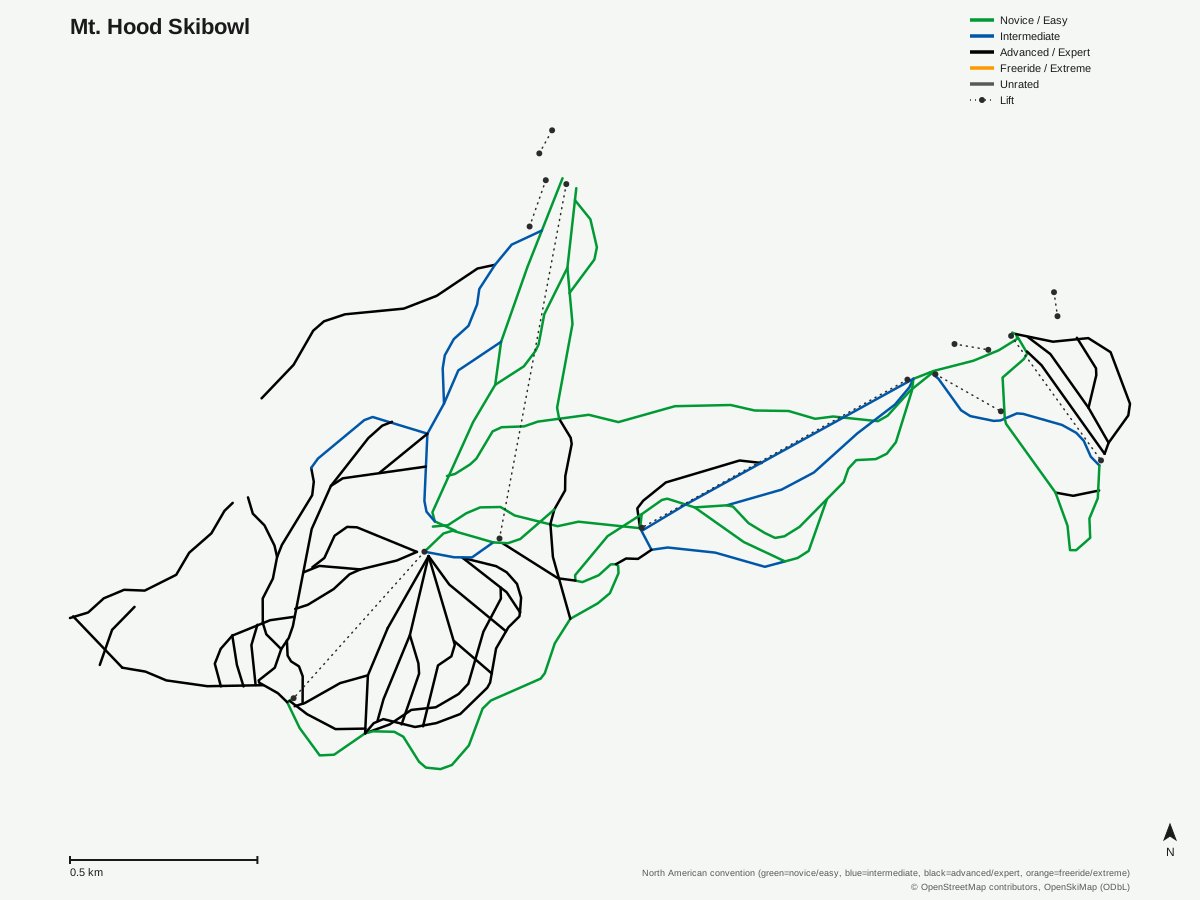
Mt. Hood Skibowl: 62 runs, 9 lifts. Drawn from OpenStreetMap run and lift data — not the official Mt. Hood Skibowl trail map. © OpenStreetMap contributors, OpenSkiMap (ODbL).
Typical conditions by month
Monthly conditions data for Mt. Hood Skibowl is not yet available.
Lift tickets & passes
Mt. Hood Skibowl has no multi-resort pass affiliations on record.
Getting there
Nearest airports
- Portland International Airport (PDX) — 72.3 km straight-line
- Salem-Willamette Valley Airport/McNary Field (SLE) — 105.7 km straight-line
- Roberts Field (RDM) — 125.6 km straight-line
Nearest cities
- Gresham, Oregon — 56.3 km straight-line
- Portland, Oregon — 75.1 km straight-line
- Vancouver, Washington — 79.3 km straight-line
Also covered by
Where to stay
A dedicated lodging guide for Mt. Hood Skibowl is not yet available.
Nearby resorts
- Timberline Lodge Ski Area — 5 km straight-line, 1371 m vertical
- Mt. Hood Meadows Ski Resort — 10 km straight-line, 845.8 m vertical
- Hoodoo Ski Area — 99 km straight-line, 300.6 m vertical
- Mt. Bachelor — 145 km straight-line, 985.9 m vertical
- White Pass Ski Area — 151 km straight-line, 620.1 m vertical
FAQ
- When was Mt. Hood Skibowl founded?
- 1928, which the resort's own site describes as making it one of the oldest ski resorts still operating in the country. It began as two adjoining operations, Skibowl, named for its bowl-shaped terrain, and Multorpor, a name combining Multnomah County and Portland, before the two merged into a single mountain.
- Why is Mt. Hood Skibowl known for night skiing?
- Ski Magazine has credited it with the most night-skiing terrain in North America, with 37 lit runs and three illuminated chairlifts. That includes access to the steeper Upper Bowl terrain after dark, terrain many resorts would reserve for daylight-only skiing.
- How big is Mt. Hood Skibowl's terrain?
- The lift-served area covers over 960 acres and totals 26.34 kilometers across 62 mapped runs, drawing on nine lifts: four chairlifts, three rope tows, a platter, and a magic carpet. For a resort roughly an hour from downtown Portland, that's a substantial skiable footprint.
- What's the difficulty breakdown at Mt. Hood Skibowl?
- Advanced terrain leads at 12.92 kilometers, easy runs cover 9.27 kilometers, and intermediate trails make up the remaining 4.15 kilometers. That's a spread that favors either newer skiers or confident advanced ones over the middle tier, with comparatively little dedicated blue-square terrain in between.
- Does Mt. Hood Skibowl have tubing?
- Yes, its Snow Tube Park includes a conveyor-assisted tube lift, and the resort also runs Cosmic Tubing, a lit night-tubing format it markets as unique to Skibowl. Both operate as separate attractions from the alpine ski lifts, aimed at visitors who may not be skiing or snowboarding at all.
- Is Mt. Hood Skibowl covered by any multi-resort ski pass?
- No pass partnerships are currently listed for the resort, so lift access runs through Skibowl's own day and season tickets rather than a shared regional or national pass product.
- What's the closest airport to Mt. Hood Skibowl?
- Portland International Airport, 72.3 kilometers away, serves as both the nearest airport and the region's main gateway. Salem's McNary Field and Redmond's Roberts Field are farther alternates at 105.7 and 125.6 kilometers, useful mainly for travelers already elsewhere in the state. On the ground, Gresham (56.3 kilometers) and Portland itself (75.1 kilometers) are the closest listed cities, with Vancouver, Washington, population around 196,442, third at 79.3 kilometers, meaning the resort effectively draws visitors from two states.
- What other activities does Mt. Hood Skibowl offer besides skiing?
- Snowmobile tours through sister company Mt. Hood Outfitters, guided snowshoe tours, ski and snowboard lessons, terrain parks, and multiple on-mountain dining spots round out the winter operation. Together with the tubing park, these push Skibowl toward a full-day, multi-activity destination rather than a lifts-only ski hill.
Data sources
Last verified: 2026-09-17
Base facts from OpenSkiMap (ODbL), OpenStreetMap contributors, Wikidata (CC0), OurAirports (public domain) and GeoNames (CC BY 4.0). See /data-sources/.