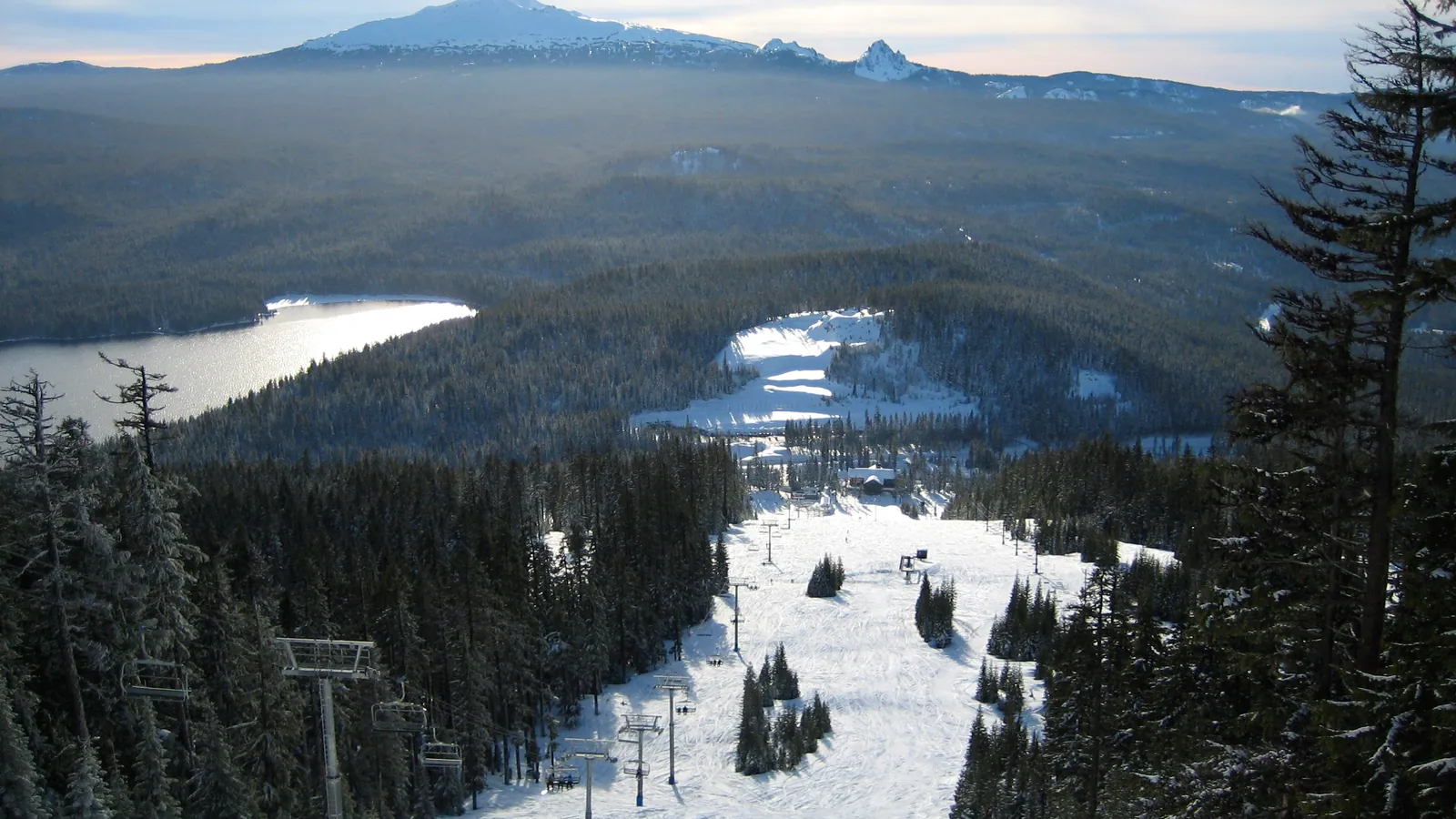
Willamette Pass
Overview
Willamette Pass positions itself first and foremost as Eugene’s local mountain, sitting on Highway 58 at the Cascade Summit roughly an hour from the city and marketed directly as the closest resort to Eugene. That framing matters for a mountain whose other headline number is its snowfall: an average of 430 inches a year, high enough that the resort leans on “legendary steeps” and heavy natural snow as its core pitch rather than groomed-corduroy consistency.
The mountain climbs 474.4 vertical meters from a 1,559.5-meter base to a 2,033.9-meter summit, with six lifts, five chairlifts and one magic carpet, serving 30 runs across 22.1 kilometers. One of those lifts carries some lift-engineering history: the resort’s own materials describe installing the first six-person high-speed detachable chairlift, a lift type that later became standard at larger resorts across North America.
Terrain distribution favors the middle of the mountain: 12.19 kilometers of intermediate runs is well ahead of 6.25 kilometers advanced and 3.65 kilometers easy, a profile that fits a mountain known more for steep, snow-heavy skiing than a wide beginner base. Willamette Pass belongs to the Power Pass network, which the resort says extends to 11 other mountains in the US and Chile, and children 12 and under get a free Power Kids Pass with the same access, mirroring the family-access approach used across the same ownership group’s other resorts.
Recent investment has kept pace with the resort’s terrain reputation, with the operator citing more than $500,000 in capital improvements for the 2025/26 season. Air access runs through central Oregon rather than directly through Eugene: Roberts Field in Redmond is technically closest at 100.4 kilometers, with Eugene Airport (111.1 km) and Rogue Valley International in Medford (153.5 km) rounding out the options, while Portland International, 224.9 kilometers away, serves as the broader regional gateway.
Run length and lift count both support the resort’s self-description as a steep, snow-heavy mountain rather than a wide beginner area: an average run of 0.74 kilometers is long for a resort with just six lifts, and vertical per lift works out to roughly 79 meters. That combination, fewer lifts, longer individual runs, heavy natural snowfall, points toward a mountain where skiers spend more time on each descent and less time cycling through short laps, a different rhythm than the dense, high-turnover layouts common at metro-area day resorts closer to Portland. Salem (168.8 km) and Gresham (212.6 km) sit even farther from the mountain than Eugene, reinforcing how squarely Willamette Pass is positioned as Eugene’s own backyard mountain rather than a resort trying to serve the wider Willamette Valley.
The resort’s base sits at 1,559.5 meters and its summit at 2,033.9 meters, a Cascade-crest elevation profile that, combined with the 430-inch average snowfall figure, helps explain why the resort leans on natural snow conditions in its marketing rather than emphasizing snowmaking the way lower-elevation resorts closer to Portland tend to. Belonging to the Power Pass network, alongside sister resorts like Nordic Valley in Utah, gives Willamette Pass a broader multi-mountain pass option beyond its own standalone lift tickets, even though its core identity, closest resort to Eugene, remains tied to a single metro area rather than a wider regional draw.
Key stats
Official website — Last checked 2026-09-13
Lifts by type
| Type | Count |
|---|---|
| chair lift | 5 |
| magic carpet | 1 |
Runs by difficulty
| Difficulty | Distance |
|---|---|
| easy | 3.65 km |
| advanced | 6.25 km |
| intermediate | 12.19 km |
Maps
View official Willamette Pass trail map (page) →
Run & lift overview
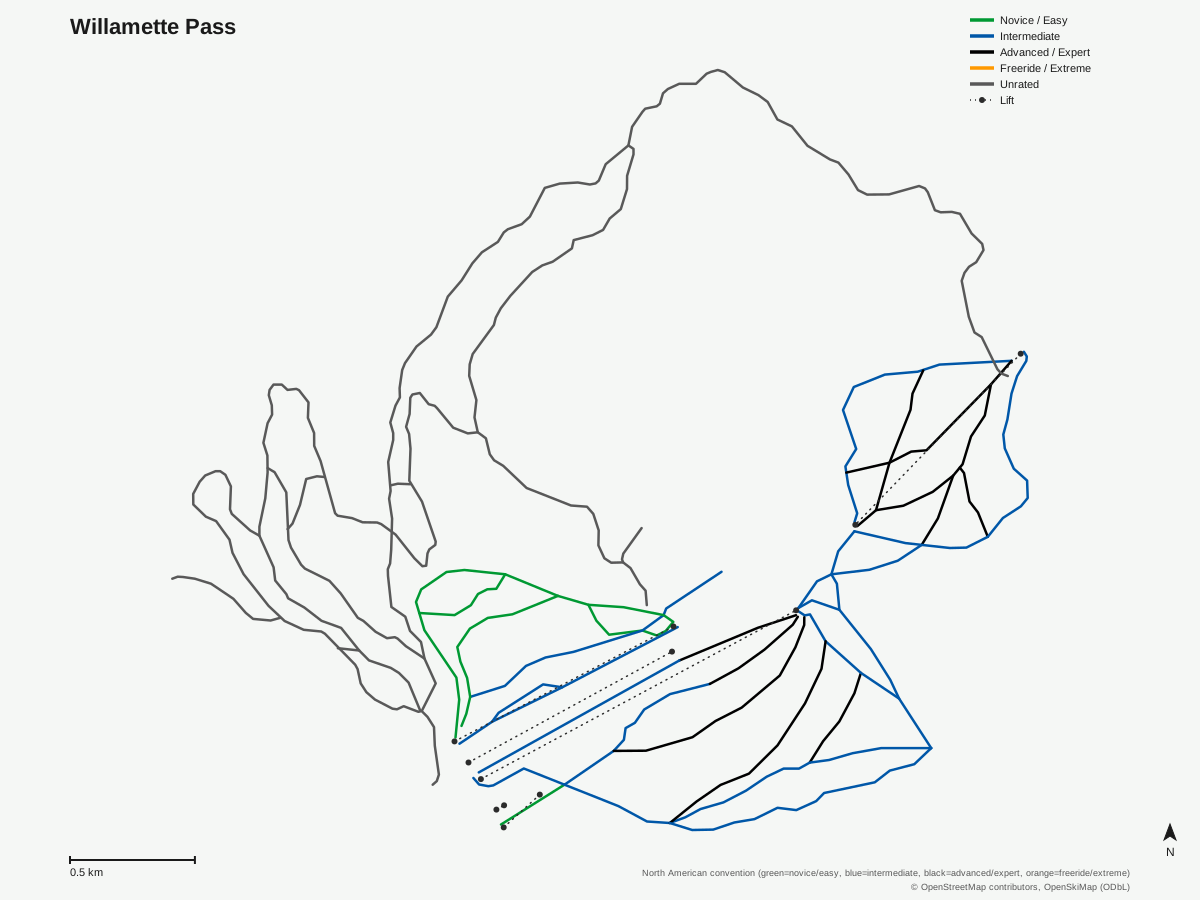
Willamette Pass: 40 runs, 6 lifts. Drawn from OpenStreetMap run and lift data — not the official Willamette Pass trail map. © OpenStreetMap contributors, OpenSkiMap (ODbL).
Typical conditions by month
Monthly conditions data for Willamette Pass is not yet available.
Lift tickets & passes
Willamette Pass has no multi-resort pass affiliations on record.
Getting there
Nearest airports
- Roberts Field (RDM) — 100.4 km straight-line
- Eugene Airport (EUG) — 111.1 km straight-line
- Rogue Valley International-Medford Airport (MFR) — 153.5 km straight-line
Nearest cities
- Eugene, Oregon — 98.4 km straight-line
- Salem, Oregon — 168.8 km straight-line
- Gresham, Oregon — 212.6 km straight-line
Also covered by
Where to stay
A dedicated lodging guide for Willamette Pass is not yet available.
Nearby resorts
- Mt. Bachelor — 51 km straight-line, 985.9 m vertical
- Hoodoo Ski Area — 89 km straight-line, 300.6 m vertical
- Mount Ashland — 179 km straight-line, 353.5 m vertical
- Mt. Hood Skibowl — 189 km straight-line, 415.7 m vertical
- Timberline Lodge Ski Area — 192 km straight-line, 1371 m vertical
FAQ
- How far is Willamette Pass from Eugene?
- About an hour by car, and the resort markets itself as the closest ski area to Eugene.
- How much snow does Willamette Pass get?
- The resort states an average annual snowfall of 430 inches, a high total tied to its position on the Cascade crest at Willamette Pass.
- How big is Willamette Pass?
- 474.4 vertical meters from a 2,033.9-meter summit to a 1,559.5-meter base, with 6 lifts (5 chairlifts, 1 magic carpet) serving 30 runs across 22.1 mapped kilometers.
- Is Willamette Pass good for intermediate skiers?
- Intermediate terrain leads clearly at 12.19 kilometers, well ahead of 6.25 km advanced and 3.65 km easy.
- What lift is Willamette Pass known for?
- The resort's own materials cite installing the first six-person high-speed detachable chairlift, alongside terrain it describes as legendary steeps.
- Which pass network does Willamette Pass belong to?
- The Power Pass network, which the resort says covers 11 other mountains across the US and Chile, plus a free Power Kids Pass for children 12 and under.
- What's the nearest airport to Willamette Pass?
- Roberts Field in Redmond is closest at 100.4 kilometers, with Eugene Airport (111.1 km) the more commonly used option given the resort's Eugene-focused marketing.
- How long is the average run at Willamette Pass, and how does its lift count compare to nearby Oregon resorts?
- 22.1 kilometers across 30 runs works out to roughly 0.74 kilometers per run, one of the longer averages among the resorts covered here, consistent with the resort's own description of long, steep terrain; six lifts (five chairlifts, one magic carpet) is a modest total, and vertical per lift comes out to about 79 meters, so the mountain relies more on a handful of long, well-placed lifts than on lift density.
Data sources
Last verified: 2026-09-17
Base facts from OpenSkiMap (ODbL), OpenStreetMap contributors, Wikidata (CC0), OurAirports (public domain) and GeoNames (CC BY 4.0). See /data-sources/.