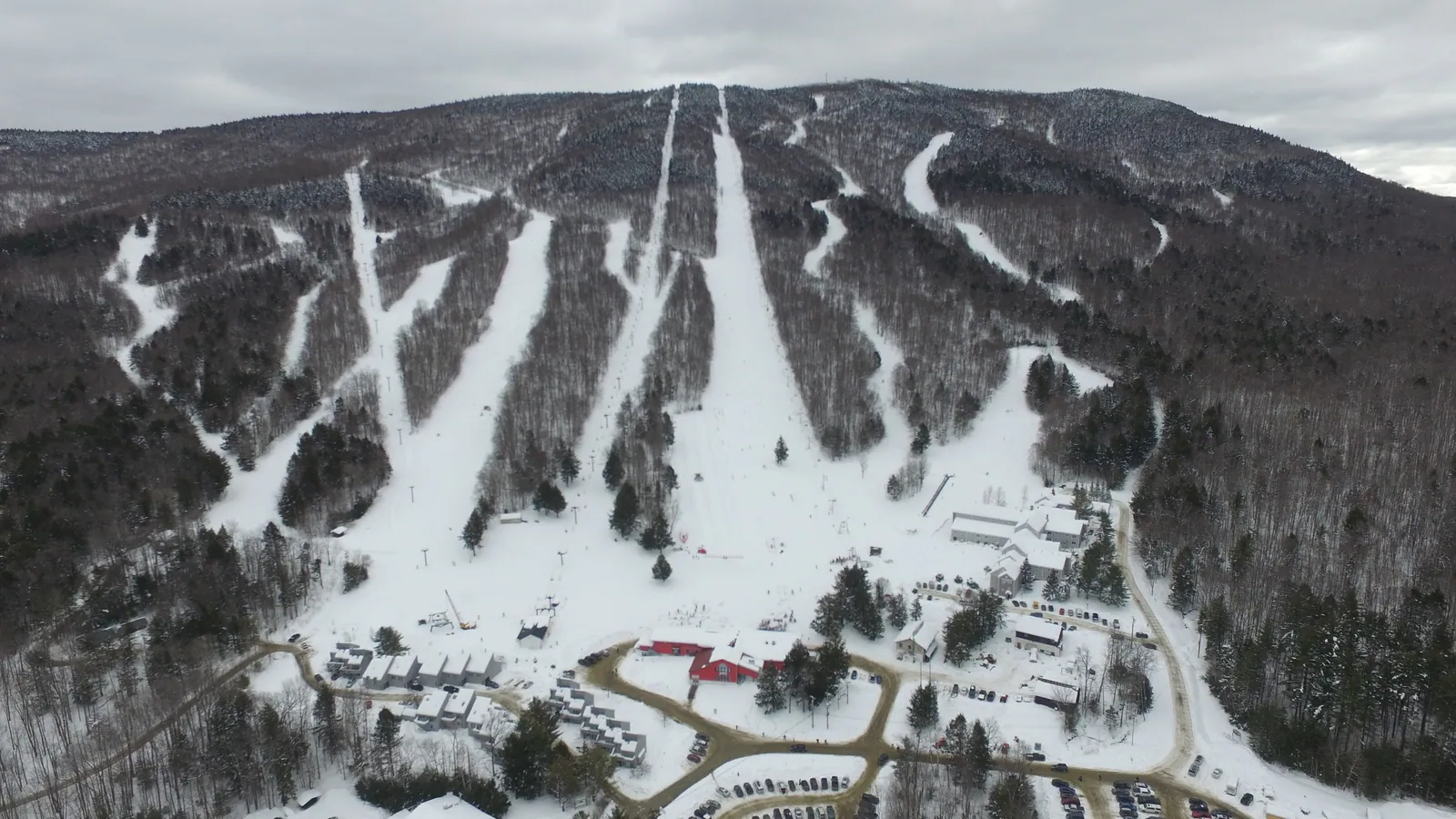
Magic Mountain Ski Area
Overview
Hans Thorner, a Swiss-born ski instructor and filmmaker, picked the site for Magic Mountain in 1960 because its slopes reminded him of the Alps he’d grown up skiing. That founding story matters here more than at most resorts, because Magic Mountain’s identity has stayed tied to that original vision even through a rocky ownership history: Boston Concessions bought the area in the mid-1980s, a real estate downturn forced a shutdown from 1991 to 1997, and it passed through several operators afterward before SKI MAGIC LLC took over in November 2016 and put more than $2 million into rebuilding the infrastructure.
What survived every ownership change is the terrain character. Magic Mountain carries what’s considered the most extensive glade and tree-skiing network in southern Vermont, with pitches at the top of the Master Magician run running close to 45 degrees, steep enough to rival bigger neighboring peaks despite Magic’s own modest 449.5-meter vertical. That vertical runs from a 419.6-meter base to an 869.1-meter summit across 22 runs totaling 11.51 km. The run mix actually skews toward newer skiers on paper: 5.76 km rated easy, 4.33 km intermediate, and 1.23 km advanced, with a further 0.19 km falling outside those standard bands, even though the mountain’s reputation is built on its steeper glade lines. Divide that 11.51 km across 22 runs and the average trail comes out to about 0.52 km, and spread over six lifts, that’s roughly 1.9 km of terrain served per lift, a tighter, more concentrated layout than resorts built around a handful of long cruising runs.
Six lifts serve that terrain: two rope tows, a magic carpet for the beginner area, and three chairlifts, one of them a Poma quad that opened in February 2024 and gave the mountain a real capacity upgrade after years of running on older, slower lifts. Magic Mountain sits inside Vermont’s old “Golden Triangle,” the informal cluster it once shared prominence with alongside Stratton and Bromley, and its independent, smaller-scale operation today reads as a deliberate contrast to those bigger, corporately owned neighbors.
The drive in isn’t long from regional airports: Rutland-Southern Vermont Regional Airport is 39.7 km away, Lebanon Municipal 60.5 km, and Albany International, the larger gateway option, 98.0 km. Albany itself is also the nearest city of real size at 100.9 km, with Manchester, New Hampshire and Springfield, Massachusetts both under a three-hour drive as well. No multi-resort pass currently lists Magic Mountain among its partners, keeping the mountain’s ticketing as independent as its ownership.
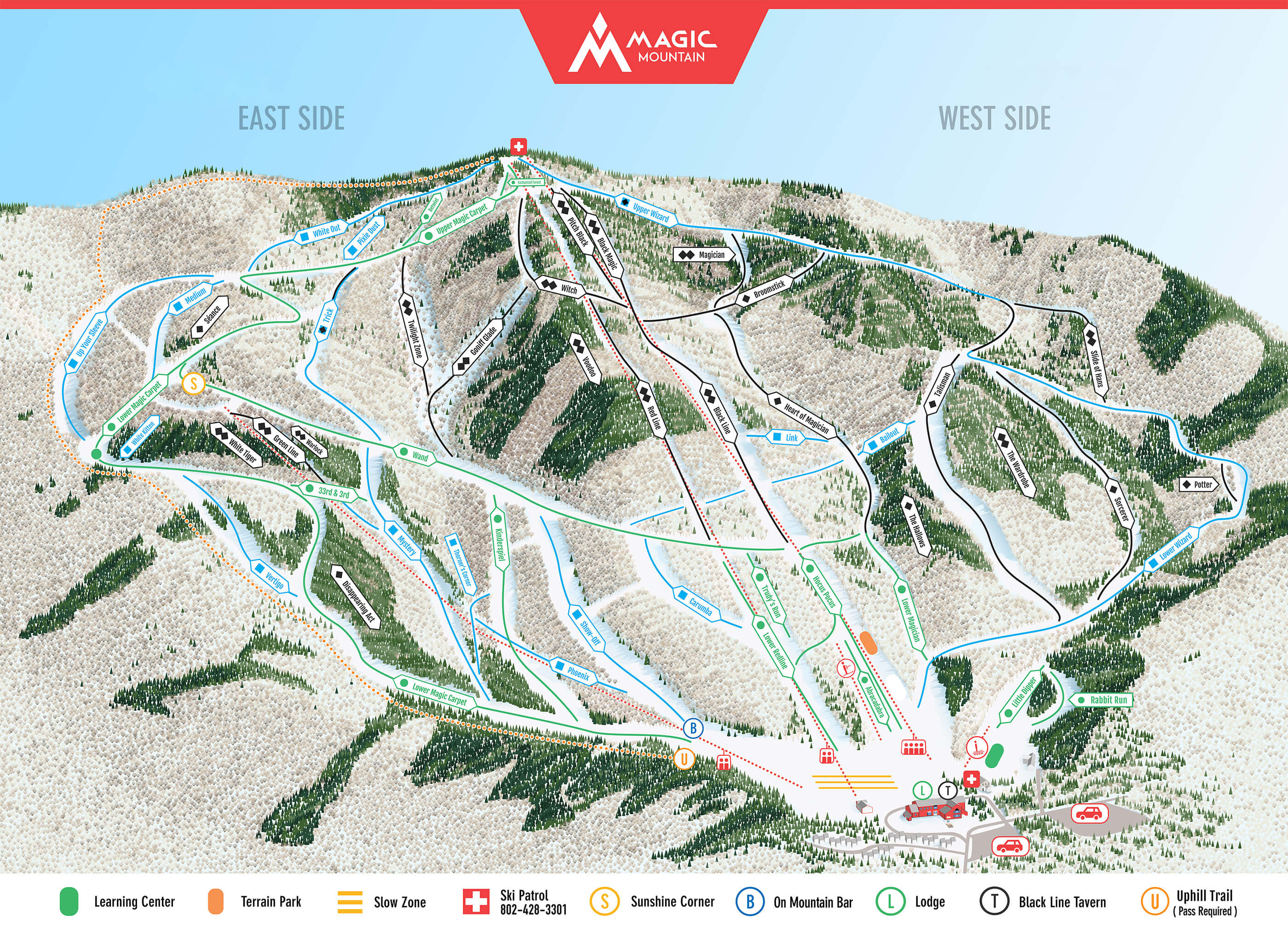
Broken down by lift type, chairlifts account for half the fleet, three of six, with two rope tows and a single magic carpet splitting the remainder, a mix that still leans on older lift technology even after the 2024 Poma quad upgrade. Set at roughly 43.20°N, 72.77°W in Windham County, the mountain sits close enough to the New York and Massachusetts state lines that its closest airports and cities span three different states rather than clustering around one metro area. Magic Mountain still distributes its trail map as a static image rather than an interactive planner, a small detail that fits the mountain’s generally low-tech, independently run character compared with the larger, more heavily marketed resorts elsewhere in the Golden Triangle. Between the 2016 ownership change, the multi-million-dollar reinvestment that followed, and the 2024 lift upgrade, Magic Mountain’s recent history reads as a slow, steady rebuild rather than the kind of rapid overhaul a large corporate operator might have pushed through in a single offseason.
Key stats
Official website — Last checked 2026-09-14
Lifts by type
| Type | Count |
|---|---|
| rope tow | 2 |
| chair lift | 3 |
| magic carpet | 1 |
Runs by difficulty
| Difficulty | Distance |
|---|---|
| easy | 5.76 km |
| other | 0.19 km |
| advanced | 1.23 km |
| intermediate | 4.33 km |
Maps
View official Magic Mountain Ski Area trail map (image) →
Run & lift overview
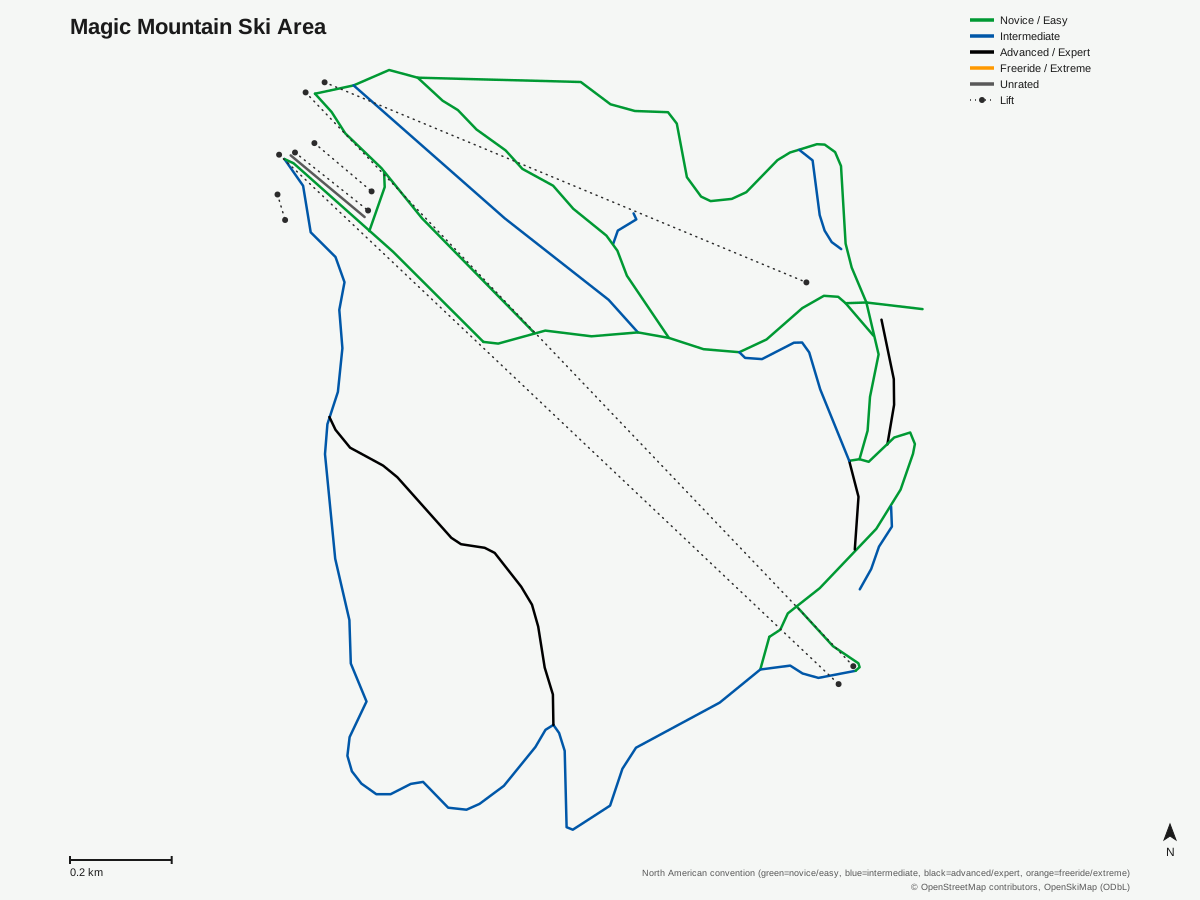
Magic Mountain Ski Area: 22 runs, 6 lifts. Reflects OpenStreetMap's run and lift mapping for Magic Mountain Ski Area, not the resort's own trail map graphic. © OpenStreetMap contributors, OpenSkiMap (ODbL).
Typical conditions by month
Monthly conditions data for Magic Mountain Ski Area is not yet available.
Lift tickets & passes
Magic Mountain Ski Area has no multi-resort pass affiliations on record.
Getting there
Nearest airports
- Rutland - Southern Vermont Regional Airport (RUT) — 39.7 km straight-line
- Lebanon Municipal Airport (LEB) — 60.5 km straight-line
- Albany International Airport (ALB) — 98 km straight-line
Nearest cities
- Albany, New York — 100.9 km straight-line
- Manchester, New Hampshire — 108.9 km straight-line
- Springfield, Massachusetts — 122.8 km straight-line
Also covered by
Where to stay
A dedicated lodging guide for Magic Mountain Ski Area is not yet available.
Nearby resorts
- Bromley Mountain Ski Resort — 14 km straight-line, 393.1 m vertical
- Stratton Mountain Resort — 16 km straight-line, 576.7 m vertical
- Okemo Mountain — 24 km straight-line, 659.7 m vertical
- Mount Snow — 29 km straight-line, 502.3 m vertical
- Killington Resort — 46 km straight-line, 907.1 m vertical
FAQ
- Who founded Magic Mountain Ski Area?
- Hans Thorner, a Swiss-born ski instructor and filmmaker, founded Magic Mountain in 1960 after finding terrain in Londonderry, Vermont that reminded him of the Swiss Alps. That founding vision still shows up in the mountain's steep, European-style glade lines today.
- Was Magic Mountain ever closed?
- Yes. It shut down from 1991 to 1997 following a real estate downturn under a previous owner, before reopening and eventually being bought by SKI MAGIC LLC in November 2016. The new ownership then put more than $2 million into infrastructure improvements, work that eventually included a new Poma quad chairlift in 2024.
- Is Magic Mountain known for glade skiing?
- Yes, its tree-skiing and glade network is considered the most extensive in southern Vermont, with pitches at the Master Magician run reaching around 45 degrees. That steepness sits in contrast to the mountain's overall run mix, which actually leans toward easier terrain on paper, since the glade network sits alongside, not instead of, a solid beginner base.
- How big is Magic Mountain Ski Area?
- It has 22 runs covering 11.51 km, a 449.5-meter vertical drop from a 419.6-meter base to an 869.1-meter summit, and six lifts. That works out to an average run length of about 0.52 km, roughly 1.9 km of terrain per lift, and close to 75 meters of vertical gained per lift.
- What lifts does Magic Mountain have?
- Six total: three chairlifts (including a Poma quad added in 2024), two rope tows, and one magic carpet for beginner terrain. That mix skews toward older, lower-capacity lift technology compared with larger Vermont resorts nearby.
- Is Magic Mountain good for beginners?
- There's a meaningful beginner base: 5.76 km of its 11.51 km of runs is rated easy, exactly half the mountain, ahead of the 4.33 km rated intermediate and 1.23 km rated advanced.
- What other ski areas are near Magic Mountain?
- Magic Mountain sits within Vermont's historic 'Golden Triangle,' the cluster that also includes Stratton and Bromley. Unlike those two larger neighbors, Magic Mountain has stayed independently owned and comparatively small in scale, a difference skiers notice in lift lines and crowd levels on busy weekends.
- What's the nearest airport to Magic Mountain Ski Area?
- Rutland-Southern Vermont Regional Airport is closest at 39.7 km, with Lebanon Municipal at 60.5 km and the larger Albany International, the main gateway, at 98.0 km. Albany is also the nearest city of real size, at 100.9 km from the mountain.
Data sources
Last verified: 2026-09-15
Base facts from OpenSkiMap (ODbL), OpenStreetMap contributors, Wikidata (CC0), OurAirports (public domain) and GeoNames (CC BY 4.0). See /data-sources/.