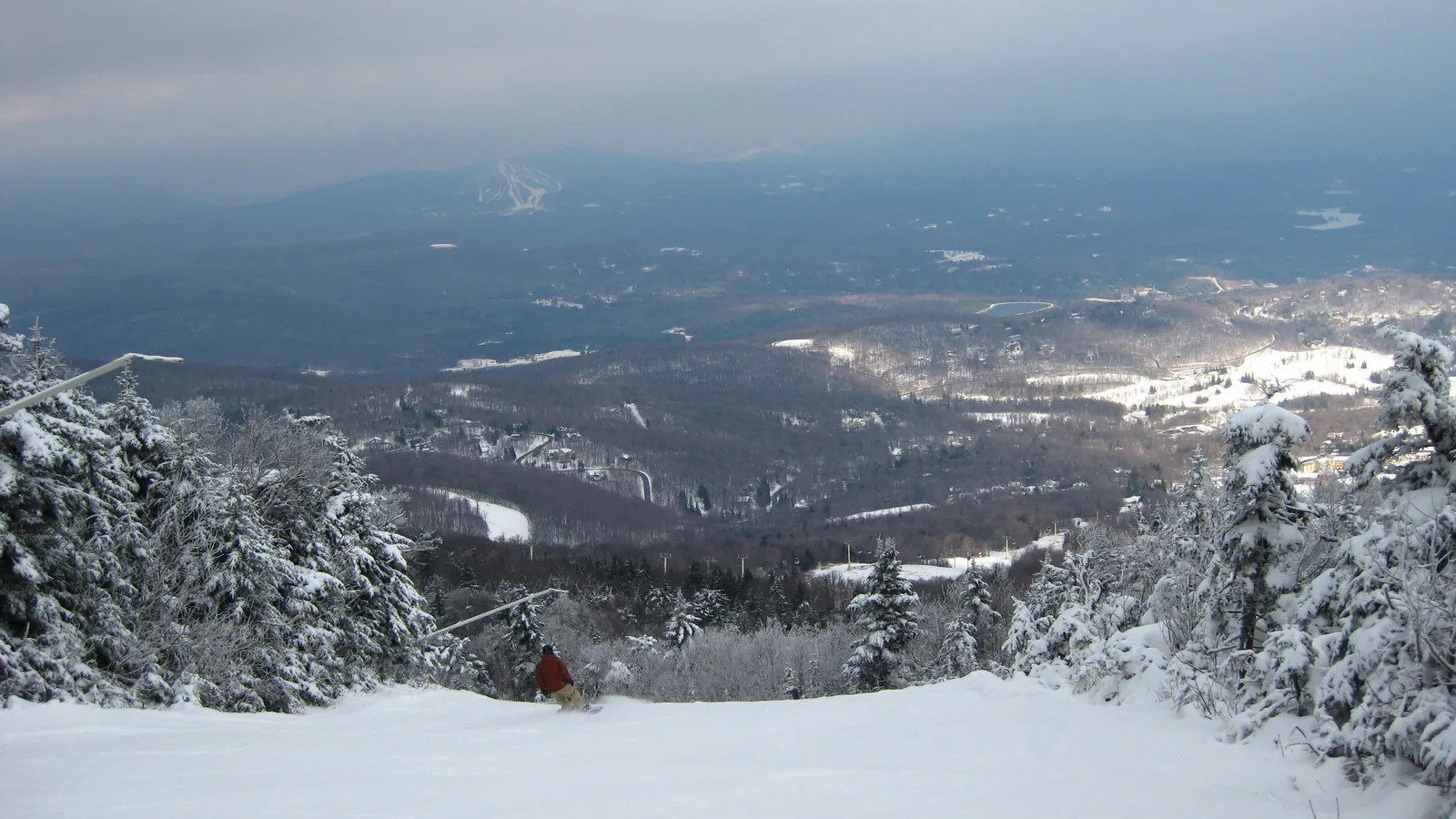
Stratton Mountain Resort
Overview
Among the New England resorts covered here, Stratton is the outlier in scale: 17 lifts, 106 runs, and about 65.5 kilometers of trail put it well ahead of its New England neighbors on nearly every measure, even though its vertical descent of roughly 577 meters is actually the smallest of the six. That combination — a wide, heavily developed base spread across a comparatively modest rise — points to what Stratton has built its identity around: breadth of terrain and amenity rather than sheer mountain size. The summit tops out as one of the higher points in southern Vermont, and the resort sits in Windham County east of Manchester, close enough to Boston, New York, and Hartford that it draws heavily from those markets rather than from Vermont’s more remote northern corridor.
Stratton opened in December 1961 with three double chairlifts and a base lodge, then expanded steadily through the 1960s with the addition of the Snow Bowl and Sun Bowl terrain pods. Financial trouble in the late 1970s brought in new ownership under Moore and Munger in 1980, and the resort has changed hands several times since, most recently coming under Alterra Mountain Company in 2017 as part of the Ikon Pass network. A gondola went in during 1988, with its cabins replaced in 2014, giving the mountain one of the more distinctive lift rides in the region alongside its extensive chairlift network.
The resort’s most consequential chapter, though, has little to do with lift infrastructure. Stratton became the first ski area in the country to allow snowboarding, an early partnership with Jake Burton that gave the emerging sport a legitimate home when many other mountains still banned it outright. That relationship grew into the Burton U.S. Open Snowboarding Championships, hosted at Stratton from 1985 to 2012, along with what’s described as the first dedicated snowboard school on the East Coast. It’s a piece of history that shaped snowboarding’s mainstream acceptance well beyond Vermont.
Stratton today functions less like a single ski hill and more like a small year-round town built around one. The base village carries a Cliff Drysdale tennis center, a golf course, a chapel, an on-site school, and an urgent care facility, alongside condominium neighborhoods developed during Intrawest’s ownership years. In summer, the same lift infrastructure supports a downhill mountain bike park, and the resort’s terrain parks continue to draw a freestyle-minded crowd that traces directly back to Stratton’s early embrace of snowboarding.
Broken into exact categories, Stratton’s 65.52 kilometers split into 24.57 km easy, 23.26 km intermediate, 14.23 km advanced, 3.03 km expert, and a small 0.29 km novice trail, with 0.14 km logged as other terrain — a spread wide enough that the mountain functions as a legitimate beginner destination and an advanced-terrain resort at the same time, rather than leaning hard in either direction.
Key stats
Official website — Last checked 2026-09-14
Lifts by type
| Type | Count |
|---|---|
| gondola | 1 |
| drag lift | 1 |
| chair lift | 9 |
| magic carpet | 6 |
Runs by difficulty
| Difficulty | Distance |
|---|---|
| easy | 24.57 km |
| other | 0.14 km |
| expert | 3.03 km |
| novice | 0.29 km |
| advanced | 14.23 km |
| intermediate | 23.26 km |
Maps
View official Stratton Mountain Resort trail map (PDF) →
Run & lift overview
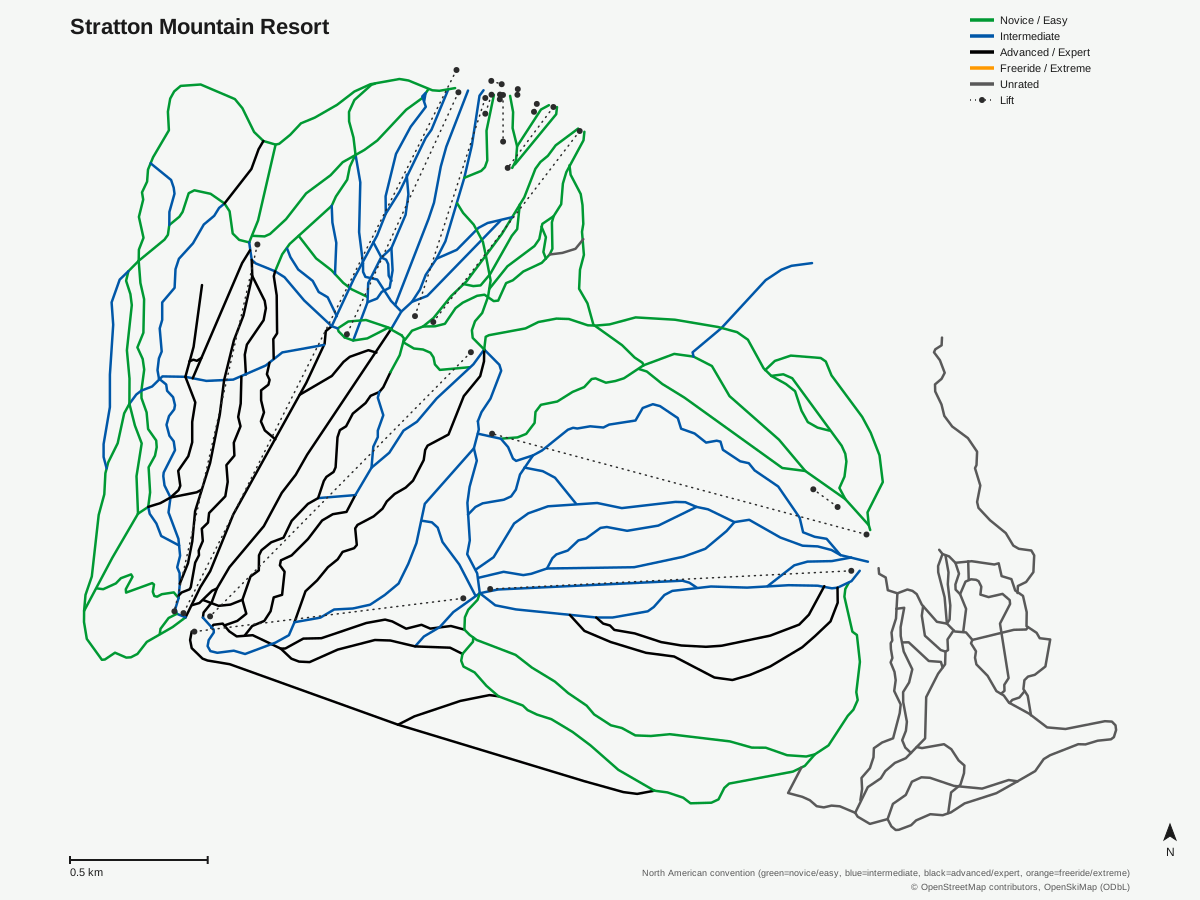
Stratton Mountain Resort: 126 runs, 17 lifts. Reflects OpenStreetMap's run and lift mapping for Stratton Mountain Resort, not the resort's own trail map graphic. © OpenStreetMap contributors, OpenSkiMap (ODbL).
Typical conditions by month
Monthly conditions data for Stratton Mountain Resort is not yet available.
Lift tickets & passes
- Ikon Pass — Unlimited, no blackout
- Ikon Base Pass — Unlimited, blackout dates apply
Getting there
Nearest airports
- Rutland - Southern Vermont Regional Airport (RUT) — 47.6 km straight-line
- Lebanon Municipal Airport (LEB) — 76.2 km straight-line
- Albany International Airport (ALB) — 82.4 km straight-line
Nearest cities
- Albany, New York — 85 km straight-line
- Springfield, Massachusetts — 114.3 km straight-line
- Manchester, New Hampshire — 119 km straight-line
Also covered by
Where to stay
A dedicated lodging guide for Stratton Mountain Resort is not yet available.
Nearby resorts
- Bromley Mountain Ski Resort — 13 km straight-line, 393.1 m vertical
- Mount Snow — 15 km straight-line, 502.3 m vertical
- Magic Mountain Ski Area — 16 km straight-line, 449.5 m vertical
- Okemo Mountain — 38 km straight-line, 659.7 m vertical
- Berkshire East Ski Resort — 54 km straight-line, 286.3 m vertical
FAQ
- How big is Stratton Mountain?
- Stratton counts 17 lifts, including a gondola, working across 106 runs, the largest lift and trail count of the six resorts covered here. Total trail distance comes to about 65.5 kilometers, with a vertical descent of roughly 577 meters.
- Did Stratton Mountain play a role in snowboarding history?
- Yes, a significant one. Stratton was the first ski area to allow snowboarding on its slopes, an early alliance with snowboard pioneer Jake Burton that helped legitimize the sport. The resort went on to host the Burton U.S. Open Snowboarding Championships from 1985 through 2012 and ran one of the first snowboard schools on the East Coast.
- Where is Stratton Mountain located?
- Stratton sits in southern Vermont's Windham County, east of Manchester near Winhall. That southerly position puts it a noticeably shorter drive from Boston, New York, and Hartford than Vermont's more northern mountains.
- Does Stratton Mountain have a gondola?
- Yes. Stratton installed a gondola in 1988, with cabins replaced in 2014, giving skiers and summer visitors a covered ride to the summit rather than relying solely on chairlifts.
- Which pass covers Stratton Mountain?
- Stratton is on the Ikon Pass network. The full Ikon Pass grants unlimited, no-blackout access, while the Ikon Base Pass covers the mountain with blackout dates during peak periods.
- Is Stratton Mountain good for beginners?
- There's a substantial beginner base to work with: roughly 24.6 kilometers of easy trail, the largest easy-terrain total of the six resorts here, plus six magic carpet lifts dedicated to that terrain.
- What's the nearest airport to Stratton Mountain?
- Rutland-Southern Vermont Regional is nearest at about 48 kilometers, Lebanon Municipal follows at 76 kilometers, and Albany International, roughly 82 kilometers out, serves as the resort's larger gateway with more flight options.
- Does Stratton Mountain have amenities beyond skiing?
- Considerably more than most New England ski areas. The base village includes a Cliff Drysdale tennis center, a golf course with membership options, a chapel, an on-site school, an urgent care facility, and a summer bike park, making it function as a year-round residential community rather than a winter-only operation.
Data sources
Last verified: 2026-09-15
Base facts from OpenSkiMap (ODbL), OpenStreetMap contributors, Wikidata (CC0), OurAirports (public domain) and GeoNames (CC BY 4.0). See /data-sources/.