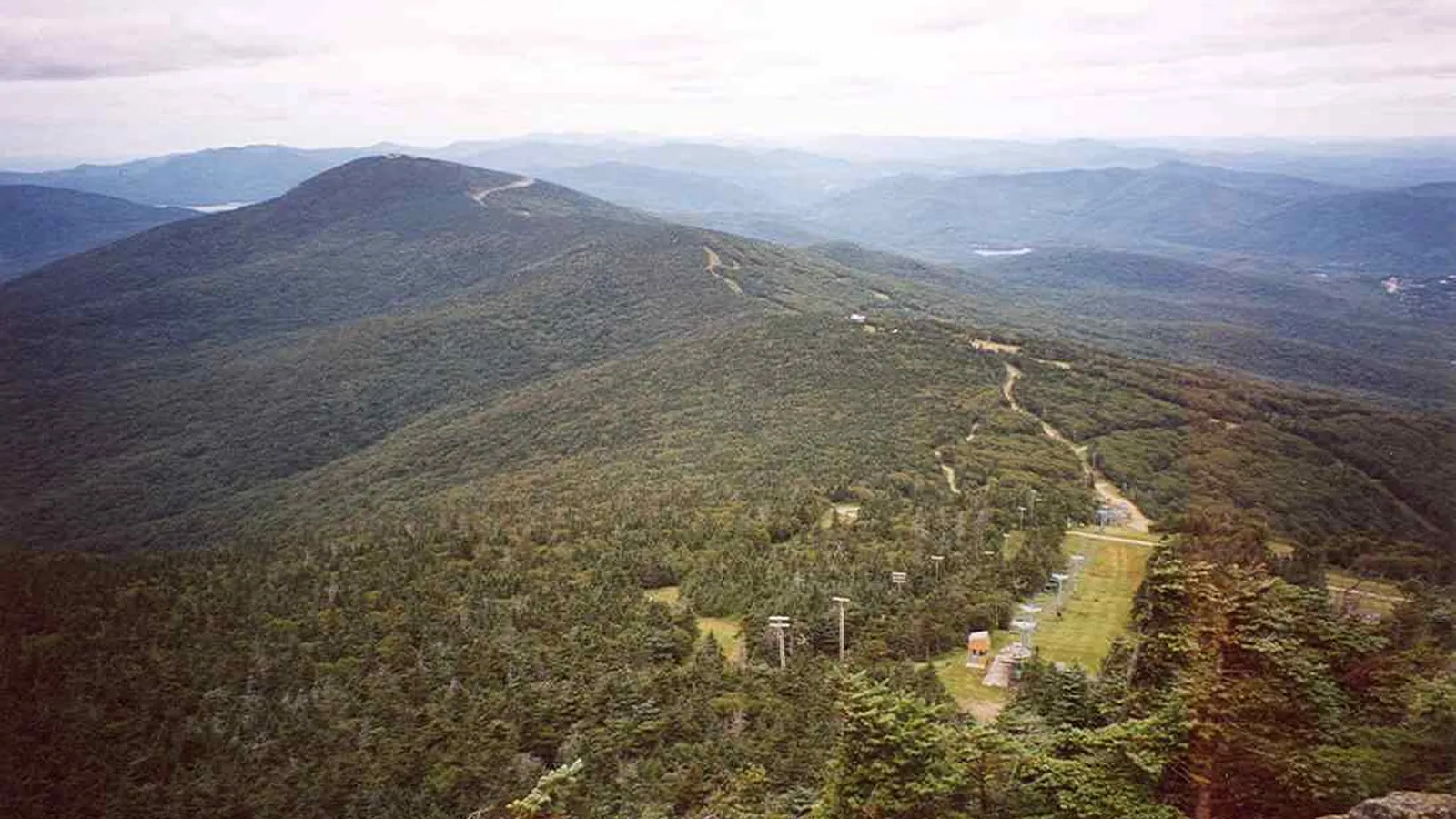
Pico Mountain Resort
Overview
Pico Mountain has a claim that few New England resorts can match: it opened on Thanksgiving 1937, making it one of the first commercial ski operations in Vermont, and in 1940 it installed the first T-bar lift built in the United States. The Mead family founded the resort, and their daughter, Andrea Mead-Lawrence, went on to win two Olympic gold medals in alpine skiing at the 1952 Winter Games, giving Pico an origin story with real competitive pedigree behind it rather than just an early-adopter footnote.
What makes Pico’s modern story unusual is its relationship with its much larger neighbor. Killington Resort bought Pico out of receivership in December 1997, and the two mountains have shared ownership ever since, even though no ski trail physically connects them — equipment and staff move between the two using a road connection rather than skiable terrain. Most Killington season passes extend to Pico, but the reverse doesn’t hold: a Pico-specific pass doesn’t buy access to Killington’s much larger terrain network.
That asymmetry suits Pico’s character. Rather than chasing Killington’s scale, the resort has leaned into staying smaller and quieter, closing to the public on non-holiday Tuesdays and Wednesdays to keep those days low-key or available for private rentals. With 7 lifts and 68 runs covering roughly 31 kilometers of mostly intermediate terrain, Pico reads as a resort built for steady, repeatable skiing rather than headline vertical or trail count. The summit does hold real black-diamond terrain, including a section locals call Little Pico, so it isn’t purely a beginner hill, but the overall character stays approachable.
The base lodge houses a Vermont Ski and Snowboard Museum exhibit, a nod to the resort’s place in the state’s skiing history, and the 75th-anniversary celebration in 2013 marked just how long Pico has been part of that story. For travelers, Rutland-Southern Vermont Regional Airport sits only about 17 kilometers away, a short enough hop that flying in and skiing the same afternoon is realistic, even though Pico carries no multi-resort pass affiliation of its own. Albany International, a larger commercial gateway roughly 127 kilometers south, gives skiers driving up from New York or Massachusetts a bigger airport option than the small regional fields closer to the mountain. By category, the terrain splits into 17.4 km intermediate, 8.37 km advanced, 4.95 km easy, and 0.14 km other, with no separately graded expert or novice section in the current data — a mountain built around solid intermediate and advanced skiing rather than a beginner-first layout or headline expert terrain. Pico’s 68 runs average out to about 455 meters apiece across the 30.86 total kilometers, and the seven-lift network works out to roughly 4.4 kilometers of piste per lift, a respectable ratio for a mountain that deliberately limits its own operating days each week.
Key stats
Official website — Last checked 2026-09-13
Lifts by type
| Type | Count |
|---|---|
| rope tow | 1 |
| chair lift | 6 |
Runs by difficulty
| Difficulty | Distance |
|---|---|
| easy | 4.95 km |
| other | 0.14 km |
| advanced | 8.37 km |
| intermediate | 17.4 km |
Maps
View official Pico Mountain Resort trail map (image) →

Run & lift overview
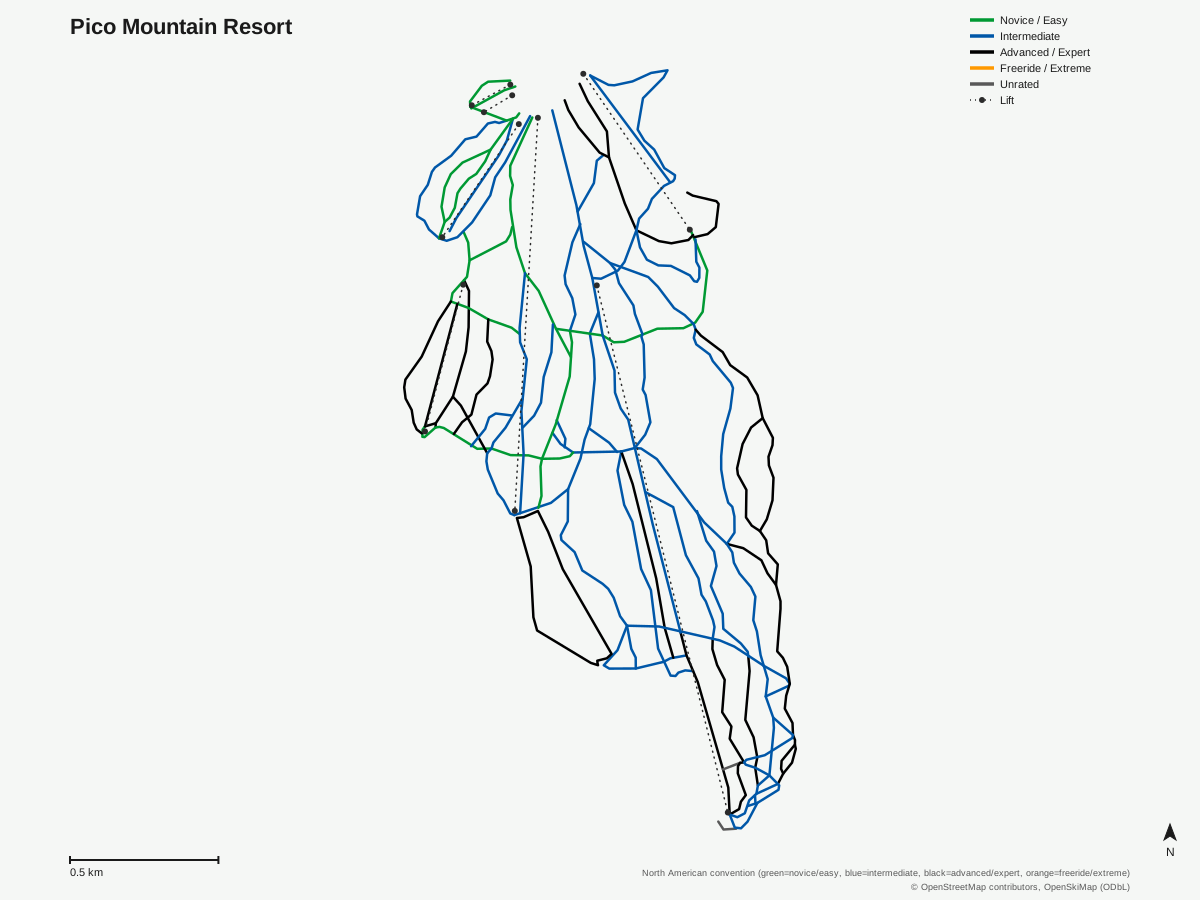
Pico Mountain Resort: 69 runs, 7 lifts. Reflects OpenStreetMap's run and lift mapping for Pico Mountain Resort, not the resort's own trail map graphic. © OpenStreetMap contributors, OpenSkiMap (ODbL).
Typical conditions by month
Monthly conditions data for Pico Mountain Resort is not yet available.
Lift tickets & passes
Pico Mountain Resort has no multi-resort pass affiliations on record.
Getting there
Nearest airports
- Rutland - Southern Vermont Regional Airport (RUT) — 16.5 km straight-line
- Lebanon Municipal Airport (LEB) — 43.3 km straight-line
- Patrick Leahy Burlington International Airport (BTV) — 94.2 km straight-line
Nearest cities
- Albany, New York — 134 km straight-line
- Manchester, New Hampshire — 134 km straight-line
- Lowell, Massachusetts — 168 km straight-line
Also covered by
Where to stay
A dedicated lodging guide for Pico Mountain Resort is not yet available.
Nearby resorts
- Killington Resort — 6 km straight-line, 907.1 m vertical
- Okemo Mountain — 28 km straight-line, 659.7 m vertical
- Middlebury College Snow Bowl — 32 km straight-line, 290.3 m vertical
- Bromley Mountain Ski Resort — 49 km straight-line, 393.1 m vertical
- Magic Mountain Ski Area — 51 km straight-line, 449.5 m vertical
FAQ
- Is Pico Mountain related to Killington?
- Yes. Killington Resort bought Pico in December 1997 after it went through receivership, and the two mountains now share ownership. Most Killington passes work at Pico, though a Pico-only pass does not grant Killington access, and no ski trail physically connects the two.
- How big is Pico Mountain?
- Pico's 7 lifts serve 68 runs spanning about 31 kilometers of trail, with roughly 589 meters of vertical fall. Most of that mileage is intermediate (17.4 km), with a solid stretch of advanced terrain (8.4 km) as well.
- Is Pico Mountain older than Killington?
- Yes, considerably. Pico opened on Thanksgiving 1937, making it one of the first commercial ski resorts in Vermont, decades before Killington's better-known modern development. It also installed the first T-bar lift in the United States in 1940.
- Is Pico Mountain crowded?
- No, and that's largely intentional. Pico deliberately closes to the public on non-holiday Tuesdays and Wednesdays and markets itself around an uncrowded, local character even while sharing an owner with one of the busiest resorts in the East.
- What's the nearest airport to Pico Mountain?
- Rutland-Southern Vermont Regional, only about 17 km from the mountain, is the shortest airport hop of any resort in this group, with Lebanon Municipal and Burlington International farther out at 43 and 94 km respectively.
- Is Pico Mountain good for families?
- The resort markets itself toward families and first-time visitors, with a golden-express area geared toward intermediate skiers and beginners, free parking with EV charging, and youth programs, alongside steeper summit runs for stronger skiers.
- Does Pico Mountain have any Olympic history?
- Yes. The Mead family founded the resort, and their daughter Andrea Mead-Lawrence won two Olympic gold medals in alpine skiing at the 1952 Winter Games, giving Pico an Olympic pedigree tied directly to its founding family.
- What's the exact terrain breakdown at Pico Mountain?
- Of the 30.86 km total, 17.4 km is intermediate, 8.37 km advanced, 4.95 km easy, and a small 0.14 km logged as other terrain — no separately graded expert or novice category appears in the current run data.
Data sources
Last verified: 2026-09-15
Base facts from OpenSkiMap (ODbL), OpenStreetMap contributors, Wikidata (CC0), OurAirports (public domain) and GeoNames (CC BY 4.0). See /data-sources/.